


Continuous readiness and willingness mandatory in suit for specific performance: Supreme Court
 Copy Link
 Share
 Save
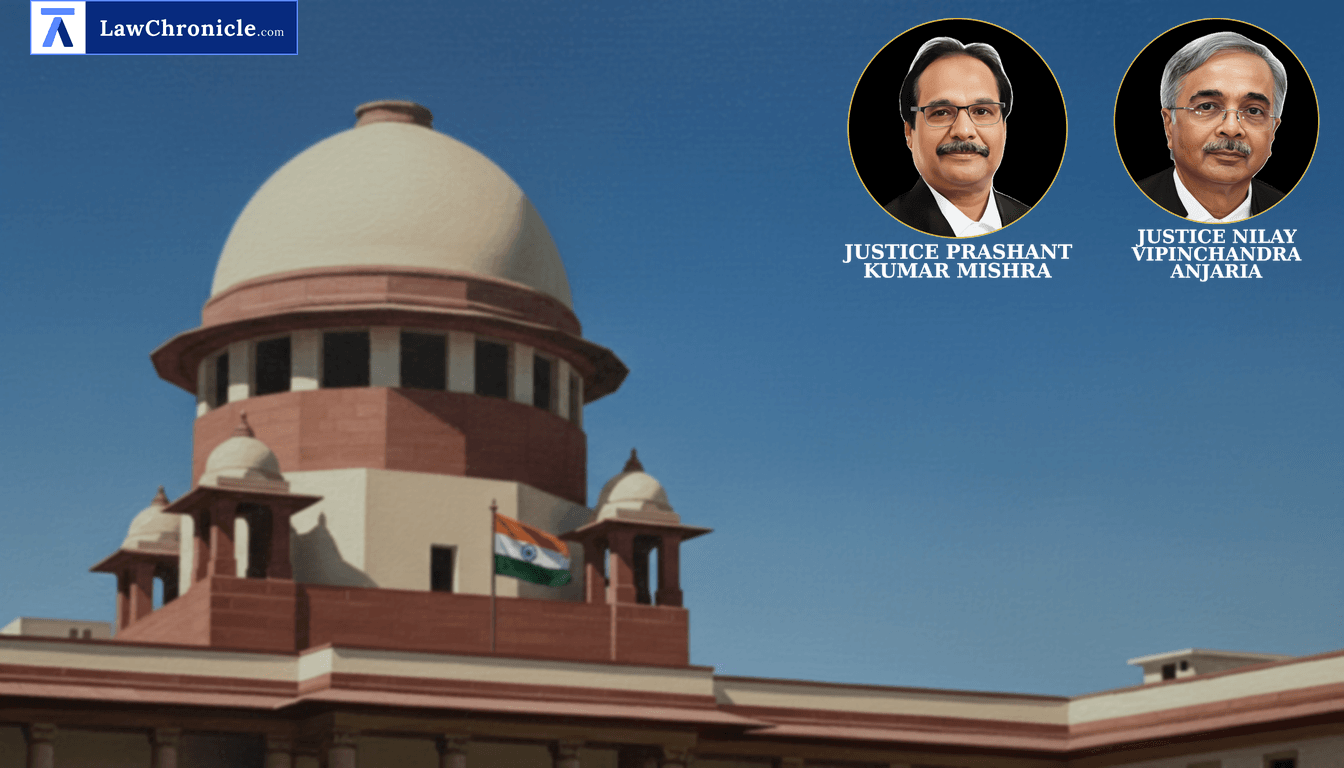
The Supreme Court has reiterated that readiness and willingness in suit for specific performance are indispensable prerequisites for seeking equitable relief under contract law. As per the Apex Court, any retributive or contradictory stance by a buyer disentitles them to a decree of specific performance. Setting aside the High Court's decree, the Supreme Court restored the Trial Court's order refusing specific performance while ordering a refund of the advance amount.
A bench comprising Justice Prashant Kumar Mishra and Justice N.V. Anjaria heard the appeal challenging a Division Bench judgment of the Madras High Court which had reversed the trial court's refusal to decree specific performance in a land sale dispute.
Supreme Court on Readiness and Willingness in Suit for Specific Performance
Addressing the legal requirement of continuous readiness and willingness, the Supreme Court highlighted that a buyer must demonstrate uninterrupted financial capability from the date of the agreement until the execution of the decree. The Court explained that "In a suit for specific performance, the plaintiffs had to show their means i.e., availability of funds and readiness and willingness continuously at all material points of time i.e., soon after the agreement till the execution of the decree."
Civil and Criminal Cases
The Court also criticized the inconsistent conduct of the buyers in lodging criminal complaints demanding their money back while simultaneously pursuing a civil suit for property conveyance. The Court, in its reasoning, observed: "Under Section 20 of the 1963 Act, the grant of a decree for specific performance is always discretionary. The exercise of discretion depends on several factors. One of the factors is the conduct of the plaintiff. The reason is that relief of a decree of specific performance is an equitable relief. A person who seeks equity must do equity."
Unilateral Termination
The Supreme Court also touched upon the maintainability of the suit without seeking a formal declaration to set aside a unilateral termination notice. The Court clarified that where an agreement confers no explicit contractual right to terminate unilaterally, the aggrieved buyer can directly file a suit for specific performance. The Bench observed that such a unilateral cancellation operates merely as a breach by repudiation.
Key Takeaways
Continuous Readiness Is Essential: Litigants seeking specific performance must prove continuous readiness and willingness mandatory in suit for specific performance through financial readiness at all stages of litigation, not just by producing funds at the appellate stage.
Clean Hands and Conduct Matter: Pursuing aggressive criminal proceedings for money recovery while claiming equitable relief for property transfer demonstrates inconsistent conduct that can defeat specific performance claims.
Unilateral Repudiation Relief: A separate declaratory prayer to invalidate a unilateral cancellation is not strictly necessary if the contract grants no explicit termination rights and the court frames issues on contract subsistence.
Discretionary Equitable Factors: Substantial time gaps, such as multi-decade delays, and hardships faced by elderly vendors remain potent grounds for courts to withhold discretionary decrees.
Ratio
Under Section 16(c) and Section 20 of the Specific Relief Act, 1963, continuous readiness and willingness mandatory in suit for specific performance to perform essential terms is a pre-condition. This includes demonstrating uninterrupted availability of consideration from the date of the contract until the decree. A buyer who acts inconsistently or fails to maintain clean hands disentitles themselves from seeking discretionary equitable relief.
Background
The dispute originated from an Agreement to Sell executed on April 1, 2004, where the vendor agreed to sell 1 acre and 33 cents of land in Udhagamandalam for a total consideration of ₹2.25 Crores. An advance was paid, and the completion was made subject to setting aside an ex-parte preliminary partition decree pending against the seller's family. A General Power of Attorney was also executed in favour of the buyer's husband, who subsequently entered into a sub-agreement with a third party.
When disputes arose over cheque dishonours, delays, and third-party creation of rights, the vendor issued notices terminating the agreement and revoking the Power of Attorney. The buyer's husband lodged a criminal complaint under Sections 420, 406, and 506 of the Indian Penal Code, 1860 seeking recovery of ₹85 Lakhs, alleging fraud. Subsequently, the buyers filed a suit for specific performance or alternative recovery of funds under the Specific Relief Act, 1963 and Section 55(6)(b) of the Transfer Of Property Act, 1882.
The Trial Court refused specific performance on grounds of clean hands and inconsistent conduct under Section 20 of the Specific Relief Act, 1963, ordering only a refund of ₹85 Lakhs with 15% interest. On appeal, the Division Bench of the Madras High Court reversed this, granting specific performance after considering a demand draft produced by the buyers during appellate hearings. The vendor then appealed to the Supreme Court.
Supreme Court's Scan of Readiness and Willingness
Analyzing procedural maintainability without a declaratory prayer, the Supreme Court relied on Annamalai vs. Vasanthi and Others ( "2025 INSC 1267": 2025 CaseBase(SC) 1079), R. Kandasamy (Since Dead) & Ors. vs. T.R.K. Sarawathy & Anr. ( "2024 INSC 884": 2024 CaseBase(SC) 780), and Mrs. A. Kanthamani vs. Mrs. Nasreen Ahmed ( "2017 INSC 202": 2017 CaseBase(SC) 457), affirming that where termination is a unilateral repudiation without contractual authority, a bare suit for specific performance remains maintainable. On cross-objections, the Court followed S. Nazeer Ahmed v. State Bank of Mysore and Ors. ( "2007 INSC 34": 2007 CaseBase(SC) 350), confirming a respondent can challenge adverse findings without filing formal cross-objections.
However, on the merits of readiness and willingness mandatory in suit for specific performance, the Supreme Court held that dishonoured cheques, missing details of fund transfers, and relying on last-minute demand drafts failed the test of continuous readiness established in Janardan Das and Others vs. Durga Prasad Agarwalla and Others ( "2024 SCC OnLine 2937": 2024 CaseBase(SC) 370), N.P. Thirugnanam (Dead) by LRs. vs. Dr. R. Jagan Mohan Rao and Others ( "(1995) 5 SCC 115": 1995 CaseBase(SC) 845), and Kamal Kumar vs. Premlata Joshi & Ors. ( "2019 INSC 16": 2019 CaseBase(SC) 1272). The Court further noted that taking contradictory positions in criminal proceedings and sub-agreements violated principles set out in Nanjappan vs. Ramasamy & Anr. ( "2015 INSC 152": 2015 CaseBase(SC) 705), Major Gen. Darshan Singh (D) By LRs & Anr. vs. Brij Bhushan Chaudhary (D) By LRs ( "2024 INSC 157": 2024 CaseBase(SC) 242), Janki Vashdeo Bhojwani and Anr. vs. IndusInd Bank Ltd. and Ors. ( "2004 INSC 695": 2004 CaseBase(SC) 255), and Muddam Raju Yadav vs. B. Raja Shanker (D) Through LRs & Ors. ( "2026 INSC 214": 2026 CaseBase(SC) 188). Additionally, relying on Mrs. Saradamani Kandappan vs. Mrs. S. Rajalakshmi & Ors. ( "2011 INSC 446": 2011 CaseBase(SC) 516), the Court noted that a lapse of over two decades made specific performance inequitable. Consequently, the Supreme Court allowed the appeal, set aside the High Court's decree, and restored the Trial Court's judgment directing refund of advance money with liberty to withdraw deposited amounts.
Case Details:
Case No.: Civil Appeal Nos. 7825-7828 of 2013
Neutral Citation: 2026 INSC 776
Case Title: V.N.A.S. Chandran v. S. Venila and Others
Source: 2026 CaseBase(SC) 714
Similar Articles
 Breaking News


