


High Court Erred In Reversing Concurrent Findings on Sale Agreement Genuineness: SC
 Copy Link
 Share
 Save
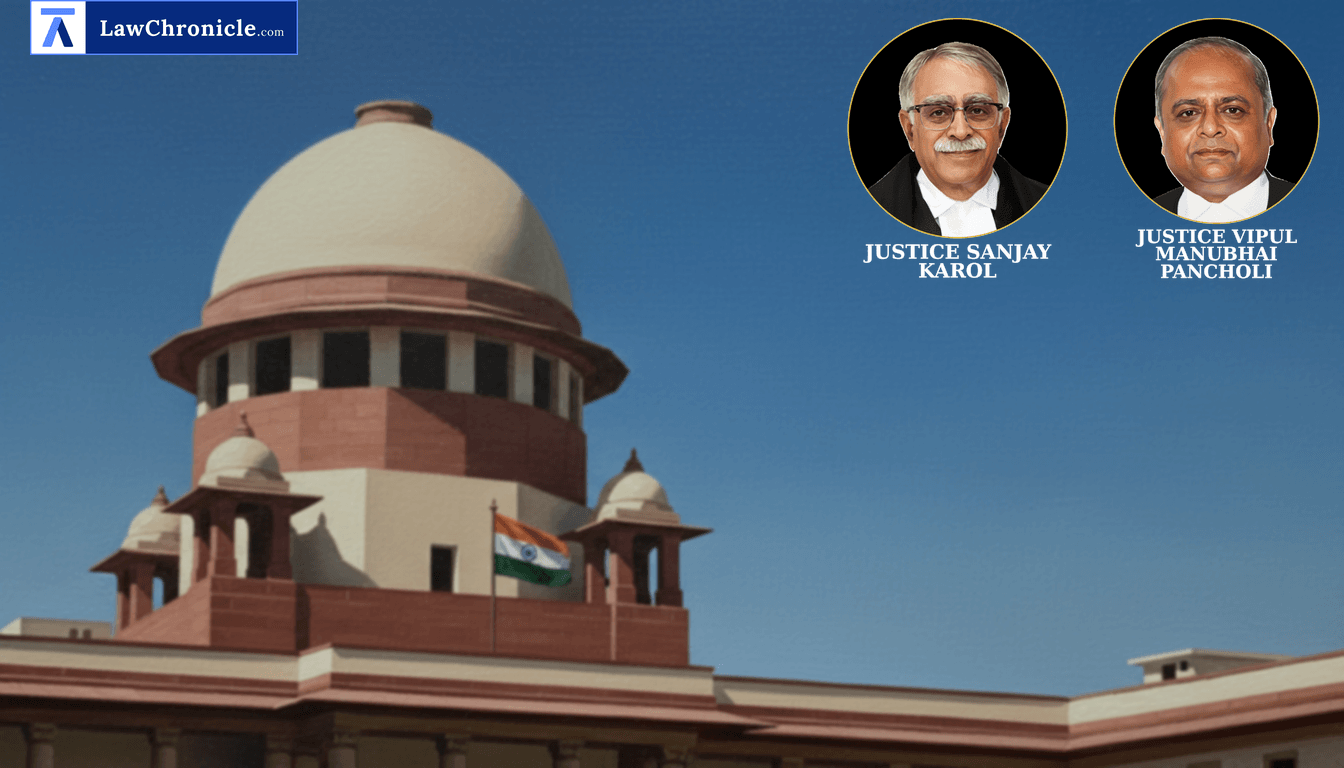
The Supreme Court restored a decree for specific performance, holding that the High Court exceeded its jurisdiction under Section 100 of the Code of Civil Procedure, 1908, by interfering with concurrent findings of fact regarding the validity of a sale agreement. The bench, comprising Justice Sanjay Karol and Justice Vipul M. Pancholi, emphasized that such findings should not be disturbed in a second appeal unless they are perverse or suffer from material illegality.
Restoration of Specific Performance Decree
The apex court observed that both the Trial Court and the First Appellate Court had concurrently found the sale agreement to be genuine and valid. The High Court's reversal of these findings was deemed impermissible. The Court has the following directions:
"Accordingly, the present appeal is allowed. The impugned judgment and decree dated 25.06.2025, passed by the High Court of Judicature at Madras in S.A. No.905 of 2017, as well the judgment and decree dated 28.08.2014, passed by the First Appellate Court insofar as it denied the relief of specific performance, are hereby set aside. The judgment and decree dated 21.12.2012, passed by the Trial Court decreeing the suit for specific performance is restored."
Supreme Court on Readiness and Willingness
Addressing the issue of the purchaser's 'readiness and willingness' under Section 16(c) of the Specific Relief Act, 1963, the Court noted that the appellant had paid approximately 93% of the total sale consideration (Rs. 9,00,000/- out of Rs. 9,30,000/-). It held that the mere delay in issuing a legal notice after the stipulated four-month period does not automatically negate readiness and willingness, especially when the suit was filed within the limitation period.
The Court, in its reasoning, observed: "If the plaintiff was unwilling to perform the contract, he would not have paid nearly 93% of the sale consideration. Merely because the legal notice came to be issued after expiry of four months from the stipulated period mentioned in the agreement, the same by itself cannot lead to an inference that the plaintiff was not ready and willing to perform the contract, especially when the suit itself was instituted well within the prescribed period of limitation."
Limitations on Second Appeal Jurisdiction
Referring to precedents like Kondiba Dagadu Kadam v. Savitribai Sopan Gujar ( "(1999) 3 SCC 722": 1999 CaseBase(SC) 3) and C. Doddanarayana Reddy v. C. Jayarama Reddy, the Court reiterated that the High Court's power under Section 100 of the Code of Civil Procedure, 1908 is strictly limited to substantial questions of law. It relied on Karnataka Board of Wakf v. Anjuman-E-Ismail Madris-Un-Niswan ( "(1999) 6 SCC 343": 1999 CaseBase(SC) 454) and State of Rajasthan v. Shiv Dayal ( "(2019) 8 SCC 637": 2019 CaseBase(SC) 2462) to emphasize that findings of fact by the first appellate court are generally binding. Furthermore, the Court cited Ramachandra Reddy v. Ramulu Ammal and Gurdev Kaur v. Kaki ( "(2007) 1 SCC 546": 2006 CaseBase(SC) 680) to underline that even an erroneous finding of fact cannot be a ground for interference unless it is perverse.
On the specific requirement of Section 16(c) of the Specific Relief Act, 1963, the Court referred to C.S. Venkatesh v. A.S.C. Murthy and Madhukar Nivrutti Jagtap v. Pramilabai Chandulal Parandekar to explain that readiness and willingness must be gathered from the overall conduct of the parties.
Background:
The dispute arose from a sale agreement dated 19.03.2010. The plaintiff paid Rs. 9,00,000/- as earnest money, with a balance of Rs. 30,000/- to be paid within four months. When the defendants became evasive, the plaintiff issued a legal notice on 01.02.2011 and subsequently filed a suit for specific performance. The defendants contended the agreement was merely a 'security document' for another transaction. While the Trial Court decreed the suit, the First Appellate Court and the High Court denied specific performance on the grounds of lack of readiness and willingness. The Supreme Court set aside these findings, ruling that the plaintiff’s conduct, particularly the payment of a substantial portion of the price, demonstrated continuous willingness.
Case Details:
Case No.: CIVIL APPEAL NO. …………………… OF 2026 (@ Special Leave Petition (Civil) No.32390 of 2025)
NeutralCitation: 2026 INSC 573
Case Title: A. SHAHUL HAMEED v. N. MALLIGARJUNA AND ORS.
Source: 2026 CaseBase(SC) 491
Similar Articles

 Breaking News


