


Contractual restriction bars pre-reference interest in Arbitration: Supreme Court
 Copy Link
 Share
 Save
Reaffirming party autonomy over statutory interest powers, the Supreme Court ruled that an express contractual prohibition on interest for delayed payments completely strips an arbitral tribunal of its jurisdiction to award pre-reference interest under the Arbitration and Conciliation Act, 1996.
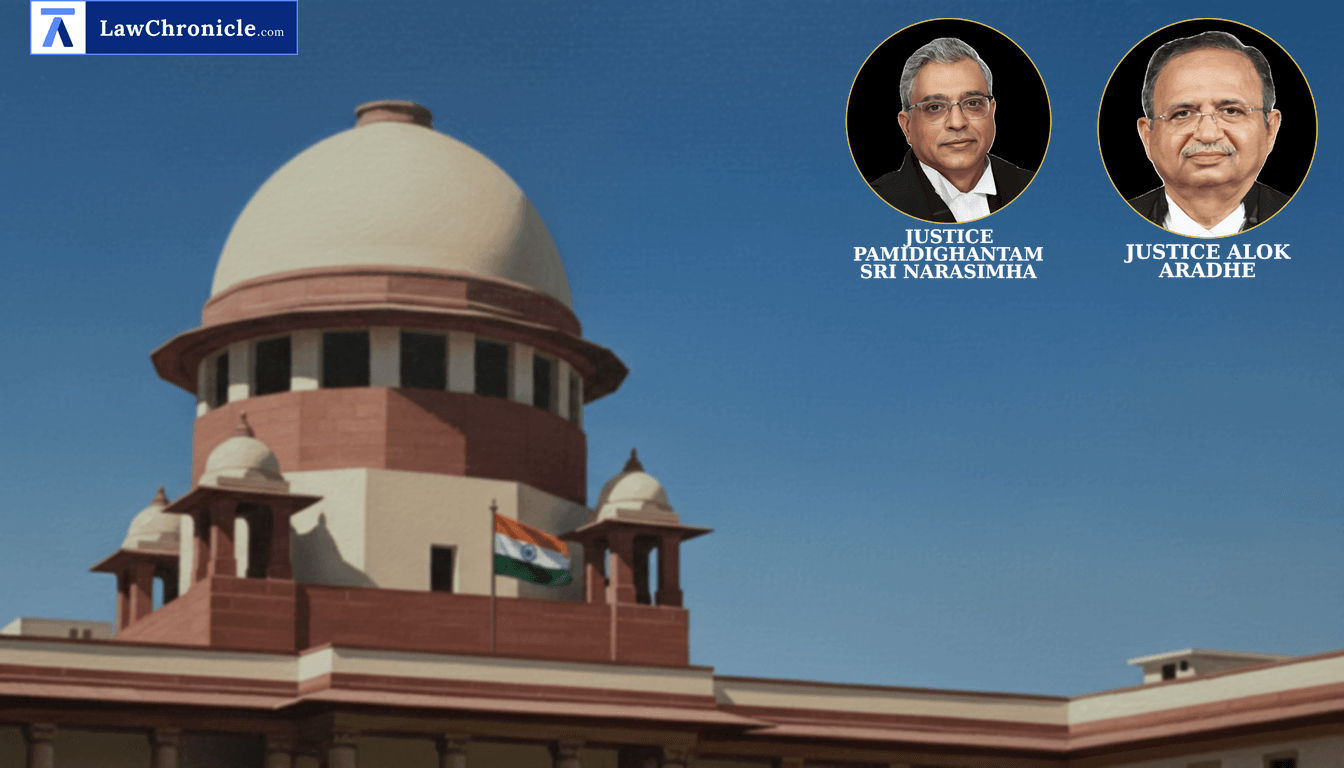
A bench of Justice Pamidighantam Sri Narasimha and Justice Alok Aradhe set aside the High Court's decision restoring pre-reference interest in arbitration in a public works contract dispute, clarifying the clear distinction between the interest regimes under the Arbitration Act of 1940 and 1996 arbitration statutes.
Key Takeaways
- Party Autonomy Prevails: Under Section 31(7)(a) of the Arbitration and Conciliation Act, 1996, contractual clauses prohibiting interest strictly bind arbitral tribunals.
- Statutory Shift Reaffirmed: The strict construction rule of the Arbitration Act, 1940 requiring explicit exclusion of an arbitrator's jurisdiction no longer applies under the 1996 Act.
- Delayed Payment Clauses: Clauses specifically barring interest on delayed payments create an absolute prohibition, distinguishing them from clauses that only address disputed balance amounts.
- Substantive vs Procedural Basis: Pre-reference interest in arbitration is governed by substantive law and cannot be sourced solely from statutory procedural provisions.
Pre-Reference Interest and Arbitration Contract
The Supreme Court analyzed the interplay between party autonomy and statutory powers governing interest. The Court, in its reasoning, observed: "Under the 1996 Act, however, the opening words of Section 31(7)(a), 'unless otherwise agreed by the parties', expressly subordinate that power to the parties' bargain. An express bar in the agreement now suffices to exclude the power, even where the bar is not specifically addressed to the arbitrator's jurisdiction. This marks a clear departure from the strict-construction approach that prevailed under the 1940 Act."
Addressing the specific wording of Clause 54 of the General Conditions of Contract (GCC), the Court highlighted that it barred claims in two independent situations—money lying due to a dispute, and delay in making payments. Distinguishing the case from earlier jurisprudence under the old Act, the Court observed: "By naming delay in payment as a separate ground, standing on its own and not tied to any dispute, Clause 54 does what the clause in Harish Chandra never did: it expressly shuts out a claim for interest arising from delayed payment, whether or not there was any dispute about it at all."
The Court issued the following order: "The impugned judgment, to the extent it restores the grant of pre-reference interest, cannot be sustained and is accordingly set aside. The appeal is allowed in the above terms."
Ratio
Under Section 31(7)(a) of the Arbitration and Conciliation Act, 1996, an express contractual clause barring interest or damages on delayed payments excludes the statutory jurisdiction of the arbitral tribunal to grant pre-reference or pendente lite interest.
Background
The appellant, North Eastern Electric Power Corporation Limited, invited tenders in June 1995 for civil works relating to a Gas Turbine Power Project in Tripura. A formal agreement was executed with the respondent, Astra Construction Private Limited, in May 1996. Disputes arose during execution, leading to arbitration.
In June 2015, the Arbitral Tribunal found the delay attributable to the appellant, awarding Rs. 3.30 crores in principal alongside pre-reference interest at 12% per annum and pendente lite/future interest at 9% per annum. Applying Sayeed Ahmed & Company v. State of U.P. & Ors. ( "(2009) 12 SCC 26": 2009 CaseBase(SC) 806) and Jai Prakash Associates Limited v. Tehri Hydro Development Corporation Limited (THDC-I), the Commercial Court under Section 34 of the Arbitration and Conciliation Act, 1996 modified the award by setting aside pre-reference and pendente lite interest, citing Clause 54 of the GCC.
However, on an appeal under Section 37 of the Arbitration and Conciliation Act, 1996, the High Court relied on State of U.P. v. Harish Chandra and Co. to restore the pre-reference interest, treating Clause 54 as inapplicable to general interest claims. The Supreme Court reversed this decision, agreeing with the principles in Sayeed Ahmed & Company v. State of U.P. & Ors. ( "(2009) 12 SCC 26": 2009 CaseBase(SC) 806), Jai Prakash Associates Limited v. Tehri Hydro Development Corporation Limited (THDC-I), ONGC v. G & T Beckfield Drilling Services Pvt. Ltd., and Pam Developments Private Limited v. State of West Bengal and Another ( "(2024) 10 SCC 715": 2024 CaseBase(SC) 317), while distinguishing older line precedents like Secretary, Irrigation Department, Government of Orissa and Others v. G.C. Roy ( "(1992) 1 SCC 508": 1991 CaseBase(SC) 531), Reliance Cellulose Products Ltd. v. ONGC Ltd. ( "(2018) 9 SCC 266": 2018 CaseBase(SC) 523), and Jaiprakash Associates Limited v. Tehri Hydro Development Corporation (India) Limited (THDC-II). The Court also held that Interest Act, 1978 defined current interest rates for statutory contexts, but could not override contractual bars under Section 31(7)(a).
Case Details:
Case No.: Civil Appeal No. OF 2026 (@ Special Leave Petition (Civil) No. 24803 of 2025)
Neutral Citation: 2026 INSC 1036
Case Title: North Eastern Electric Power Corporation Limited (NEEPCO) v. Astra Construction Private Limited
Appearances:
For the Petitioner(s): Mr. Tushar Mehta, learned Solicitor General, Mr. Raghavendra P. Shankar, learned Additional Solicitor General
For the Respondent(s): Mr. Ritin Rai, learned Senior Counsel, Mr. C.S. Vaidyanathan, learned Senior Counsel (for intervenors)
Source: 2026 CaseBase(SC) 7188
Similar Articles



 Breaking News


