


Convictions for Possession of Government Cement Set Aside as Statutory Controls Were Withdrawn
 Copy Link
 Share
 Save
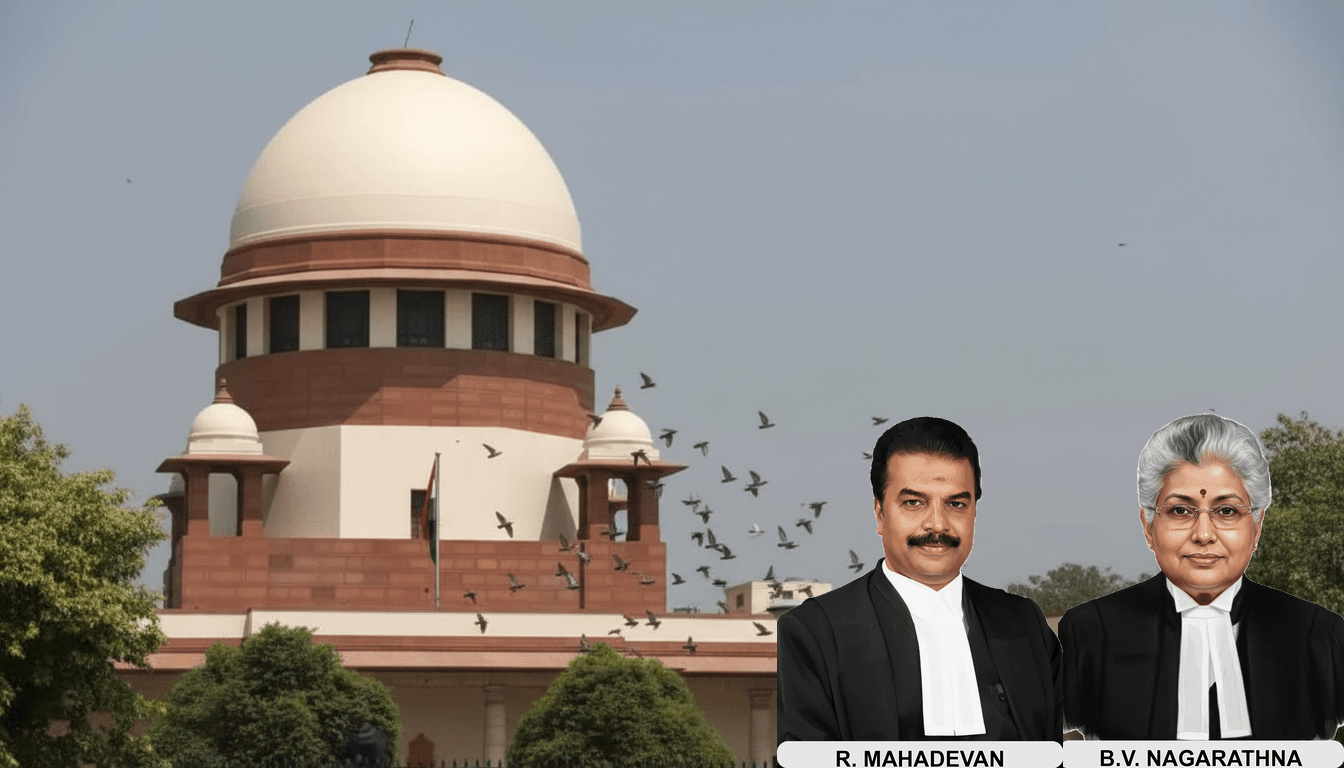
A two-judge Bench of Justices B.V. Nagarathna and R. Mahadevan heard appeals by two accused against their convictions under Sections 3 and 7 of the Essential Commodities Act, 1955, arising from alleged possession and unauthorised storage of government-quota cement. The appeals challenged concurrent findings of the trial court and the Bombay High Court affirming one-year rigorous imprisonment and fines for the appellants for diverting cement supplied for execution of a Public Works Department contract.
The Court allowed the appeals and set aside the convictions and sentences. It held that, on the date of the alleged offence (24.03.1994), the central Cement Control Order, 1967 and the Maharashtra licensing regime under the Maharashtra Cement (Licensing and Control) Order, 1973, no longer provided an operative statutory foundation for prosecution under Section 7 of the E.C. Act, in view of S.O.168 dated 01.03.1989 (which removed price and distribution control of cement effective 1 March 1989) and S.O.624 dated 07.08.1990 (which rescinded delegation of retail-distribution licensing powers). The Court, in its reasoning, observed: “Therefore, the prosecution launched against the appellants under the E.C. Act was wholly misconceived. Both the trial Court and the High Court failed to examine the legal effect of decontrol and proceeded solely on an appreciation of evidence, ignoring the absence of a statutory foundation for the offence. Such an approach strikes at the root of the conviction and renders the same unsustainable in law.” The Court further cautioned that “acts such as diversion of Government‑supplied cement meant for public works, dishonest retention thereof, or unauthorised dealing in such Government property may still attract penal consequences under the Indian Penal Code,” noting that the investigating agency ought to have considered appropriate IPC provisions.
Background
The prosecution alleged that cement supplied from a PWD godown under a government quota for a road construction contract was diverted and found stored in premises linked to the appellants. Police seized 365 bags during a raid and recovered 25 further bags later; investigation implicated several accused, and the trial court convicted four persons including the two appellants. The appellants appealed; the High Court dismissed their appeals and affirmed conviction and sentence, after which the appeals were brought before the Supreme Court.
Counsel for the appellants contended that by the time of the alleged offence all statutory controls over cement had been withdrawn and that no subsisting order under Section 3 was proved; they relied on notifications and earlier decisions requiring proof of an operative control order for conviction under Section 7. The State maintained that possession of government‑supplied cement was proved and that the burden then shifted to the appellants to justify their possession. The Supreme Court examined the statutory history — including the Cement Control Order, 1967, its amendment by S.O.168(E) of 01.03.1989 removing price and distribution controls, and the withdrawal of state licensing powers by S.O.624(E) of 07.08.1990 — and found no subsisting statutory order on the date of the raid. Applying established precedent regarding the effect of deletion or repeal where no saving operates, the Court concluded the prosecution under the E.C. Act was legally untenable; accordingly, the convictions and sentences were set aside, bail bonds (if any) were cancelled and any fine paid was ordered to be refunded. The Court observed it was unnecessary to decide other contentions and noted the investigating agency’s failure to invoke criminal provisions under the IPC where appropriate.
Case Details:
Case No.: Criminal Appeal Nos. 1630 of 2015 and 1631 of 2015
Case Title: Manoj v. State of Maharashtra & Anr.; Prakash v. State of Maharashtra & Anr.
Appearances:
For the Petitioner(s): [Names not specified in the judgment]
For the Respondent(s): [Names not specified in the judgment]
Source: 2026 CaseBase(SC) 125
Similar Articles




 Breaking News


