


Counsel's Demise Sufficient Cause for Setting Aside Ex-Parte Decree: Rajasthan HC
 Copy Link
 Share
 Save
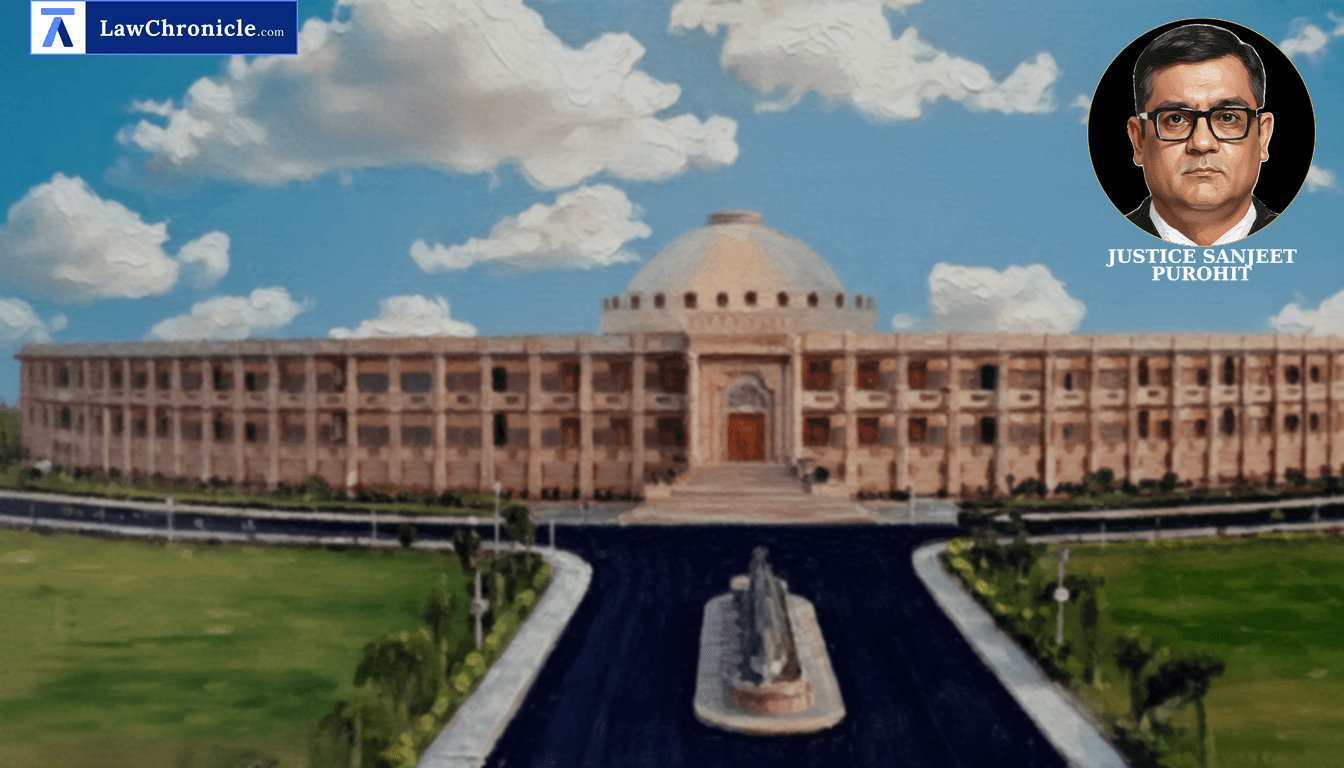
Substantive rights in immovable property cannot be foreclosed by procedural defaults, as the Rajasthan High Court quashed a trial court's refusal to set aside an ex-parte decree occasioned by the death of a conducting advocate. The Bench reinforced that procedural law is a handmaid to justice, designed to facilitate adjudication rather than punish litigants for circumstances beyond their control, such as the demise of their legal representative.
In an appeal challenging the rejection of an application under Order IX Rule 13 of the Code of Civil Procedure, 1908, Hon'ble Mr. Justice Sanjeet Purohit observed that a litigant who has done everything within their power to participate in proceedings should not suffer for the inaction or misfortune of their agent. The Rajasthan High Court set aside the ex-parte judgment and decree passed by the Additional District & Sessions Judge, Gharsana, noting that the trial court had acted with "unwarranted haste" in concluding the trial while the appellant, a 70-year-old rural resident, remained unaware of her counsel's death.
Key Takeaways
Justice Over Technicality
The Rajasthan High Court reaffirmed that the primary objective of Code of Civil Procedure, 1908 is to do substantial justice, and technicalities should not prevent the court from correcting illegalities perpetuated by ex-parte orders.
Sufficient Cause Definition
"Sufficient cause" is an elastic expression that must be construed liberally; absence due to a counsel's demise is a bona fide ground for relief, especially for aged litigants in remote areas.
Adversarial System Realities
Litigants are not expected to act as "watchdogs" of their advocates; once a lawyer is engaged, the party can reasonably trust the agent to manage procedural requirements.
Scope of Inquiry
The inquiry under Order IX Rule 13 must focus strictly on the date the party was proceeded against ex-parte and cannot be defeated by prior conduct or subsequent procedural lapses of the counsel.
Court's Rationale on 'Sufficient Cause' and Counsel Default
The Rajasthan HighCourt emphasized that in the Indian adversarial system, day-to-day personal attendance of a litigant is neither contemplated nor meaningful. Relying on Rafiq & Anr. v. Munshilal & Anr. ( "(1981) 2 SCC 788": 1981 CaseBase(SC) 89), the Bench noted that a party having done everything in their power to participate should not be penalized for the misdemeanour or omission of their advocate.
The Rajasthan High Court observed that "The expression 'sufficient cause' is elastic and cannot be confined within any strait-jacket formula. The inquiry necessarily depends upon facts and circumstances of each case and must take into account whether defendant had honestly and sincerely intended to appear when the matter was called for hearing. Absence arising from circumstances beyond defendant’s control and where negligence, inaction or want of bona fides cannot be imputed, would constitute the kind of circumstance which may warrant exercise of discretion under the provision."
Asymmetry in Statutory Scheme for Ex-Parte Orders
Justice Purohit highlighted a significant legislative intent in Code of Civil Procedure, 1908: while an order rejecting the setting aside of an ex-parte decree is appealable under Order XLIII Rule 1(d), an order allowing such an application is not. The Rajasthan High Court noted that “This asymmetry in the statutory scheme is significant and holds the key to the underlying wisdom of the legislature. It is precisely because law prioritizes adjudication of substantive rights on merits that the Code provides an appellate remedy where such course is refused. An order rejecting an application under Order IX Rule 13 shuts the right of the defendant to contest the suit on merits and thereby permits the rights to be determined by reason of procedural default.”
Ratio
Procedural law is designed to facilitate justice and not to operate as a penal enactment. Under Order IX Rule 13 of the Code of Civil Procedure, 1908, the expression 'sufficient cause' must receive a liberal, justice-oriented construction to ensure that substantive rights are adjudicated on merits. A litigant who has engaged counsel and acted with due diligence cannot be deprived of an opportunity to be heard due to the counsel's demise or negligence, as the doctrine of audi alteram partem remains a foundational principle of judicial adjudication.
Background
The dispute involved a suit for declaration and permanent injunction filed by Smt. Godavari regarding agricultural land originally allotted to her deceased husband. The appellant, a subsequent purchaser under a registered sale deed dated 14.05.2004, had contested the suit since 2013. However, on 19.07.2024, the trial court proceeded ex-parte because the appellant's counsel, Shri Dharampal Godara, had passed away, a fact unknown to the 70-year-old appellant.
Though the appellant engaged new counsel and filed an application under Order IX Rule 7, that application was dismissed for non-prosecution on 28.10.2024. The trial court subsequently passed an ex-parte decree on 29.01.2025. The appellant moved an application under Order IX Rule 13 within nine days, which the trial court rejected, citing a lack of diligence. The Rajasthan High Court, following precedents like G.P. Srivastava v. R.K. Raizada & Ors. ( "(2000) 3 SCC 54": 2000 CaseBase(SC) 1171), Parimal v. Veena @ Bharti ( "(2011) 3 SCC 545": 2011 CaseBase(SC) 302), and Sangram Singh v. Election Tribunal, Kotah ( "AIR 1955 SC 425": 1955 CaseBase(SC) 1), found the trial court's approach too rigid and technical, emphasizing that the appellant's promptness after the decree reflected vigilance, not negligence.
Case Details:
Case No.: S.B. Civil Miscellaneous Appeal No. 2689/2026
Neutral Citation: 2026:RJ-JD:45017
Case Title: Smt. Baljeet Kaur v. Smt. Godavari & Ors.
Appearances:
For the Petitioner(s): Mr. Pankaj Sharma, Advocate
For the Respondent(s): Mr. Sohan Lal Jain, Advocate
Source: 2026 CaseBase(RAJ) 25222
Similar Articles
 Breaking News


