


Remarriage No Bar To Setting Aside Improperly Decided Divorce Decrees: Andhra Pradesh HC
 Copy Link
 Share
 Save
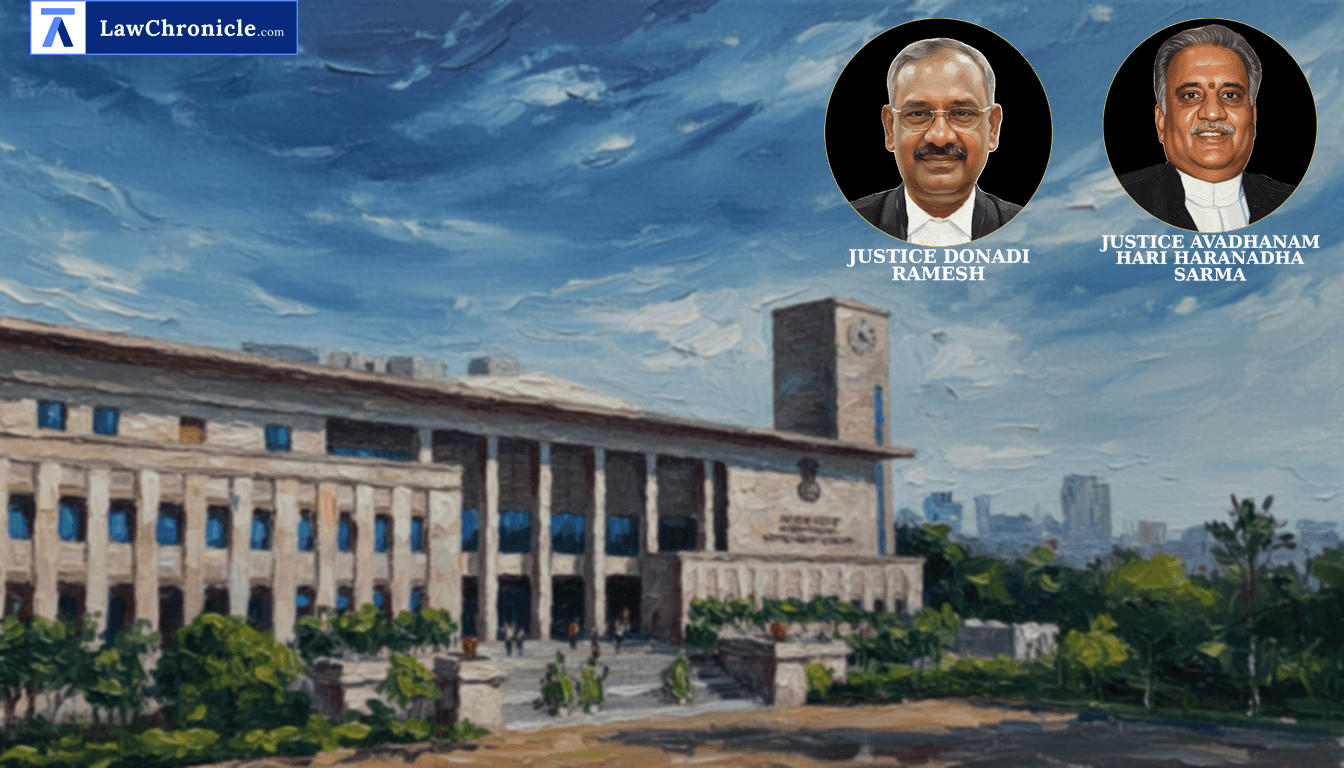
Trial Courts cannot proceed with matrimonial disputes as 'contested' when a party is unrepresented due to an advocate's withdrawal without notice, as such procedural shortcuts effectively deny litigants their right to fair hearing and statutory remedies. The Andhra Pradesh High Court has reinforced that judicial efficiency must not supersede the principles of natural justice, holding that passing a decree on merits while recording 'nil' evidence for one side constitutes a procedural irregularity that necessitates restoration of the original proceedings.
In a significant determination of procedural fairness, a Division Bench comprising Justice D Ramesh and Justice A. Hari Haranadha Sarma set aside a divorce decree granted by a Trial Court that had closed the wife's evidence without ensuring she was notified of her counsel's withdrawal. The Court emphasized that even if a party later remarries, it does not automatically insulate a flawed decree from judicial scrutiny when fundamental rights to a fair trial have been compromised.
Key Takeaways
Mandatory Notice on Advocate Withdrawal
Courts must ensure litigants are personally notified when their counsel reports 'no instructions' to prevent ex parte-style orders from being disguised as contested merits decisions.
Procedural Rights Preservation
Labeling a case as 'contested' when the defendant is absent deprives them of specific remedies like Code of Civil Procedure, 1908 Order IX Rule 13, which is exclusively available for setting aside ex parte decrees.
Limits of Judicial Discretion under Order XVII
Judges cannot simply close evidence and decide on merits under Code of Civil Procedure, 1908 Order XVII Rule 3 if the party is absent; they must instead follow the ex parte procedures outlined in Rule 2.
Remarriage Does Not Preclude Appeal
Subsequent remarriage by a spouse does not render an appeal against the original divorce decree infructuous if the initial order was passed in violation of fair trial principles.
Trial Court's Procedural Departure Under the Divorce Act
The respondent-husband had initiated proceedings under Section 10 (i) (ix) (x) of the Indian Divorce Act, 1869 seeking dissolution of marriage on grounds of cruelty and desertion. Although the appellant-wife filed a counter, the Trial Court noted that her advocate reported 'no instructions.' Instead of treating the matter as ex parte, the Trial Judge recorded her cross-examination as 'Nil' and proceeded to hear arguments, eventually granting the divorce.
The Court, in its reasoning, observed: "Ex parte disposal and contested disposal may have different count for the Court, but for a party, the same will affect some procedural remedies and rights available to such party. When the counsel for the party has reported ‘no instructions’ and when it is nobodies case, that the wife [appellant herein] was informed by her counsel, prior to such reporting of no instructions, proceeding further without notice to the said party by the Court, is found as denial of fair opportunity."
Judicial Rationale and Mandatory Precedents
The Bench relied on Rashid Shapurji Chennai Vs. Collector Land Acquisition ( "1974 AIR(AP) 273": 1973 CaseBase(AP) 19) to highlight that when a party fails to appear at an adjourned hearing, the Court must proceed under Rule 2 of Order XVII, which leads to Code of Civil Procedure, 1908 Order IX procedures, rather than deciding the suit on merits. The Court also cited the Supreme Court's ruling in Malkiat Singh v. Joginder Singh ( "(1998) 2 SCC 206": 1997 CaseBase(SC) 1096), which established that if a counsel withdraws, the interests of justice require that a fresh notice for the actual date of hearing be sent to the parties.
The High Court further referenced Thanneru Venkataiah v. Vadlamudi Kasaiah to reiterate that an advocate is under obligation to inform the client if they no longer find it feasible to provide assistance. The High Court concluded that the Trial Court's rush to dispose of the matter on the very next day after hearing arguments, without notifying the wife, was unsustainable.
The Court has following directions:
"1) The decree and order dated 29.11.2023 passed in D.O.P. No. 46 of 2022 on the file of the Court of the I Additional District Judge, Krishna, Machilipatnam, are set aside.
2) D.O.P. No.46 of 2022 on the file of the Court of the I Additional District Judge, Krishna, Machilipatnam, shall stand restored.
3) The learned Trial Judge shall proceed with D.O.P. No. 46 of 2022 from the stage of cross-examination of PW.1 as per law by providing fair opportunity to both the parties.
4) Registry is directed to communicate a copy of this order forthwith.
5) Both the parties are directed to appear before the Court of the I Additional District Judge, Krishna, Machilipatnam on 28.10.2026, to proceed with the matter and cooperate with the learned Trial Judge, for expeditious disposal of the case."
Ratio
When a party's counsel withdraws from a case by reporting 'no instructions' without evidence of prior notice to the client, the Court is duty-bound to issue a fresh notice to the party before proceeding. Any judgment rendered without such notice, by treating the evidence as 'nil' instead of following the ex-parte procedure under Order XVII Rule 2 and Order IX of the CPC, constitutes a violation of natural justice and is liable to be set aside.
Background
The appellant-wife challenged the order of the I Additional District Judge, Krishna, which dissolved her marriage. The primary grievance was that she was denied an opportunity to contest the case as her counsel had withdrawn without her knowledge. The husband argued that he had already remarried following the expiry of the limitation period post-decree. However, the High Court held that the procedural lapse in the Trial Court outweighed these subsequent developments. The Court set aside the original decree and restored the case to the stage of cross-examination to ensure both parties receive a fair trial.
Case Details:
Case No.: CIVIL MISCELLANEOUS APPEAL NO: 305 OF 2025
Neutral Citation: 2026:APHC:38080
Case Title: Radhika @ Hepzibha Beluah Peeriga v. Prabhudas Ramakurthi
Appearances:
For the Petitioner(s): Sri K V Raghu Veer
For the Respondent(s): Sri Y N Anjaneyacharyulu
Source: 2026 CaseBase(AP) 15672
Similar Articles
 Breaking News


