


Court Deposit Counts As Payment: Madras High Court Rejects Land Acquisition Lapse Plea
 Copy Link
 Share
 Save
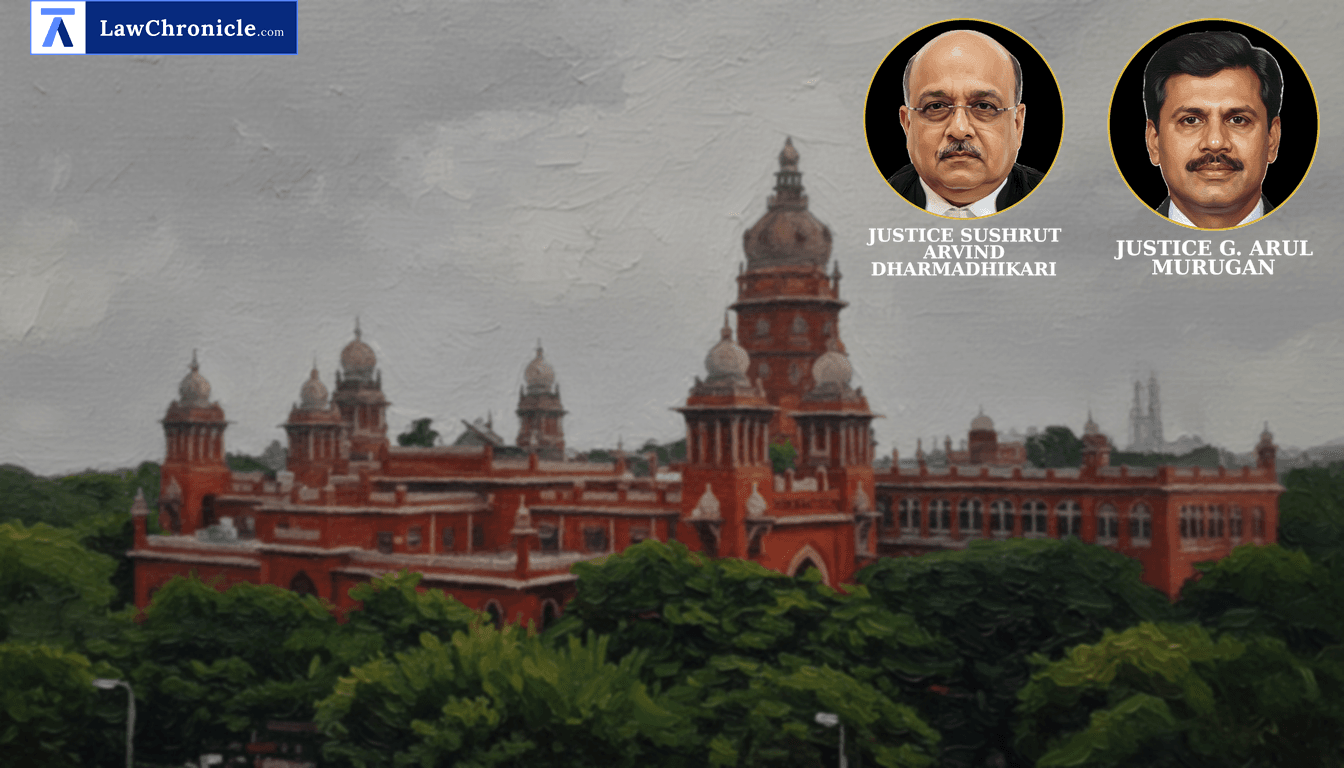
The Madras High Court has ruled that compensation deposited in a Civil Court due to title disputes constitutes valid 'payment', effectively barring landowners from invoking lapse provisions under the new land law.
A Division Bench comprising the Chief Justice Sushrut Arvind Dharmadhikari and Justice G. Arul Murugan heard the writ appeal challenging a Single Judge's order. The appellant sought a declaration that acquisition proceedings initiated in 1989 for a Tamil Nadu Housing Board scheme had lapsed under Section 24(2) of the Right to Fair Compensation and Transparency in Land Acquisition, Rehabilitation and Resettlement Act, 2013.
Key Takeaways
Judicial Interpretation of 'Payment'
Depositing compensation in a Civil Court under the Land Acquisition Act, 1894 satisfies the requirement of payment under the new Act, preventing the lapse of acquisition.
Conjunctivity of Section 24(2)
Both conditions: non-payment of compensation and non-taking of physical possession, must exist simultaneously to trigger a lapse; the occurrence of either saves the acquisition.
Bar on Belated Challenges
Challenges to the validity of decades-old awards are barred by delay and laches, and new prayers cannot be introduced for the first time at the appellate stage.
Court Observations on Section 24(2) Compliance
The Bench observed that the appellant’s case failed to meet the legal threshold for a lapse declaration. The Madras High Court noted that the Housing Board had successfully demonstrated that possession of a significant portion of the land was taken in 2006, and the remaining portion stayed with the appellant only due to an interim order she obtained in 2009.
The Bench observed that “What matters for Section 24(2) of the New Act is not whether the appellant personally received the cheque, but whether compensation was paid or deposited in accordance with law. Where the entitlement to compensation is genuinely disputed among rival claimants, Section 31 of the Old Act itself contemplates deposit in court as the mode of payment... The deposit, therefore, counts as payment of compensation for the purposes of the New Act.”
Ratio
For the purposes of Section 24(2) of the Right to Fair Compensation and Transparency in Land Acquisition, Rehabilitation and Resettlement Act, 2013, the term 'payment' includes the deposit of compensation in a Civil Court under Section 31 of the Land Acquisition Act, 1894 when title is disputed. Furthermore, the conditions of non-possession and non-payment must be read conjunctively; if either condition is satisfied by the State, the acquisition does not lapse. Legal protection against lapse is not available when the retention of possession is due to a court-ordered stay obtained by the landowner.
Background
The dispute originated from a 1989 notification for a housing scheme in Chengalpattu Taluk. An award was passed in 1992, but since the ownership of the 1 acre 41 cents of land (including a rice mill) was contested among four parties, the compensation of Rs.41,636/- was deposited with the Subordinate Judge, Chengalpattu. The appellant had previously sought re-conveyance and obtained a stay on dispossession in 2009.
Following the enactment of the Right to Fair Compensation and Transparency in Land Acquisition, Rehabilitation and Resettlement Act, 2013, the appellant argued that the acquisition lapsed as she had not received the money and still held possession. However, the respondents produced contemporaneous records from 1992 proving the court deposit. The Madras High Court relied on the precedent set in Indore Development Authority v. Manoharlal to hold that the acquisition survived. The Bench also dismissed a belated challenge to the 1992 award, citing gross delay and laches.
Case Details:
Case No.: W.A.No.2555 of 2026
Neutral Citation: 2026:MHC:3926
Case Title: K.Bhuvaneswari v. The Government of Tamil Nadu and Others
Appearances:
For the Petitioner(s): Mr.V.R.Kamalanathan for Mr.R.Manibarathi
For the Respondent(s): Mr.C.A.Ramanan, Government Advocate for R1 and R2; Mr.N.Moorthi for R3
Source: 2026 CaseBase(MAD) 24087
Similar Articles


 Breaking News


