


SC Quashes Obscenity Conviction; Culpable Homicide Charge Reduced to Sec 325 IPC
 Copy Link
 Share
 Save
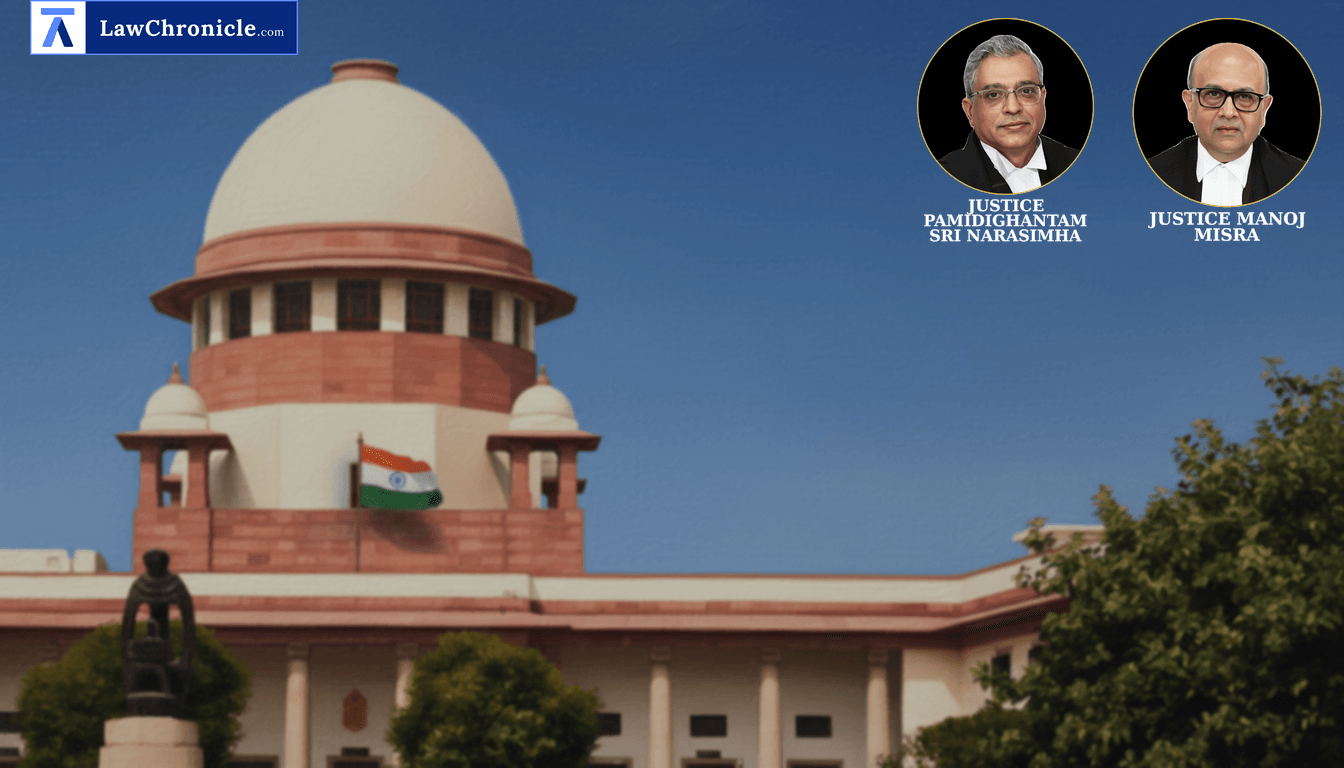
A bench of Justices Pamidighantam Sri Narasimha and Manoj Misra heard connected criminal appeals against the judgments of the High Court of Judicature at Madras (Madurai Bench) that had altered trial court outcomes in a 2014 boundary-dispute assault which resulted in death. The appeals challenged convictions and sentences imposed on two accused who were tried along with two others for offences under Sections 294(b), 323, 324, 325 and 302/304 IPC read with Section 34 IPC arising from Crime No. 189 of 2014.
The Court partly allowed the appeals and modified convictions and sentences. It set aside the High Court’s convictions under Section 294(b) IPC for the use of abusive language, holding that “mere use of the word ‘bastard’, by itself, is not sufficient to arouse prurient interest of a person.” The Court affirmed that one accused (Sivakumar) was guilty of culpable homicide not amounting to murder under Section 304 Part II IPC, but reduced his sentence from five years rigorous imprisonment to three years. The other accused (Senthil) had his conviction under Section 304 Part II read with Section 34 IPC set aside for lack of proof of common intention, though his conviction under Section 324 IPC for causing injury to PW‑4 was maintained and his sentence was altered to the period already undergone.
The Court, in its reasoning, observed: “Now, we shall examine whether A‑1 could be said to have shared a common intention to cause such bodily injury to the deceased which resulted in his death. The facts of the case reflect that A‑1 charged on the deceased by taking an Aruval in his hand but, when PW‑4 intervened, gave two blows to PW‑4, which did not result in any grievous injury. No doubt, it has come in the testimony of PW‑4 that A‑2 took a log and gave a hard blow on the head of the deceased while uttering that all problems are because of the deceased and he should die, but this statement is not attributed to A‑1. Besides, there is no evidence that A‑1 exhorted A‑2 to strike the deceased. Thus, upon consideration of the circumstances in which the incident unfolded and the manner in which the deceased was assaulted by A‑2, besides there being no reliable evidence to show that A‑1 had beaten the deceased after he fell to the ground, in our view, it would not be safe to hold that A‑1 shared common intention with A‑2 to cause such bodily harm to the deceased as is likely to cause his death. In this view of the matter, the conviction of A‑1 under Section 304 Part II read with Section 34 IPC is set aside. However, conviction of A‑1 for causing injury to PW‑4 and thereby committing an offence punishable under Section 324 IPC is confirmed.”
Background
The dispute arose between neighbours and close relatives over a common boundary. On 20.09.2014, when the deceased (Kaliyamurthy) was fencing his land, a confrontation ensued with A‑1 (Senthil), A‑2 (Sivakumar), and others. The prosecution alleged that A‑1 struck with an Aruval, injuring PW‑4 (Kalaivanan), and that A‑2 lifted a log and struck the deceased on the head. The deceased was taken to the hospital and later died; autopsy revealed a depressed fracture of the left parietal skull and intracranial bleeding. Trial court (27.02.2017) had acquitted two accused (A‑3 and A‑4), convicted A‑1 under Section 324 and A‑2 under Section 325. The widow (PW‑1) and the State appealed; the High Court (26.03.2019 & 04.04.2019) reversed some findings, convicted A‑1 and A‑2 under Section 294(b) and altered their convictions to include Section 304 Part II read with 34 IPC, sentencing both to five years R.I. and fines in respect of the culpable homicide findings.
Before the Supreme Court, appellants contended the absence of intent or knowledge necessary for culpable homicide and lack of common intention. The State relied on medical evidence of grievous cranial injury and witness testimony that A‑2 had targeted the deceased. The Supreme Court examined definitions and precedents, including its guidance in Apoorva Arora on obscenity for Section 294(b), and Section 299/304 principles on culpable homicide. Applying evidence standards, the Court concluded that use of an abusive epithet did not satisfy the statutory test of “obscene” under Section 294(b) and set those convictions aside. It found sufficient evidence to sustain culpable homicide against A‑2 (Sivakumar) but not to attribute the same mens rea to A‑1 (Senthil) under Section 34, thereby setting aside A‑1’s Section 304 Part II culpable homicide conviction while confirming his Section 324 conviction.
Final result: Both appeals were partly allowed. Senthil’s conviction under Section 324 was maintained but his Section 304 II/34 and 294(b) convictions were set aside; his sentence was reduced to the period already undergone and he need not surrender. Sivakumar’s conviction under Section 304 Part II was affirmed but his sentence was reduced from five to three years R.I.; he was directed to surrender and serve the remaining reduced sentence. No alteration to the finding of culpable homicide against Sivakumar was sought by the State.
Case Details:
Case No.: CRIMINAL APPEAL No. 1807 OF 2019; CRIMINAL APPEAL No. 677 OF 2020
NeutralCitation: 2026 INSC 318
Case Title: SIVAKUMAR …APPELLANT v. STATE REP. BY THE INSPECTOR OF POLICE …RESPONDENT; SENTHIL @ JANAKIRAM …APPELLANT v. STATE REP. BY THE INSPECTOR OF POLICE …RESPONDENT
Appearances:
For the Petitioner(s): Sri S. Nagamuthu, learned senior counsel
For the Respondent(s): Mr. Sabarish Subramanian, learned counsel
Source: 2026 CaseBase(SC) 283
Similar Articles



 Breaking News


