


Death 7 Days Post-Incident By Septicemia Not Murder: Delhi HC
 Copy Link
 Share
 Save
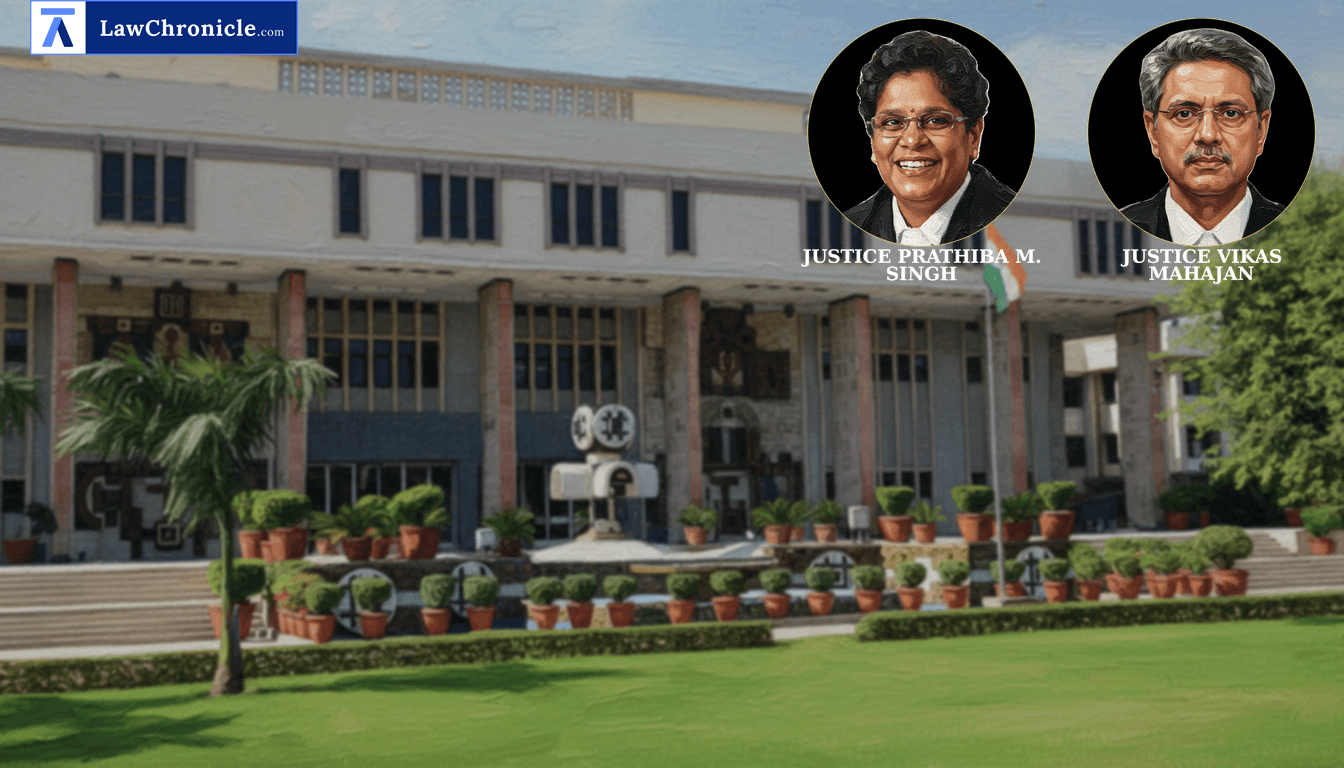
In a decisive recalibration of criminal culpability standards, the Delhi High Court has held that fatal complications arising days after an assault due to hospital-acquired septicemic shock cannot be categorized as murder when there was no explicit intention or grievous injury sufficient to cause death in the ordinary course of nature. Modifying the conviction of two men from murder to culpable homicide not amounting to murder, the Court underscored that prosecution must conclusively satisfy statutory tests under Section 300 of the Indian Penal Code, 1860 rather than relying on the advanced age of a victim.
A Division Bench comprising Justice Prathiba M. Singh and Justice Vikas Mahajan delivered the verdict while hearing appeals challenging a trial court order that had sentenced the appellants to life imprisonment for the death of their 65-year-old neighbour.
Key Takeaways
- Absence of Intention Defeats Murder Charge: Inflicting simple injuries using a non-deadly weapon like a short wooden stick negates the specific criminal intent required to prove murder.
- Post-Assault Complications Reclassified: Fatalities resulting from septicemic shock days after hospital admission cannot automatically be attributed as direct fatal injuries sufficient in the ordinary course of nature.
- Strict Applicability of Section 300 Exceptions: The Court reiterated that Section 300 Clause (2) requires established proof of the victim's pre-existing infirmity known to the assailant, not mere advanced age.
- Proportionality in Sentencing: Highlighting the balance between victim rights and accused rights, the Bench limited the sentence to the time already served over four years.
Court's Analysis and Legal Findings
The Delhi High Court examined whether the nature of injuries and the cause of death brought the case within the four clauses of Section 300 of the Indian Penal Code, 1860. Evaluating the guiding principles laid down by the Supreme Court in Sitaram Kuchhbedia v. Vimal Rana and Ors. ( "(2026) SCC Online SC 293": 2026 CaseBase(SC) 148) and Pulicherla Nagaraju v. State of AP ( "(2006) 11 SCC 444": 2006 CaseBase(SC) 230), the Bench held that the prosecution failed to prove an intention to cause death or an intention to inflict an injury sufficient in the ordinary course of nature to cause death.
The Court noted that out of seven injuries noted on the deceased, six were simple contusions or abrasions, while the seventh was a minor sutured wound on the forehead. The medical officer explicitly testified that the forehead injury could not be the cause of death. Aligning with the precedent in Virsa Singh v. State of Punjab ( "1958 SCC OnLine SC 37": 1958 CaseBase(SC) 94), the Bench observed that the trial court's finding regarding the sufficiency of injuries to cause death was perverse.
The Court, in its reasoning, observed: "The deceased was admitted in the hospital on 28th February, 2019 at about 1.30 AM and died 7 days later on 07.03.2019, evidently not on account of the injuries inflicted by the Appellants, rather due to the septicemic shock, which could possibly be on account of the infection contracted by the deceased during her stay at the hospital. In the absence of the opinion of the Doctor that the injuries inflicted to the deceased were sufficient to cause death in the ordinary course of nature, the offence under Clause (3) of Section 300 IPC is not made out."
Addressing the trial court's invocation of Section 300 Clause (2), the Bench further clarified: "Clause (2) is not attracted to the case in hand, inasmuch as it is not the case of the prosecution that the deceased was suffering from any disease or was not in a sound state of health, and that such a fact was within the knowledge of the Appellants. Merely because, the deceased was aged about 65 years, in our opinion, would not be sufficient to bring the case within the ambit of the said Clause."
The Court has following directions:
"It is thus, directed that the Appellants may be released forthwith, if not required in any other case."
Ratio
Where an assault results in non-grievous injuries inflicted without dangerous weapons, and the victim subsequently dies days later due to medical complications like septicemic shock without a definitive medical opinion that the injuries themselves were sufficient in the ordinary course of nature to cause death, the offense falls under Section 304 Part II and not Section 302 of the Indian Penal Code, 1860.
Background
The case originated from an incident on the night of February 28, 2019, where the appellants allegedly assaulted their 65-year-old neighbour following an altercation. The victim was taken to the hospital fully conscious and passed away seven days later on March 7, 2019. The trial court convicted the appellants under Section 302 read with Section 34 of the Indian Penal Code, 1860, primarily relying on the testimony of an eye-witness and sentencing them to life imprisonment.
On appeal under Section 415(2) of the BNSS, 2023 (corresponding to provisions under the CrPC), counsel for the appellants contended that the weapon used was merely a 1.5-foot wooden stick and that death was caused by hospital-contracted septicemia rather than the direct injuries. Relying on Ganga Dass v. State of Haryana ( "1994 Supp (1) SCC 534": 1993 CaseBase(SC) 711) and Rampal Singh v. State of U.P. for procedural evaluation and sentence modification in septicemia deaths, the High Court accepted the contention, set aside the murder conviction, modified it to Section 304 Part II, and ordered the immediate release of the appellants as they had already served over four years in custody.
Case Details:
Case No.: CRL.A. 1635/2025 and CRL.A. 255/2026
Case Title: Saddam @ Ataur Rehman v. State NCT of Delhi (with connected matter)
Appearances:
For the Petitioner(s): Mr. Chatanya Siddharth and Mr. Kartikey Chaudhary, Advocates.
For the Respondent(s): Mr. Ritesh Kumar Bahri, APP with Ms. Divya Yadav & Mr. Lalit Luthra, Advs. SI Shiv Dayal Kumar.
Source: 2026 CaseBase(DEL) 4785
Similar Articles
 Breaking News


