


Delay Condonation in Penal Appeals Must Be Proactive: SC
 Copy Link
 Share
 Save
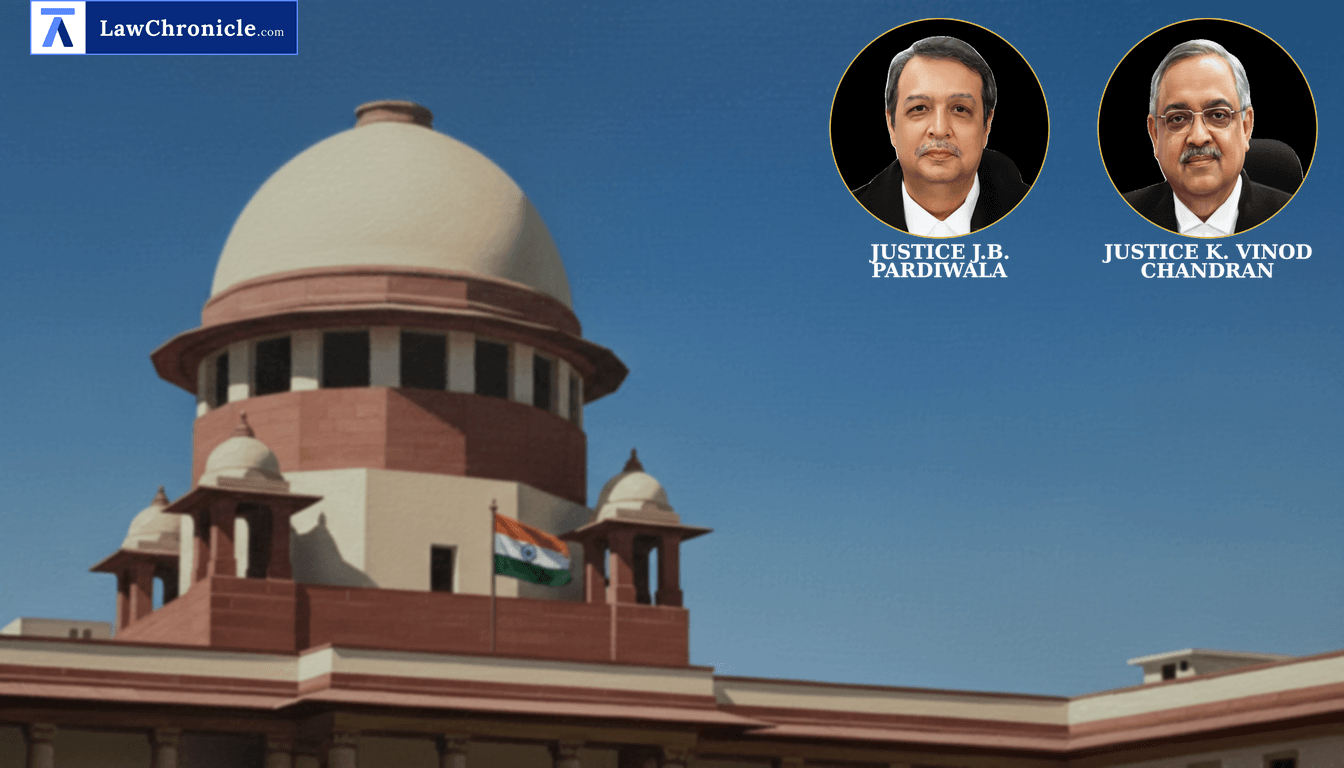
Erasing 22 years of incarceration based on flawed evidence, the Supreme Court delivered a scathing rebuke against procedural rigidity in criminal justice by setting aside a murder conviction founded on highly shaky eyewitness testimony.
A bench comprising Justice J.B. Pardiwala and Justice K. Vinod Chandran expressed deep dismay over the High Court's refusal to condone delay in jail appeals filed by convicts who have spent decades behind bars.
Key Takeaways
Proactive Approach in Liberty Matters: Constitutional Courts must adopt a proactive, rather than merely liberal, approach to condone delays in appeals against convictions that deprive citizens of basic liberty.
Judicious Exercise of Remission: Local opposition or law and order apprehensions cannot serve as an absolute bar against the State judiciously exercising its power of remission.
Rejection of Inadmissible Confessions: Confessions extracted through police coercion and third-degree methods remain wholly inadmissible under law.
Mandatory Resettlement Assistance: Legal service authorities and local administrations are duty-bound to attempt the active rehabilitation of individuals wrongfully incarcerated for decades.
Analyzing the evidentiary flaws, the Court highlighted how third-degree methods were deployed to extract inadmissible confessions while lower courts acted as mere mute spectators. The Court, in its reasoning, observed: "Three lives were snuffed out, having been bludgeoned to death, a person taken into custody on mere suspicion from whom a confession; though not admissible was extracted employing third-degree methods, the trial court fails to evaluate the evidence properly and the High Court remains a moot spectator while adding to the tally of disposals; cumulatively resulting in 22 years being erased out of a person’s life without any reliable evidence."
The Court has following directions:
"We deem it appropriate to direct the District Legal Services Authority, Koraput, State of Odisha to attempt rehabilitation or resettlement of the appellant for which the District Administration, headed by the District Collector shall assist."
Ratio
When a convict approaches a Constitutional Court in appeal against a conviction and sentence of life imprisonment, any delay in filing the appeal regardless of its length must be condoned proactively to safeguard fundamental liberty, especially when the underlying conviction rests on unreliable or legally inadmissible evidence.
Background
The case arose from the brutal murder of three women in a locality. The trial court convicted the appellant for murder under Section 302 of the Indian Penal Code primarily relying on the testimony of a single eyewitness, sentencing him to life imprisonment. The appellant suffered incarceration for 12 years before filing a jail memo of appeal along with an application seeking condonation of a 3157-day delay. The High Court rejected the delay condonation application and dismissed the appeal.
By the time the matter reached the Supreme Court, the appellant had spent 22 years in prison. The Supreme Court previously condoned the delay of 3703 days in filing the SLP and granted bail. Upon examining the evidence, the Apex Court observed glaring discrepancies: the sole eyewitness's testimony was highly improbable, the investigating officer failed to prepare a scene sketch, no bloodstains were found on the recovered weapons on FSL examination, and recovery witnesses testified that police beat the accused to extract a confession, rendering it inadmissible under Section 25 of the Indian Evidence Act, 1872. Statements recorded under Section 161 of the Code of Criminal Procedure, 1973 also suffered from major omissions. Finding that the prosecution failed to prove guilt beyond reasonable doubt, the Supreme Court allowed the appeal, set aside the conviction, and ordered immediate rehabilitation measures.
Case Details:
Case No.: Criminal Appeal No. of 2026 (@Special Leave Petition (Crl.) No.7128 of 2026)
Neutral Citation: 2026 INSC 802
Case Title: Arjun Jani @ Tuntun v. State of Orissa
Source: 2026 CaseBase(SC) 736
Similar Articles


 Breaking News


