


Delayed Compensation For Land Acquisition Violates Constitutional Right To Property: Rajasthan HC
 Copy Link
 Share
 Save
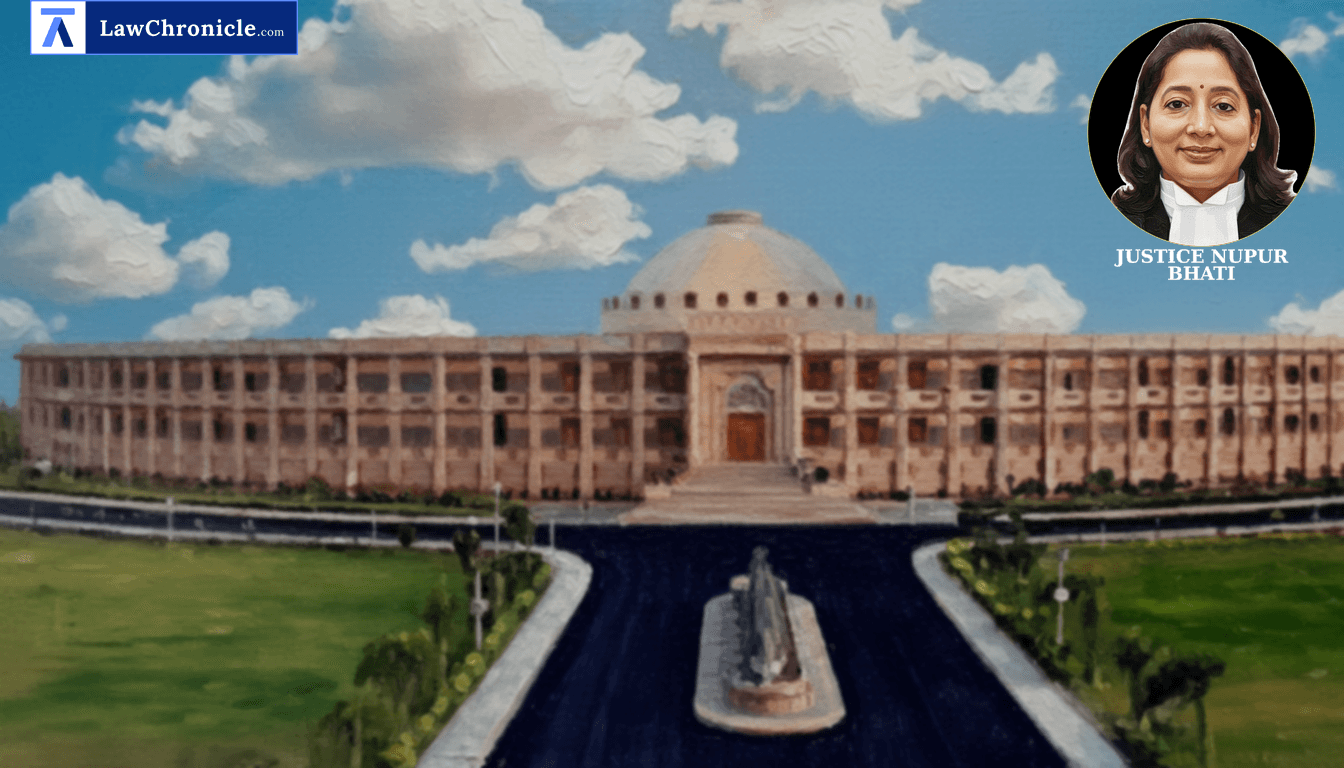
The Rajasthan High Court has reaffirmed that the state's power of eminent domain is inextricably linked to the obligation of providing prompt compensation, ruling that administrative lethargy in disbursing awards constitutes a substantive violation of human and constitutional rights. In a stern rebuke to state authorities, the court clarified that once an award is finalized, the government cannot withhold payments under the guise of internal correspondence or administrative deliberations.
Sitting at the Jodhpur Bench, Hon'ble Dr. Justice Nupur Bhati heard a writ petition filed by a senior citizen seeking the release of compensation for land acquired in District Pali for industrial development. The Bench noted that despite the land being recorded in the name of the Rajasthan State Industrial Development and Investment Corporation (RIICO) and construction commencing, the petitioner had not received a single penny.
Key Takeaways
Property Rights as Human Rights
In line with evolving jurisprudence, the Court held that the right to property under Constitution of India, 1950 is not just a constitutional right but a fundamental human right that protects citizens against the state's excess of power.
Time is of the Essence
Administrative delays in identifying land, evaluating objections, and disbursing payments are no longer mere procedural lapses but are deemed traumatic events that require efficient conclusion within a reasonable timeframe.
Absolute Obligation of the State
Once a statutory award is passed, the state’s obligation to pay becomes absolute; internal departmental disputes regarding the quantum of compensation cannot be used as a justification to stall disbursements to landowners.
Land Acquisition Compensation Right
While discussing the right to compensation for land acquisition aligned with constitutional right to property, the Rajasthan High Court expressed that "...the law is firmly established that State's power of eminent domain is not absolute but is inextricably linked to the obligation of providing fair and prompt compensation. Delay in the payment of compensation has consistently been viewed by Courts not merely as a procedural lapse, but as a substantive violation of the constitutional guarantee under Constitution of India, 1950 as well as the human rights of citizens... Time is of the essence in the payment of compensation, and the said proposition is inherent in the constitutional mandate of Constitution of India, 1950."
The Rajasthan High Court observed that the delay in payment of compensation constitutes a clear breach of the mandate of Constitution of India, 1950. Relying on the precedent set in Laxman Singh & Ors. Vs. The State of Rajasthan & Ors. ( "SBCWP No.2794/2026": 2026 CaseBase(RAJ) 6547), the Bench noted that withholding dues for years effectively makes a mockery of constitutional protections.
Ratio
The right to property, though no longer a fundamental right, remains a constitutional right under Constitution of India, 1950 and a human right. Once private land is acquired for a public purpose and compensation is determined under a statutory award, the State is under a bounden duty to ensure timely disbursal. Any delay caused by internal administrative correspondence regarding the quantum of the award is legally unjustifiable and violates the constitutional scheme.
Background
The petitioner, a 67-year-old woman, approached the High Court after her land in Village Nimli Brahman, Tehsil Rohat, was taken over by RIICO for industrial development. While the revenue records were mutated in favor of RIICO and construction work began, the compensation award remained stagnant. The petitioner argued that she was similarly situated to the litigants in Laxman Singh & Ors. Vs. The State of Rajasthan & Ors. ( "SBCWP No.2794/2026": 2026 CaseBase(RAJ) 6547), where the court had already intervened against the National Highways Authority of India for similar delays.
The Rajasthan High Court referred to several landmark Supreme Court rulings, including Kolkata Municipal Corporation & Anr. v. Bimal Kumar Shah & Ors. ( "(2024) 10 SCC 533": 2024 CaseBase(SC) 35), Urban Development Trust v. Vidhya Devi and Ors., and Tukaram Kana Joshi and Ors. thr. Power of Attorney Holder v. M.I.D.C. and Ors. ( "MANU/SC/0933/2012": 2012 CaseBase(SC) 437), to emphasize that the purchasing power of money dwindles over time due to inflation, and delayed payments cause double injury to uprooted landowners. Following the principles laid down in Bernard Francis Joseph Vas and Ors. vs. Government of Karnataka and Ors ( "Manu/SC/0001/2025": 2025 CaseBase(SC) 95) and Ultra-Tech Cement v. Mast Ram and Ors., the Rajasthan High Court allowed the writ petition and ordered the immediate release of funds.
Case Details:
Case No.: S.B. Civil Writ Petition No. 26709/2026
Neutral Citation: [2026:RJ-JD:53283]
Case Title: Raji Devi v. State of Rajasthan and Ors.
Appearances:
For the Petitioner(s): Ms. Harshita, Advocate
Source: 2026 CaseBase(RAJ) 30786
Similar Articles

 Breaking News


