


State Cannot Retain Private Property Without Lawfully Acquiring It: J&K High Court
 Copy Link
 Share
 Save
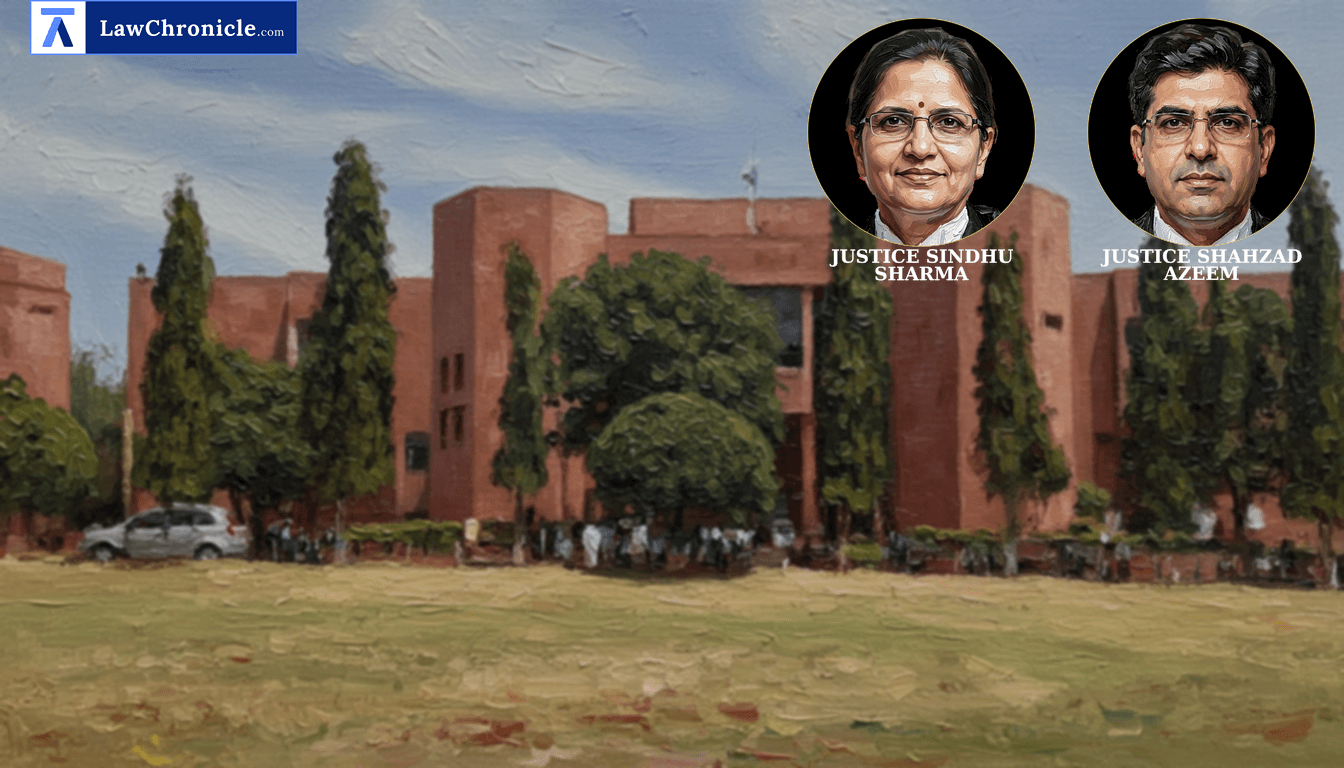
The Jammu and Kashmir and Ladakh High Court has delivered a scathing rebuke to state authorities for illegally occupying private land for public infrastructure, ruling that even the plea of 'voluntary donation' cannot validate the deprivation of property without a registered deed or statutory compensation. Affirming that the Right to Property is a human right, the court held that the state must either restore the land to the owner or pay requisite compensation, as delay and laches cannot be used as a shield to perpetuate a continuing violation of constitutional rights.
A Division Bench comprising Justice Sindhu Sharma and Justice Shahzad Azeem heard the intra-court appeal filed by the Union Territory of Jammu and Kashmir. The appellants challenged a Single Judge's order that had directed them to compensate a landowner whose property was utilized for constructing a Panchayat Ghar in 2004, allegedly on an unfulfilled assurance of providing him employment as a Chowkidar.
Key Takeaways
Constitutional Protection Overrides Administrative Delay
The court clarified that the plea of delay and laches cannot defeat a claim where the state has deprived a citizen of property without following due process of law, as such deprivation constitutes a continuing cause of action.
Validity of Oral Land Donations Rejected
State authorities cannot claim land was 'voluntarily donated' without producing cogent, legal material like a valid gift deed; mere resolutions by local inhabitants are not binding or sufficient for a transfer of title.
Right to Property as a Human Right
Reiterating the shift in legal jurisprudence, the court emphasized that property rights are now recognized as human rights under the Constitution of India, 1950, requiring strict adherence to the Rule of Law for any acquisition.
State's Obligation for Occupation Charges
Beyond just the market value of the land, the state is liable to pay rent or 'use and occupation charges' for the entire period it remained in unauthorized possession before formal acquisition.
Court's Observations on Right to Property and State Conduct
The Court, in its reasoning, observed: "The State cannot retain possession of private property and utilise the same for a public purpose without following the procedure established by law. The respondent being small land owner is deprived of his property without payment of any compensation till date. The respondent is, thus, entitled to payment of compensation as it has resulted in infraction of basic rights of Right to Property as guaranteed under Constitution of India, 1950 and is also entitled to use and occupation charges for the same."
The Bench further noted that there is no law permitting the deprivation of the property of citizens without compensation. It relied on Tukaram Kana Joshi and others Thr. Poa Holder v. M.I.D.C. and others to highlight that the right to property is a human right and part of a democratic body politic governed by the Rule of Law.
The Court has following directions:
"The appellants shall comply with the directions contained therein, including the direction for determination and payment of appropriate compensation in accordance with law and payment of rent for the use and occupation of the land."
Ratio
The State cannot deprive a citizen of their property except in accordance with the procedure established by law. In cases where the State takes possession of private land for public use without formal acquisition or payment of compensation, the cause of action is a continuing one, rendering the doctrine of delay and laches inapplicable. Any claim of 'voluntary donation' must be substantiated by valid and unconditional legal transfers; otherwise, the landowner is entitled to both the acquisition compensation and use and occupation charges under Article 300A of the Constitution of India, 1950.
Background
The dispute originated in 2004 when the Rural Development Department took over 2 Kanals of the respondent's land in Rajouri for a Panchayat Ghar. The respondent claimed he surrendered the land based on an assurance of a government job, which never materialized. Conversely, the State argued the land was a voluntary gift made in the presence of a Sarpanch and that the petition filed in 2010 was barred by delay.
The Court examined the precedent in Vidya Devi v. State of Himachal Pradesh & Ors. ( "(2020) 2 SCC 569": 2020 CaseBase(SC) 1040), which established that condonation of delay is a matter of judicial discretion when fundamental rights are breached. It also referred to Chuni Lal Bhagat v. State of J&K and another, where a Division Bench held that gift deeds executed based on unfulfilled assurances of employment are invalid. Finding that the State failed to prove an unconditional gift, the Court dismissed the appeal and upheld the Single Judge's direction to compensate the owner and pay arrears of rent.
Case Details:
Case No.: LPA No. 17/2024
Case Title: UT of Jammu and Kashmir & Ors. Vs. Parkash Chand & Anr.
Appearances:
For the Petitioner(s): Mr. Ravinder Gupta, AAG.
For the Respondent(s): Mr. Ashok Sharma, Advocate.
Source: 2026 CaseBase(JK) 1066
Similar Articles
 Breaking News


