


Delayed Tender Challenges Cannot Stall Procurement Timelines: SC
 Copy Link
 Share
 Save
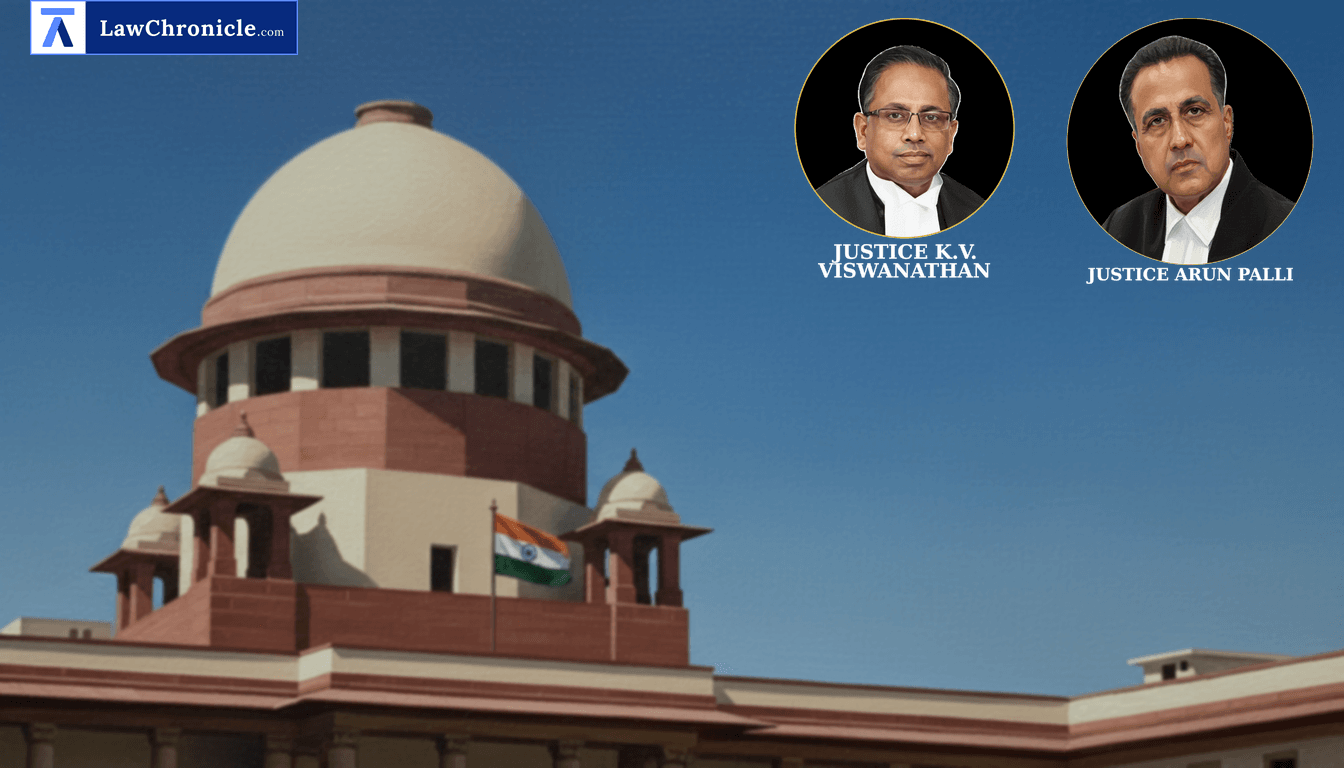
In a decisive check on delayed legal challenges against public procurement, the Supreme Court ruled that laches in tender disputes must be measured against the progression of the tender process rather than calendar time alone. The decision ensures that late-stage judicial intervention does not derail public infrastructure procurement meant for institutional beneficiaries.
A bench of Justice K.V. Viswanathan and Justice Arun Palli affirmed the judgment of the Delhi High Court, dismissing appeals filed against the rejection of writ petitions challenging tender conditions set by the Directorate of Education, Government of NCT of Delhi.
Key Takeaways
- Progression Over Calendar Time: Courts will measure delay in tender challenges based on the progress of the procurement process rather than mere passage of days.
- Prompt Action Mandatory: Bidders perceiving eligibility conditions as discriminatory must move the court immediately upon publication of the tender.
- Protection of Third-Party Interests: Judicial discretion will not be exercised to stall tenders when participating bidders have already acquired interests through technical and financial evaluations.
The Supreme Court highlighted that the primary grievance regarding tender eligibility accrues on the exact date of publication. The Court observed that discretionary relief under Article 226 of the Constitution of India, 1950 cannot extend to litigants who delay action while the procurement landscape materially changes.
The Court, in its reasoning, observed: "Delay in public procurement, whether goods or services, is not just to be measured against the calendar for the purposes of limitation but as against the progression of the process. Time is of extreme essence in such cases for they involve a larger public interest, and consist of multiple and complex stages of evaluation. Judicial discretion, therefore, must be exercised with extreme circumspection to ensure that fence–sitters, proxies, and unscrupulous litigants who bring a challenge at an advanced stage, are not allowed to disrupt an ongoing process."
Addressing the challenge to operational requirements like local office presence, the Court distinguished the precedent in Vinishma Technologies Pvt. Ltd. v. State of Chhattisgarh & Anr. ( "2025 INSC 1182": 2025 CaseBase(SC) 1114). The Court held that operational conditions having a rational nexus with prompt installation, servicing, and safety for school children do not automatically amount to exclusionary barriers.
Ratio
Delay in challenging tender conditions is determined by the stage and progression of the procurement process rather than mere calendar time. Courts will not entertain belated challenges to published eligibility criteria at advanced evaluation stages when third-party rights have accrued and public interest is adversely affected.
Background
The dispute arose from seven tenders issued by the Directorate of Education, Delhi, for procuring sports equipment and outdoor gymnasium items worth approximately Rs. 34 Crores for government schools. The appellants challenged conditions including past performance criteria, office/warehouse requirements in Delhi/NCR, sample submissions, and the lack of Micro and Small Enterprises relaxations under the Public Procurement Policy MSE Order (2012).
The appellants approached the High Court nearly four months after the publication of the notices, by which time technical evaluations were advanced and certain contracts were awarded. The High Court dismissed the writ petition on grounds of delay, non-participation, and lack of merit in the gym tender challenge, citing principles from Gaurav Enterprises v. GTB Hospital & Anr..
The Supreme Court upheld the High Court's dismissal, leaving open the broader question regarding the validity of local operational clauses like Clause 2.17 for an appropriate future proceeding.
Case Details:
Case No.: Civil Appeal No. 10772 of 2026
Neutral Citation: 2026 INSC 881
Case Title: M/s. Utkarsh Enterprises & Ors. v. Union of India & Ors.
Appearances:
For the Petitioner(s): Mr. Raju Ramachandran, Sr. Adv., Ms. Aanchal Basur, Adv.
For the Respondent(s): Ms. Swati Ghildiyal, Adv.
Source: 2026 CaseBase(SC) 803
Similar Articles

 Breaking News


