


Delhi HC: Courts Cannot Carve Out Claims Not Pleaded Before Arbitral Tribunal
 Copy Link
 Share
 Save
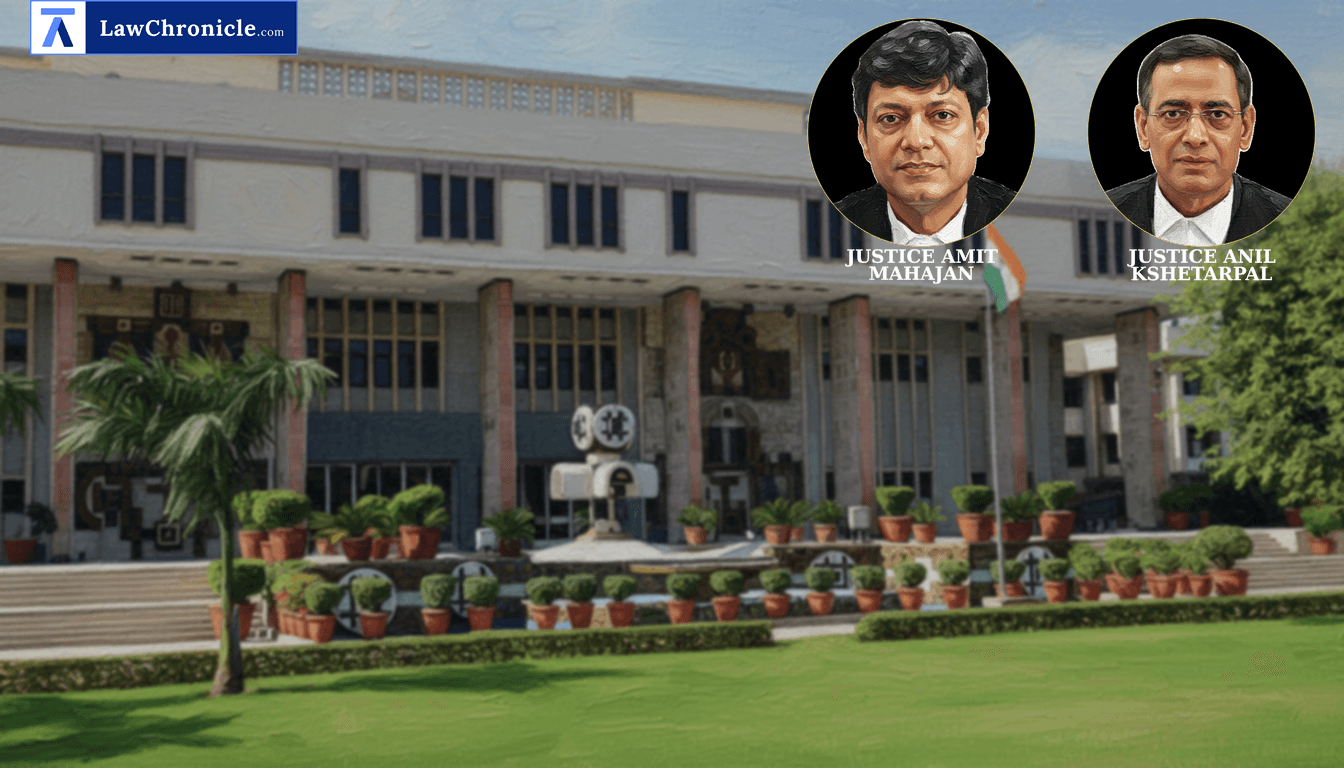
The Delhi High Court set aside a Single Judge's order that had partially interfered with an arbitral award, clarifying that courts exercising jurisdiction under Arbitration and Conciliation Act, 1996 cannot restructure claims or adjudicate components that were never specifically pleaded or independently urged before the Arbitrator.
A Division Bench comprising Justice Anil Kshetarpal and Justice Amit Mahajan heard the appeal challenging a decision that had bifurcated a consolidated claim for outstanding dues. The Court emphasized that judicial review under Section 34 must remain within the confines of the original pleadings and cannot be used to permit a party to set up a case not argued during the arbitration proceedings.
The Limits of Judicial Review under Section 34
The Court observed that the learned Single Judge had exceeded the permissible contours of interference by segregating a specific amount from a larger claim and treating it as an independent, arbitrable component, despite the claimant having specifically tied the entire amount to a post-contractual period. The Bench noted that such an approach amounts to an impermissible reappreciation of evidence and a departure from the limited scope of Arbitration and Conciliation Act, 1996.
The Court, in its reasoning, observed: "Once the Respondent itself confined Claim A to alleged outstanding dues for the period from 01.09.2014 to 15.01.2015, the Arbitral Tribunal was required to adjudicate the claim as framed. The Tribunal could not be faulted for failing to return findings on an alleged claim relating to the period prior to 31.08.2014 when no such claim had been independently pleaded, quantified or pressed before it. Consequently, the premise on which the learned Single Judge proceeded, namely that the Tribunal omitted to adjudicate such claim, is itself unsustainable."
Restoration of the Arbitral Award
The Bench further noted that the Arbitral Tribunal had provided sufficient reasoning by relying on bank statements and emails to conclude that all valid invoices had been cleared. Relying on the principles in Dyna Technologies Pvt. Ltd. v. Crompton Greaves Ltd. ( "(2019) 20 SCC 1": 2019 CaseBase(SC) 2340), the Court held that brief reasoning is not a ground for setting aside an award as long as the logic is intelligible. The Court has following directions:
"The present Appeal is allowed. The Impugned Order dated 18.02.2022 passed by the learned Single Judge is set aside. Consequently, the arbitral award dated 06.08.2019 stands restored; it being held that the same does not suffer from any infirmity warranting interference under Section 34 of the Act. The pending application also stands disposed of."
Background:
The dispute arose from a Service Agreement dated 09.08.2011 between the Appellant (a manufacturer) and the Respondent (a logistics firm). The agreement expired on 31.08.2014, but the Respondent claimed dues for services allegedly rendered until January 2015. Before the Arbitrator, the Respondent (Shine Travels) specifically claimed Rs. 26,79,927.22 for the period between September 2014 and January 2015.
The Arbitral Tribunal rejected all claims, holding that the post-expiry period was not covered by the arbitration clause and that, in any case, payments were proven by bank records. However, in a petition under Section 34 of Arbitration and Conciliation Act, 1996, the Single Judge found that approximately Rs. 11.49 Lakhs of that claim actually related to the pre-expiry period and set aside the award to that extent for failure to adjudicate forgery allegations regarding those specific invoices.
The Division Bench, acting under Section 37 of Arbitration and Conciliation Act, 1996 read with Section 13(1A) of the Commercial Courts Act, 2015, found that since the Respondent had explicitly labeled the entire claim as post-expiry in its pleadings, the Single Judge could not re-characterize it to find a flaw in the Tribunal's award. Relying on Gayatri Balasamy v. ISG Novasoft Technologies Ltd. regarding the severability of awards, the Court concluded that the Single Judge had restructured the claim in a manner not traceable to the grounds under Section 34(2) of the Act.
Case Details:
Case No.: FAO(OS)(COMM) 149/2022 & CM APPL. 27421/2022
Case Title: MITSUI PRIME ADVANCED COMPOSITES INDIA PRIVATE LIMITED v. SHINE TRAVELS & CARGO PVT. LTD.
Appearances:
For the Petitioner(s): Mr. R. Jawahar Lal, Mr. Sayyam Maheshwari, Advs.
For the Respondent(s): Mr. A K Pandey, Ms. Aayushi Pandey, Advs.
Source: 2026 CaseBase(DEL) 466
Similar Articles

 Breaking News


