Delhi HC: Registration Not Mandatory for Family Settlement Recording Past Oral Partition
 Copy Link
 Share
 Save
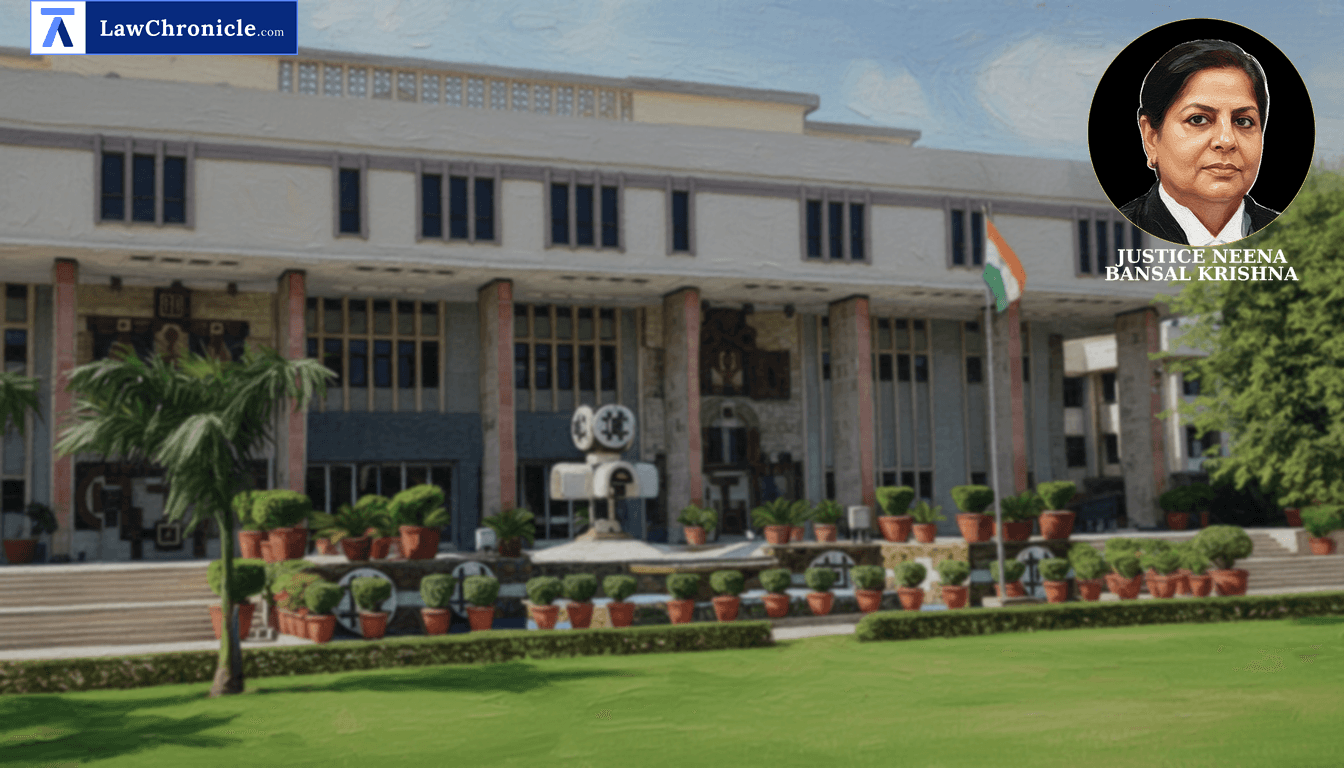
The Delhi High Court, through a bench of Justice Neena Bansal Krishna, restored a trial court decree for possession, emphasizing that family settlements recording past oral partitions do not require compulsory registration. The court observed that such documents merely record a pre-existing arrangement intended to maintain family peace and do not create new rights in immovable property.
Justice Neena Bansal Krishna heard the Regular Second Appeal challenging the First Appellate Court's decision, which had reversed a trial court's order for possession in a dispute between brothers. The central issue revolved around the validity of an oral family settlement supported by a subsequent memorandum and its admissibility as evidence under the Registration Act, 1908.
Court Affirms Validity of Unregistered Family Settlements
The High Court held that the First Appellate Court erred in ignoring overwhelming documentary evidence, including municipal records and electricity connections, which proved that a partition had occurred. The Court noted that a memorandum of family settlement is a mere recital of facts and does not require registration under Section 17 of the Registration Act, 1908 if it records a past transaction.
The Court has the following directions:
"The impugned Judgment dated 17.09.2013 of learned ADJ in Regular First Appeal is hereby, set aside and the Decree passed by learned Civil Judge decreeing the Suit for Possession of the Plaintiff, is hereby, restored. The Appeal is accordingly, allowed and the Suit of the Plaintiff/Appellant for possession, is hereby decreed."
Legal Rationale on Antecedent Title
The Court, in its reasoning, observed: "It is well settled that compromise or family arrangement is based on the assumption that there is an antecedent title of some sort in the parties and the agreement acknowledges and defines what that title is, each party relinquishing all claims to property other than that falling to his share and recognising the right of the others... no conveyance is required in these cases to pass the title from the one in whom it resides to the person receiving it under the family arrangement."
The Court further relied on Kale and Others vs. Deputy Director of Consolidation and Ors. to clarify that the object of such arrangements is to protect the family from long-drawn litigation and perpetual disputes. It reiterated that even if a family arrangement is not registered, it acts as an estoppel to prevent members from revoking the arrangement if they have already acted upon it, as held in Ravinder Kaur Grewal.
Background:
The dispute involved four brothers who jointly purchased land in 1954. The Plaintiff, Dhanpat Rai Gupta, alleged that an oral family settlement in 1986 allotted specific portions to each brother. He claimed that he constructed two shops, but Defendant No. 1, Kashmiri Lal Gupta, forcibly dispossessed him from one shop and an adjoining area in 1992. The Plaintiff sought relief under Sections 6 and 9 of the Specific Relief Act, 1963.
While the trial court decreed the suit in favor of the Plaintiff based on the 1986 Memorandum of Settlement and conduct of the parties, the First Appellate Court reversed the decree, citing a lack of registration of the settlement document and insufficient evidence of exclusive allotment. The High Court, however, found that the brothers had acted independently by paying separate house taxes and obtaining individual electricity meters, thereby confirming the oral partition. The Court applied the Code of Civil Procedure, 1908 to evaluate the findings of fact and law, ultimately setting aside the appellate judgment.
Case Details:
Case No.: RSA 266/2013 & CM APPL. 19811/2013
Case Title: Shri Dhanpat Rai Gupta v. Shri Kashmiri Lal Gupta (Since Deceased) & Ors.
Appearances:
For the Petitioner(s): Mr. Dalip Kumar Malhotra and Mr. Rajesh Kumar Malhotra, Advs.
For the Respondent(s): Mr. Kunwar Karan and Sourabh Dhall, Advs. for R-4 & R-5; Mr. Shekhar Dasi, Mr. Mohd Talha, Mr. Ayush Dassi and Mr. Divyansh Malhotra, Advs. for LR’s R-1.
Source: 2026 CaseBase(DEL) 452
Similar Articles
 Breaking News