


Delhi HC: Unilateral Legal Notices Cannot Resurrect Time-Barred Claims
 Copy Link
 Share
 Save
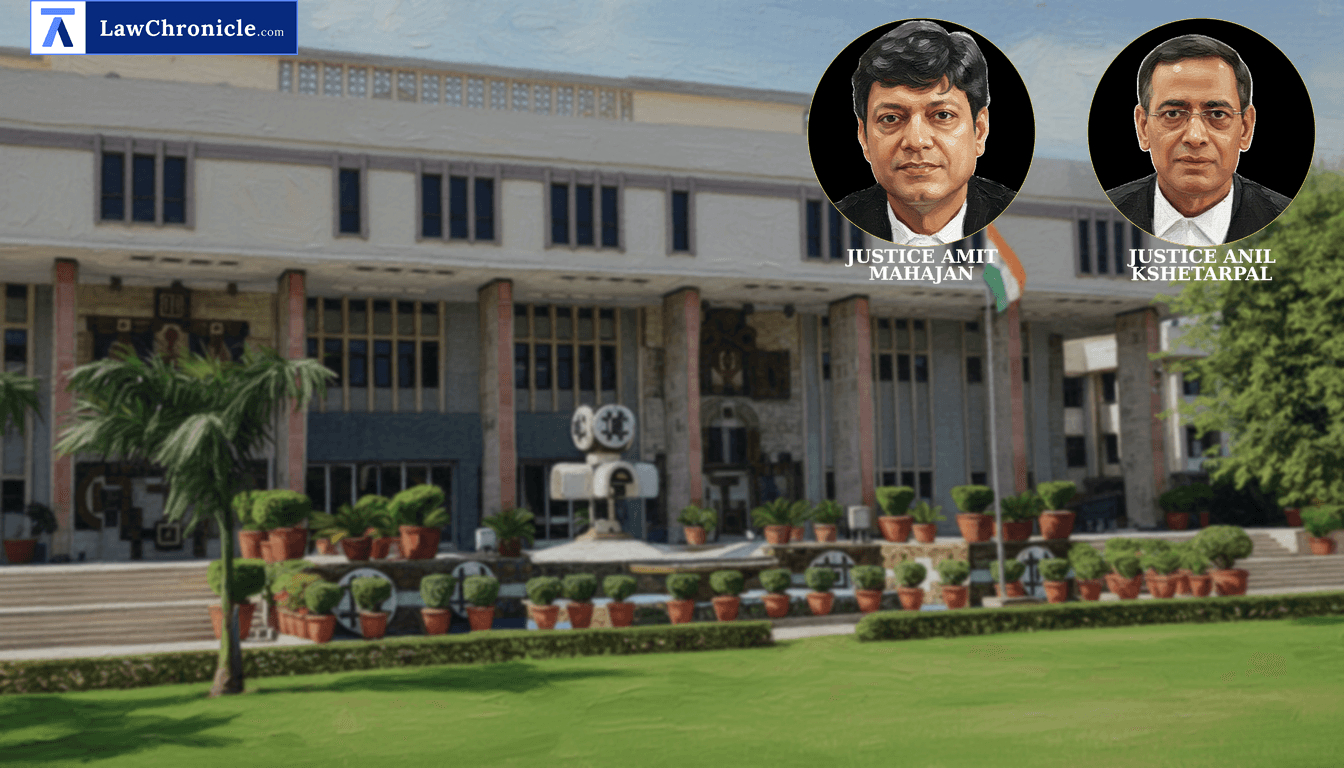
Clever drafting and unilateral legal notices cannot transform a dead claim into a live one, as the law assists the vigilant and not those who slumber over their rights. The Delhi High Court has reinforced that limitation for the price of goods sold on credit runs strictly from the expiry of the contractually agreed credit period, regardless of subsequent demands or refusals.
A Division Bench of Justice Anil Kshetarpal and Justice Amit Mahajan heard the appeal against a commercial court order which had rejected a recovery suit at the threshold. The Appellant, a cement and RMC manufacturing company, challenged the dismissal of its suit for outstanding dues of approximately Rs. 69.72 Lakhs, which the trial court found to be barred by limitation.
The Mandate of Order VII Rule 11 and Limitation
The Court rejected the Appellant's contention that limitation is always a mixed question of fact and law that requires a full trial. Relying on Saleem Bhai v. State of Maharashtra ( "(2003) 1 SCC 557": 2002 CaseBase(SC) 394), the Bench noted that where the plaint and documents disclose an unimpeachable chronology showing the suit is barred, the Court is not obliged to put parties through a trial.
In its reasoning, the Court observed: "Clever drafting cannot create an illusion of a cause of action where none survives. Where the plaint and the documents annexed to it disclose an unimpeachable chronology from which the bar of limitation is manifest, the Court is not obliged to put the parties through the expense and delay of a trial which can have but one outcome."
The Bench clarified the distinction between Shakti Bhog Food Industries Limited v. Central Bank of India ( "(2020) 17 SCC 260": 2020 CaseBase(SC) 1366) and the present matter, noting that while Shakti Bhog Food Industries Limited v. Central Bank of India ( "(2020) 17 SCC 260": 2020 CaseBase(SC) 1366) involved a residuary article (Article 113) with no objective trigger, the present case is governed by Article 15 of the Limitation Act, 1963, which fixes the starting point by a contractually stipulated event.
Recurring vs Continuing Cause of Action
One of the primary legal questions was whether non-payment under a running account constitutes a 'continuing wrong' under Section 22 of the Limitation Act, 1963. The Court, citing Union of India v. Tarsem Singh ( "(2008) 8 SCC 648": 2008 CaseBase(SC) 607) and Balakrishna Savalram Pujari Waghmare v. Shree Dhyaneshwar Maharaj Sansthan ( "AIR 1959 SC 798": 1959 CaseBase(SC) 202), distinguished between the injury and its effects.
The Court, in its reasoning, observed: "The wrongful act complained of is the failure to pay a sum which fell due upon the expiry of a defined credit period. That failure is complete on the day the credit period expires. What persists thereafter is not the injury but its effect - the Appellant remains out of its money, and its books continue to reflect a debit. The Appellant confuses the wound with the scar."
Applying principles from M.R. Gupta v. Union of India ( "(1995) 5 SCC 628": 1995 CaseBase(SC) 984), the Bench held that each supply under the weekly billing system created a separate, recurring cause of action rather than one continuous breach.
Impact of Legal Notices and COVID-19 Extensions
The Court dismissed the argument that a reply to a legal notice refusing payment constitutes the 'starting point' for limitation. Following M/s J.M. Construction Pvt. Ltd. v. Smt. Krishna Sachdev & Ors and Greatech Fashions v. S.K. Industries, the Bench held that the issuance of a legal notice does not lead to the commencement of a fresh period of limitation. Furthermore, an acknowledgment under Section 18 of the Limitation Act, 1963 must be made before the expiry of the prescribed period. Since the Respondent's reply was issued after the limitation had already run out, it could not resurrect the claim as per Khan Bahadur Shapoor Fredoom Mazda v. Durga Prasad Chamaria ( "AIR 1961 SC 1236": 1961 CaseBase(SC) 392).
Regarding the pandemic-era extension granted by the Supreme Court in In Re: Cognizance for Extension of Limitation, the Bench calculated that even with the benefit of ninety days from March 1, 2022, the suit filed in October 2023 was delayed by nearly seventeen months.
The Court has following directions:
"Consequently, the appeal is dismissed and the Impugned Judgment and decree dated 19.04.2024 is upheld. Pending applications, if any, stand disposed of."
Key Takeaways:
Statutory Triggers Overrule General Demands
In commercial contracts for goods sold on credit, limitation starts strictly when the credit period expires as per Article 15 of the Limitation Act, not when a party eventually demands payment.
Non-Payment is Not a Continuing Wrong
Failure to pay a debt is a completed breach on the due date; the subsequent financial loss is merely an effect, meaning the limitation clock does not reset daily.
Legal Notices are Not Lifeboats
Unilateral legal notices issued after the limitation period has expired cannot reset the clock or serve as a 'fresh' cause of action to bypass Order VII Rule 11 of the CPC.
Acknowledgment Rules are Strict
For a document to extend limitation under Section 18, it must be signed within the original limitation period and must admit a subsisting jural relationship of debtor and creditor.
Ratio Decidendi:
In suits for the price of goods sold and delivered with a fixed period of credit, the period of limitation under Article 15 of the Schedule to the Limitation Act, 1963, commences on the date of expiry of such credit period. The non-payment of such contractual dues constitutes a recurring, rather than a continuing, cause of action. A unilateral legal notice or a reply thereto denying liability issued after the expiry of the prescribed period cannot extend limitation or serve as an acknowledgment of debt under Section 18 of the Act.
Background:
The Appellant, M/s Prism Johnson Limited, supplied various grades of concrete to the Respondent for the construction of a school in Gurugram. The contract provided for weekly billing with a 60-day credit period. The last payment entry in the running account was dated March 6, 2018. In December 2021, the Appellant issued a legal notice for unpaid dues of over Rs. 69 Lakhs, to which the Respondent replied on December 30, 2021, disputing the quality of goods and denying liability. The Appellant filed a commercial suit in October 2023 after pre-institution mediation under the Commercial Courts Act, 2015 failed. The Commercial Court rejected the plaint under Order VII Rule 11 of the Code of Civil Procedure, 1908, holding the suit was barred by limitation since the cause of action accrued in 2018. The High Court upheld this finding, noting that even with COVID-19 limitation extensions, the suit was significantly delayed.
Case Details:
Case No.: RFA(COMM) 383/2024
Case Title: M/S Prism Johnson Limited V. M/S Master Nihal Singh Memorial Education Society
Appearances:
For the Petitioner(s): Ms. Nimisha Sharma, Adv.
For the Respondent(s): Mr. P.K. Agrawal, Mr. Akshay Chitkara, Ms. Sanjoli Gupta and Mr. Rishabh Tomar, Advs.
Source: 2026 CaseBase(DEL) 507
Similar Articles

 Breaking News


