


Plaint Barred by Limitation Must Be Rejected Under Order VII Rule 11: SC
 Copy Link
 Share
 Save
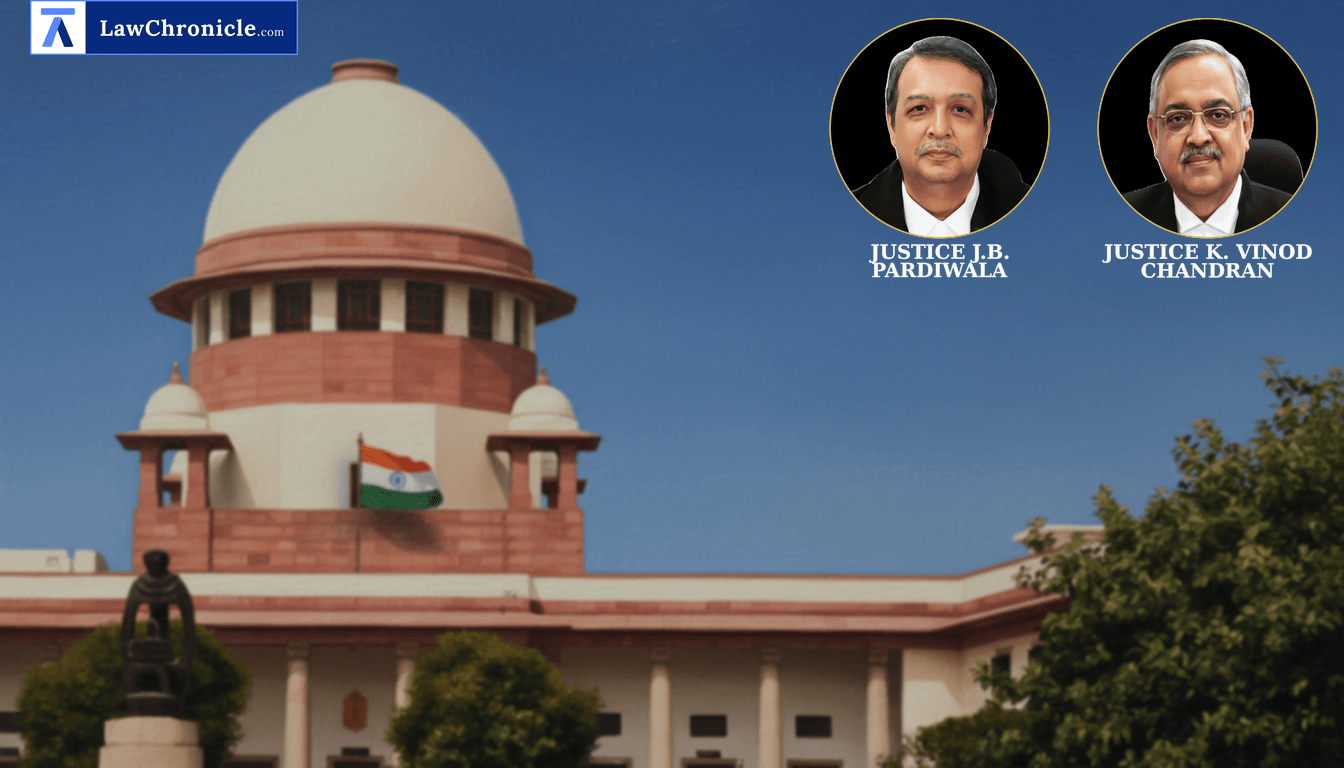
Where time-bar is obvious from the face of the plaint averments, courts cannot hesitate to nip the suit in the bud by rejecting the plaint under Order VII Rule 11. Severely reprimanding trial courts for ignoring glaring admissions of delayed causes of action in property litigation, the Supreme Court has ruled that self-serving public notices cannot extend statutory limitation periods to save a hopelessly delayed suit.
A bench of Justice J. B. Pardiwala and Justice K. Vinod Chandran set aside the concurrent findings of the Trial Court and the High Court which had refused to reject a suit under Order VII Rule 11. The bench held that while limitation is generally a mixed question of fact and law, a plaint is liable to be rejected at the threshold if the cause of action disclosed in the pleading itself demonstrates that the suit is filed beyond the prescribed period of limitation.
Key Takeaways
Threshold Rejection of Time-Barred Suits: Courts must strictly enforce Order VII Rule 11 when the plaint averments themselves reveal that the relief sought is barred by limitation.
Subsequent Disputes Do Not Extend Limitation: Letters, notices, or communications reiterating an existing dispute arising from the initial cancellation of a contract do not create a fresh cause of action.
Public Notices Do Not Reset Time Limits: Issuing a public notice to caution third parties against purchasing disputed property is a self-serving act that does not restart the statutory limitation clock.
The Supreme Court observed that when evaluating an application under Order VII Rule 11, the court must exclusively examine the averments in the plaint and the documents annexed therewith. Emphasizing the principles laid down in Shri Mukund Bhavan Trust v. Shrimant Chhatrapati Udayan Raje Pratapsinh Maharaj Bhonsle and Another ( "(2024) 15 SCC 675": 2024 CaseBase(SC) 876), the bench reiterated that courts should not hesitate to grant relief when a suit is glaringly barred by time on the face of the record.
The Court, in its reasoning, observed: "...when an application to reject the plaint is filed, the averments in the plaint and the documents annexed therewith alone are germane... Keeping in mind the position of law that limitation is a mixed question of fact and law, found the facts arising therein, glaring from the plaint averments itself and held the suit to be hopelessly barred by limitation. It was held that the Court cannot be hesitant in granting relief of rejection of a plaint when it is so obvious from the pleadings itself."
The Court issued the following directions:
"The plaint filed in O.S. No.632 of 2022 between the parties pending in Additional District and Sessions Judge, Chengalpattu, shall stand rejected."
Ratio
Under Order VII Rule 11, a plaint is liable to be rejected as barred by law if the cause of action set out in the plaint itself shows that the suit was instituted beyond the period of limitation, and subsequent communications or self-serving public notices reiterating the original cause of action do not give rise to a fresh or extended period of limitation.
Background
The dispute originated from two Joint Venture Agreements entered into on August 18, 2014, for the development of two vacant plots measuring 4,800 sq. ft. to construct eight flats. Under the agreements, the original property owner was to receive 56% of the super built-up area, while the developer respondent was entitled to the remaining 44% share in both the land and the super built-up area. Asserting that construction was not completed within the stipulated 15-month timeframe, the appellant cancelled the joint venture agreements via written communication on April 20, 2016, followed by a lawyer's notice on July 22, 2016.
Despite ongoing disputes and notices exchanged in 2016, the respondents filed the civil suit (O.S. No. 632 of 2022) only in October 2022 seeking division and allotment of their 44% share. The appellant filed an application under Order VII Rule 11 for rejection of the plaint on the ground of limitation. The Trial Court rejected the application, holding that limitation was a mixed question of fact and law requiring trial, which was subsequently confirmed by the High Court.
Reversing both lower court decisions, the Supreme Court noted that according to Paragraph 17 of the plaint itself, the primary cause of action arose on April 20, 2016, when the cancellation letter was sent. Subsequent exchanges of legal notices in 2016 only highlighted the dispute and did not create fresh causes of action. The public notice issued by the respondent on June 8, 2022, was merely a self-serving act and could not reset the clock. Consequently, the Supreme Court allowed the appeal and rejected the plaint.
Case Details:
Case No.: Civil Appeal No.11194 of 2026 (Arising out of SLP (C) No.23279 of 2025)
Neutral Citation: 2026 INSC 908
Case Title: N Asha Devi v. R Aravind Kumar & Anr.
Appearances:
For the Petitioner(s): Sri A. K. Ganguli, Senior Advocate
For the Respondent(s): Sri M. S. Ganesh, Senior Advocate
Source: 2026 CaseBase(SC) 911
Similar Articles
 Breaking News


