


Dharmasthala Rape-Murder Case: Supreme Court Orders De Novo Probe by SIT
 Copy Link
 Share
 Save
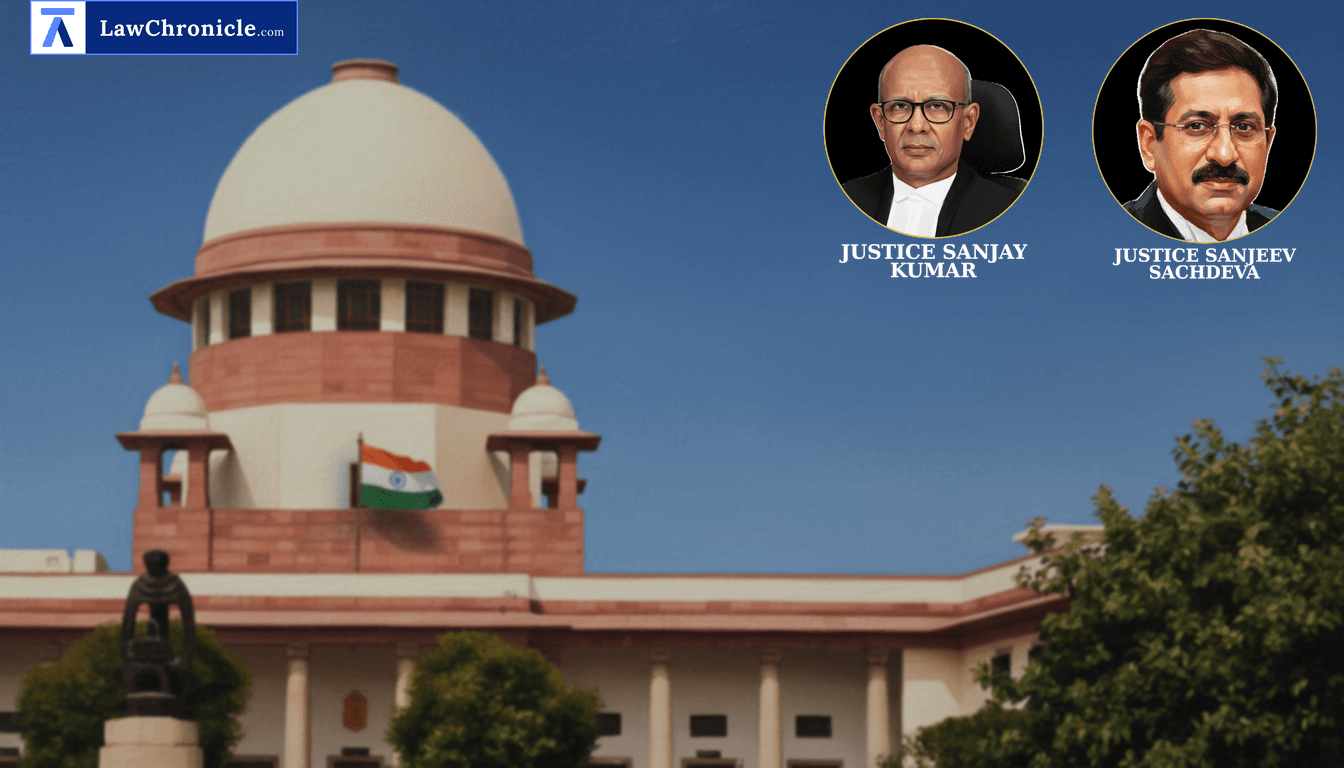
Exposing a shocking pattern of institutional inertia and flawed investigations that shielded real perpetrators in Dharmasthala case of brutal rape and murder, the Supreme Court has set aside the High Court order and ordered a de novo investigation by a Special Investigation Team. Asserting that a fair investigation is an indispensable component of the right to life guaranteed under Constitution of India, the Apex Court held that severe investigative lapses cannot be brushed aside under the guise of lost evidence at the golden hour.
A Division Bench comprising Justice Sanjay Kumar and Justice Sanjeev Sachdeva delivered the judgment, setting aside the Karnataka High Court's dismissal of a writ petition seeking a fresh probe into the gruesome rape and murder of a 17-year-old girl.
Key Takeaways
- Constitutional Right To Fair Probe: Reaffirmed that fair investigation is an intrinsic part of Constitution of India, without which a criminal trial remains inherently flawed.
- Mandate For De Novo Investigation: Established that Constitutional Courts hold dynamic powers to direct fresh or de novo investigations even post-trial acquittals to prevent a complete miscarriage of justice.
- Preservation Of Biological Clues: Overruled the High Court's presumption on lost evidence, noting that preserved physical materials and DNA samples are still capable of establishing forensic matches.
- Protection Against Double Jeopardy: Explicitly shielded an earlier acquitted accused under Constitution of India and Section 300 of the Code of Criminal Procedure from re-investigation or fresh prosecution.
Supreme Court on Dharmasthala Rape-Murder Case
The Supreme Court observed with grave concern that the manner in which various investigative agencies gathered and evaluated evidence shocked the conscience of the Court. The Bench took note of the brutality in Dharmasthala rape and murder case while expressing concern that "In a case where a minor girl of 17 years of age is brutally raped and murdered, the manner in which the investigation had progressed and the manner in which the various investigating agencies conducted the investigation and gathered and evaluated the evidence shocks the very conscience of the court. The person who was prosecuted was held to be incapable of committing the offence. Clearly the investigation has been conducted in a manner that causes injustice to the victim. The possibility of the real culprit(s) manipulating the investigation cannot be ruled out. Such lax and improper investigation gives premium to the Investigating Officers who failed to do their job correctly and diligently."
The Apex Court accordingly directed de novo investigation in the case, and constitution of a Special Investigation Team while excluding any investigating officer or team who has been associated with the previous investigation. The order restricts any interference with the investigation so that it is not tainted like the earlier one.
Ratio
Where a Constitutional Court finds that a criminal investigation was conducted in a tainted, biased, or highly defective manner that actively shielded the real perpetrators, the commencement or conclusion of a trial does not operate as an absolute bar against ordering a de novo investigation by an independent body to uphold the rule of law and prevent a failure of justice.
Background
In October 2012, a 17-year-old college girl went missing and her body was recovered the following day in a half-naked condition with strangulation marks in Mannasanka, Belthangady. The local police subsequently registered offences under Section 376 and Section 302 of the Indian Penal Code. Local residents apprehended one Santhosh Rao, who was projected by local police as the perpetrator. However, the victim's family consistently maintained that three influential local persons were involved and that Rao was falsely implicated.
Due to public outcry, the investigation was handed over first to the CID and subsequently to the CBI. Both agencies filed chargesheets blaming Santhosh Rao while giving a clean chit to the three suspects. During the trial, the trial court acquitted Santhosh Rao, observing that he suffered from phimosis, making the crime improbable, that crucial evidence like vaginal swabs were allowed to disintegrate, and that key physical evidence like dry school bags at the rainy spot suggested the crime occurred elsewhere.
Following the trial court's acquittal, the victim's father approached the Karnataka High Court under Article 226 of the Constitution of India and Section 482 of the Code of Criminal Procedure seeking a re-investigation. Though the High Court acknowledged that the facts demanded re-investigation, it dismissed the plea relying on Popular Muthiah vs State, reasoning that evidence lost during the golden hour could not be recovered. The petitioner subsequently appealed to the Supreme Court.
Analyzing precedents including Vinay Tyagi vs Irshad Ali @Deepak and Others ( "(2013) 5 SCC 762": 2012 CaseBase(SC) 863), Neetu Kumar Nagaich v. State of Rajasthan ( "(2020) 16 SCC 777": 2020 CaseBase(SC) 1812), Kashmeri Devi v. Delhi Admn., Babubhai v. State of Gujarat, Bharati Tamang v. Union of India ( "(2013) 15 SCC 578": 2013 CaseBase(SC) 972), Zahira Habibulla H. Sheikh v. State of Gujarat ( "(2004) 4 SCC 158": 2004 CaseBase(SC) 708), Pooja Pal v. Union of India ( "(2016) 3 SCC 135": 2016 CaseBase(SC) 504), Rattiram v. State of M.P. ( "(2012) 4 SCC 516": 2012 CaseBase(SC) 598), Dharam Pal v. State of Haryana ( "(2016) 4 SCC 160": 2016 CaseBase(SC) 634), and Section 173(8) read with Section 178(3) of the Code of Criminal Procedure as cited in Hasanbhai Valighai Qureshi Vs. State of Gujarath and Others ( "AIR 2004 SC 2078": 2004 CaseBase(SC) 97), the Supreme Court held that the High Court erred in holding that no useful purpose would be served. It pointed out that physical evidence containing DNA and hair samples was still preserved under Section 27 of the Indian Evidence Act and could be subjected to forensic comparison, thus allowing the appeal.
Case Details:
Case No.: Criminal Appeal No. 2026 (@ Special Leave Petition (Crl.) No. 5763 of 2026)
Neutral Citation: 2026 INSC 1030
Case Title: Kusumavati Gowda v. The Government of Karnataka & Ors.
Source: 2026 CaseBase(SC) 7019
Similar Articles
 Breaking News


