


SC: High Court Cannot Convert Revision To Appeal To Overturn Acquittal Without Cause
 Copy Link
 Share
 Save
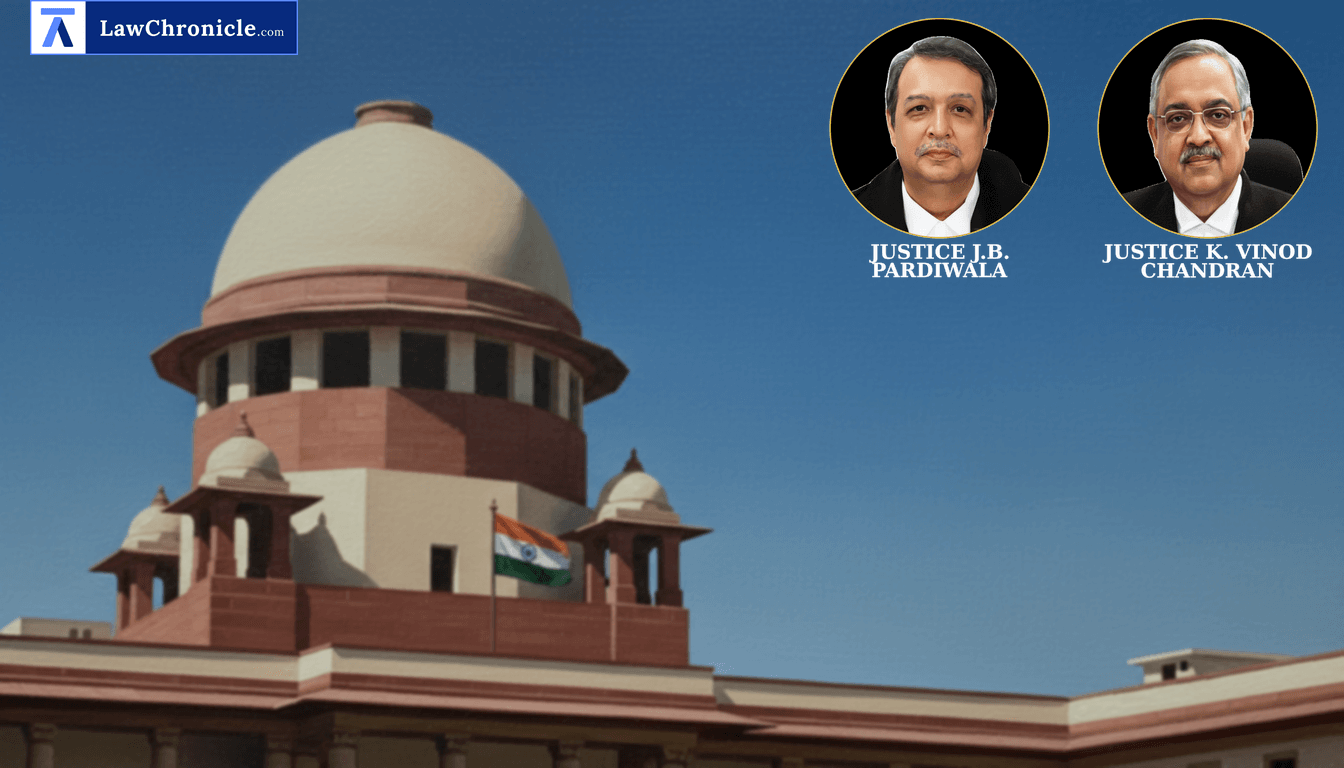
Reinforcing the sacred tenet of criminal jurisprudence that an order of acquittal fortifies the presumption of innocence, the Supreme Court ruled that High Courts cannot routinely convert revision petitions into appeals to disturb well-reasoned acquittals. The ruling underlines that mere suspicion or isolated recovery evidence cannot eclipse fundamental gaps in prosecution evidence to reverse trial court acquittals.
A Division Bench comprising Justice J.B. Pardiwala and Justice K. Vinod Chandran set aside a Bombay High Court judgment that had remitted a 1988 murder trial back to the Additional Sessions Judge for fresh consideration. Re-evaluating the evidence in its entirety, the Supreme Court restored the trial court's order acquitting all the accused.
Re-evaluation of Evidence and Judicial Observations
Examining the ocular and medical testimony, the apex court observed that the eyewitness accounts suffered from critical contradictions, while the chemical analysis report and recovery under Section 27 of the Indian Evidence Act, 1872 were insufficient by themselves to prove guilt. The Court noted that the initial doctor treating the deceased testified to him being unconscious throughout, contradicting allegations of dying declarations.
The Court, in its reasoning, observed: "The murder went unavenged, but it is not for the courts to convict the accused on mere assumptions when the evidence led by the prosecution fails to satisfy the judicial mind, of the guilt of the accused. The decisions are legion which speak of what a reasonable doubt is, and it is trite that while an acquittal is handed down by the Trial Court, it fortifies the presumption of innocence that is available to an accused. The principle not to overturn an acquittal if the view taken in the order of acquittal is plausible; even if another view is possible, is not one of mere caution but is a tenet of criminal jurisprudence which ensures no prejudice being caused to the accused and ensures the benefit of any reasonable doubt arising, being conferred on the accused."
The Court issued the following directions:
"We allow the appeal and restore the order of the Trial Court. The accused shall stand acquitted. If they are in prison, they shall be released forthwith, if not wanted in any other case and if they are in already on bail, their bail bonds shall stand cancelled."
Key Takeaways
Presumption of Innocence Reinforced: A trial court order of acquittal double-fortifies the constitutional right to innocence, requiring an exceptionally high threshold to overturn.
Section 27 Recovery Is Inadequate Alone: Recoveries under Section 27 of the Indian Evidence Act, 1872 showing human blood cannot sustain a conviction unless accompanied by an unbroken chain of circumstantial or reliable direct evidence.
Invocations of Revisional Power Restricted: High Courts cannot exercise revisional jurisdiction under Section 401 of the Code of Criminal Procedure, 1973 or Section 442 of the Bharatiya Nagarika Suraksha Sanhita, 2023 to mechanically order remands when the trial court view remains plausible.
Ratio
Where the trial court's order of acquittal is based on a plausible view of unreliable eyewitness testimony and contradictory medical evidence, revisional courts cannot convert revision petitions into appeals or order a remand merely because another view is possible, as an acquittal reinforces the presumption of innocence.
Background:
The dispute stemmed from an incident on February 14, 1988, involving an alleged murder under Section 302 of the Indian Penal Code, 1860. The Trial Court evaluated the prosecution case which relied on motive, eyewitnesses, dying declarations, and Section 27 recovery under the Indian Evidence Act, 1872 and recorded a complete acquittal.
A criminal revision petition was subsequently moved before the Bombay High Court by the victim's brother. Initially, the High Court overturned the acquittal without hearing the accused, leading to a remand by the Supreme Court in view of Section 401(2) of the Code of Criminal Procedure, 1973. Upon remand, the High Court again remitted the matter back to the Additional Sessions Judge to reconsider eyewitness testimony, Chemical Analysis reports, and recoveries.
The Supreme Court analyzed the statutory remedies available to victims, citing Mallikarjun Kodagali v. State of Karnataka ( "(2019) 2 SCC 752": 2018 CaseBase(SC) 569) and Joseph Stephen v. Santhanasamy ( "(2022) 13 SCC 115": 2022 CaseBase(SC) 212), noting that post the 2009 amendment to Section 372 of the Code of Criminal Procedure, 1973, victims possess a direct statutory right of appeal against acquittals. Considering Section 401(4) and Section 401(5) of the Code of Criminal Procedure, 1973 (analogous to Section 442 of the Bharatiya Nagarika Suraksha Sanhita, 2023), the Bench observed that while High Courts possess powers to convert revision petitions into appeals, such powers must be exercised within jurisdictional parameters. Upon re-appreciating the evidence, the Supreme Court concluded that no case was made out to disturb the plausible view taken by the trial court, allowed the appeal, and restored the acquittal.
Case Details:
Case No.: Criminal Appeal No. of 2026 (@ Special Leave Petition (Crl.) No. 1115 of 2023)
NeutralCitation: 2026 INSC 754
Case Title: Khalil Pasha & Ors. v. Abdul Rasheed & Anr.
Appearances:
For the Petitioner(s): Mr. Amol Nirmalkumar Suryawanshi, AOR
For the Respondent(s): Ms. Mukta Gupta, Senior Advocate (Amicus Curiae), Mr. Anuj Agarwala, AOR
Source: 2026 CaseBase(SC) 696
Similar Articles




 Breaking News


