


Dismissal Not Justified Without Fresh Notice After De Novo Enquiry: SC
 Copy Link
 Share
 Save
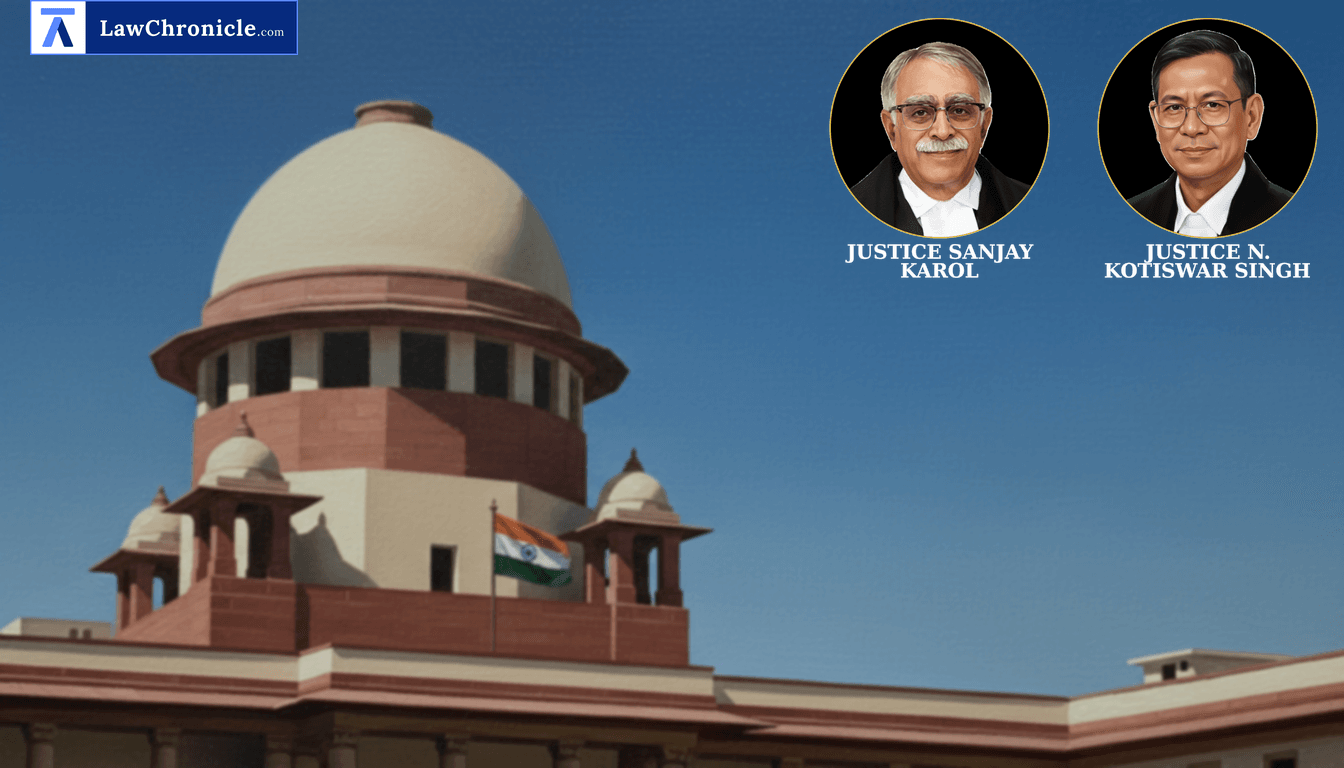
The Supreme Court, in Surekha Domaji Bele v. Executive Engineer, Testing Division, MSEDCL, has held that where a domestic enquiry is found to be vitiated, and the misconduct is subsequently proved through de novo proceedings before the Labour Court, the disciplinary authority cannot mechanically impose the penalty of dismissal on the basis of a decade-old show-cause notice.
A bench of Justice Sanjay Karol and Justice Nongmeikapam Kotiswar Singh emphasized that the decision-making process for imposing the severest form of punishment requires independent application of mind to the findings that ultimately survive after adjudication. The Court underscored that while the adjudication of guilt might be final, the quantum of punishment must be re-evaluated in light of the employee's long service and the specific nature of the proven charges.
Legal Competence and Constitutional Protections
The appellant, an employee of the Maharashtra State Electricity Distribution Company Limited (MSEDCL), challenged her dismissal on several grounds, including the competence of the Executive Engineer to pass the order. She contended that as her appointing authority was the Superintending Engineer, an officer of lower rank could not dismiss her. However, the Court observed that the MSEDCL Service Regulations specifically empowered the Executive Engineer for Pay Grade-III employees.
Regarding the appellant's reliance on Article 311(1) of the Constitution of India, the Court referred to S.L. Agarwal v. General Manager, Hindustan Steel Ltd. to clarify that employees of government-controlled corporations do not automatically hold a 'civil post' under the Union or State. Consequently, they cannot claim constitutional protection against dismissal by an authority subordinate to the appointing authority if the service regulations provide otherwise.
The Requirement of a Fresh Show-Cause Notice
The central issue revolved around the procedural validity of the dismissal order dated July 12, 2017. The management had relied on a show-cause notice issued in 2008, despite the fact that the original domestic enquiry had been declared unfair by the Labour Court. Following a remand from the Industrial Court, the management proved the misconduct before the Labour Court through fresh evidence.
The Court noted that Regulation 88(j) of the MSEDCL Employees Services Regulations, 2005, mandates a notice after the enquiry is completed. Drawing from principles in Khem Chand v. Union of India ( "AIR 1958 SC 300": 1957 CaseBase(SC) 128) and Managing Director, ECIL v. B. Karunakar ( "(1993) 4 SCC 727": 1993 CaseBase(SC) 112), the bench held that the delinquent is entitled to meet the reasoning of the findings that influence the disciplinary authority.
The Court, in its reasoning, observed: "The disciplinary authority was required to consider the findings which ultimately survived, namely the findings recorded in the de novo adjudication before the Labour Court, and thereafter apply its mind to the appropriate punishment. This consideration necessarily included the gravity of the misconduct, the nature of the charges proved, the Appellant’s long service, past record, absence or presence of financial loss or dishonesty, and whether a lesser penalty would meet the ends of justice."
Prolonged Suspension and Subsistence Allowance
Addressing the denial of subsistence allowance during an eleven-year suspension, the Court referred to State of Maharashtra v. Chandrabhan Tale ( "(1983) 3 SCC 387": 1983 CaseBase(SC) 56) and O.P. Gupta v. Union of India ( "(1987) 4 SCC 328": 1987 CaseBase(SC) 3), asserting that suspension should not become an indefinite condition of economic disability. While the management cited the appellant's failure to report at a specific office as a ground for denial, the Court pointed out that MSEDCL Employees Services Regulations, 2005 requires a periodic review of suspension beyond six months.
Guidelines on Proportionality of Punishment
The Court found the penalty of dismissal to be 'shockingly disproportionate' given the absence of financial misappropriation or moral turpitude. Citing Ranjit Thakur v. Union of India ( "(1987) 4 SCC 611": 1987 CaseBase(SC) 59), B.C. Chaturvedi v. Union of India ( "(1995) 6 SCC 749": 1995 CaseBase(SC) 611), and Chairman-cum-Managing Director, Coal India Ltd. v. Mukul Kumar Choudhuri, the bench reiterated that the 'doctrine of proportionality' allows judicial interference if a punishment is grossly excessive. It further held that treating the suspension period itself as a punishment in addition to dismissal was an impermissible 'amalgam of penalties,' following the ratio in Union of India v. S.C. Parashar ( "(2006) 3 SCC 167": 2006 CaseBase(SC) 129).
Directions Issued by the Court
The Court has issued the following directions:
"111.1. We hold that imposition of the second punishment of treating the suspension undergone as punishment was not permissible and accordingly, the same is set aside.
111.2 With respect to the punishment of dismissal which we consider wholly disproportionate to the charges proved, the competent authority shall consider any punishment other than the ultimate penalty of dismissal from service, after considering the Appellant’s long service, past record, age, nature of misconduct, absence or presence of financial loss, and other relevant circumstances.
111.3. It shall also decide the service and monetary consequences of the suspension period in accordance with the Regulations as discussed above including payment of subsistence allowance in terms of our observations above.
111.4. The finding that misconduct stood proved against the Appellant shall remain undisturbed and we are not reopening the adjudication of misconduct recorded in Complaint (ULP) No. 34 of 2008 by the Labour Court, which was also affirmed in Revision (ULP) No. 37 of 2017 by the Industrial Court. The Appellant was a party to the adjudicatory proceedings before the Labour Court where the misconduct was recorded and had the opportunity to lead and in fact led the evidence in her favour.
111.5. We also find no error in the concurrent finding that the Executive Engineer was competent under the applicable MSEDCL Employees Service Regulations to pass an order of punishment against the Appellant, who was a Pay Grade-III employee. The challenge to the dismissal order on the ground of lack of competence is therefore rejected.
111.6. However, regarding the dismissal order dated 12.07.2017, the disciplinary authority proceeded substantially on the earlier show-cause notice dated 25.04.2008, which was based on the domestic enquiry that was subsequently found not to be valid. After remand, the misconduct was still established, but in a different manner before the new forum, i.e., based on the evidence led before the Labour Court. The disciplinary authority was, therefore, required to give another show cause notice with fresh application of mind to enable the Appellant to submit her representation as regards the nature of punishment.
111.7. Before imposing the penalty of dismissal from service, the disciplinary authority failed to consider the relevant factors bearing on punishment, including the nature and gravity of the misconduct, the Appellant’s long service, past record, age, absence of financial loss to the Respondent-Company, or dishonesty, and the possibility of imposing a lesser penalty.
The dismissal order dated 12.07.2017 is, therefore, set aside as wholly disproportionate, while leaving the finding of misconduct undisturbed.
111.8 The competent authority shall, within four weeks from the date of receipt of this judgment, issue a proper show-cause notice to the Appellant based on the findings of the Labour Court in Complaint (ULP) No. 34 of 2008, as regards the penalty proposed to be imposed other than dismissal, having regard to the gravity of the misconduct. Thereafter, the competent authority shall pass a reasoned order on penalty within eight weeks.
111.9. The competent authority shall determine the Appellant’s claim for subsistence allowance in two parts.
For the period after 03.03.2007 till 12.07.2017, the Appellant shall be treated as eligible for subsistence allowance. The said amount shall be paid to the Appellant irrespective of the nature of punishment that may be passed."
Case Details:
Case No.: Civil Appeal No. of 2026 (@ SLP(C) No. ________ of 2026) (@Diary No. 11294 of 2025)
NeutralCitation: 2026 INSC 639
Case Title: SUREKHA DOMAJI BELE v. EXECUTIVE ENGINEER, TESTING DIVISION, MSEDCL
Source: 2026 CaseBase(SC) 571
Similar Articles
 Breaking News


