A Constitution Like No Other? 14 Distinctive Features of India's Constitutional Framework
 Copy Link
 Share
 Save
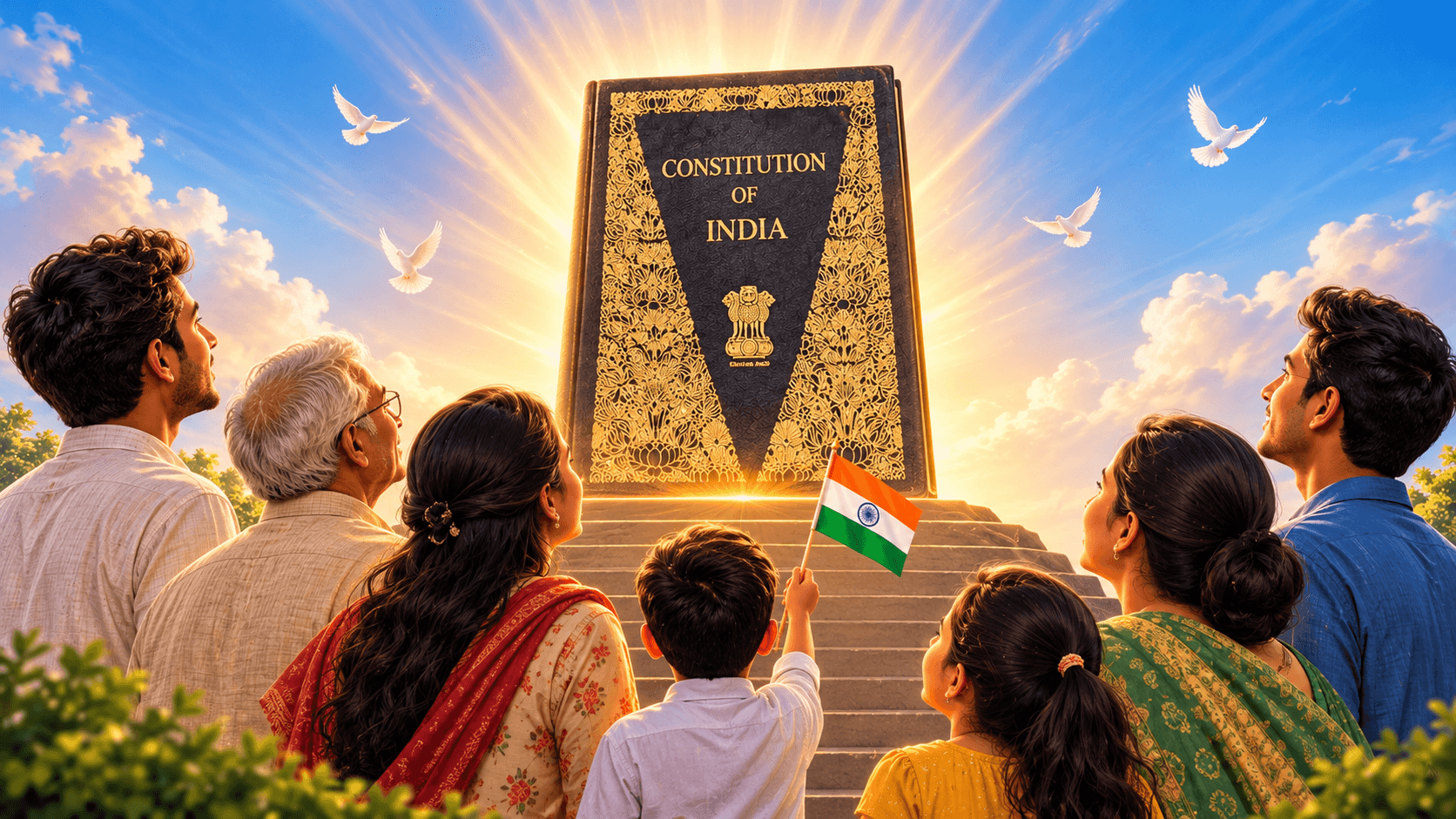
On 26 November 1949, the Constituent Assembly adopted the Constitution of India. It gave a newly independent, deeply diverse nation a framework that few other countries have attempted. This one document is meant to hold together a vast nation: hundreds of languages, many faiths, vast inequalities and a continental landmass under a single democratic order. As India observes Constitution Day on 26 November 2026, marking 77 years since its adoption, it is worth asking a question that students, lawyers and citizens often return to: what makes the Indian Constitution distinctive?
This article examines the distinctive features of the Indian Constitution, from its sheer length and borrowed-yet-original design to doctrines created by the Supreme Court that now sit at the heart of Indian constitutionalism.
Quick Overview: Key Features of the Constitution of India
- The longest written constitution of any sovereign country
- A blend of rigidity and flexibility in the amendment process
- A federal structure with a strong unitary bias
- A parliamentary form of government at both the Union and State levels
- Fundamental Rights balanced by non-justiciable Directive Principles of State Policy
- An independent, integrated judiciary with the power of judicial review
- Universal adult franchise and an independent Election Commission
- A secular State enforcing equal respect for all religions
- Constitutional commitment to social justice and affirmative action
- Single citizenship and an integrated judicial system
1. The Longest Written Constitution in the World
When the Constitution of India wholly came into force on 26 January 1950, it contained a Preamble, 395 Articles, 22 Parts and 8 Schedules. After successive amendments, it now stands at roughly 448 Articles in 25 Parts and 12 Schedules. That's the reason why it is routinely described as the longest written constitution in the world.
Several reasons explain why Indian Constitution is so detailed:
- Detailed administrative provisions: Much of the Government of India Act, 1935, which the framers drew upon heavily, dealt with administrative detail, and that detail carried over within the Constitution of India.
- One place for Union and State governance: Unlike the United States, where each State has its own constitution, India's Constitution provides for the Union and the States together.
- Diversity and historical injustice: Special provisions for Scheduled Castes, Scheduled Tribes, minorities, backward classes and tribal areas ensure equality in its real sense, enforced through the Constitution of India.
- Distrust of ambiguity: The framers preferred to spell out institutions, powers and limits rather than leave them to convention.
The reason why it took the Constituent Assembly two years, eleven months and eighteen days to complete its work, with the Drafting Committee chaired by Dr B.R. Ambedkar, is reflected in the Constitution we hold today.
2. Indian Constitution: A Bag of Borrowing
The Constitution is often called a "bag of borrowings", a description that undersells the deliberate selection that took place. The framers adapted features to Indian conditions rather than copying them as it is. Given below are some pointers to strengthen that argument:
| Feature | Principal Source |
| Federal scheme, office of the Governor, emergency provisions, public service commissions | Government of India Act, 1935 |
| Parliamentary government, rule of law, single citizenship, bicameralism | United Kingdom |
| Fundamental Rights, judicial review, independence of the judiciary, Preamble | United States |
| Directive Principles of State Policy | Ireland |
| Union with a strong Centre, residuary powers with the Union | Canada |
| Concurrent List, freedom of trade and commerce | Australia |
| Fundamental Duties | Former USSR |
| Ideals of liberty, equality and fraternity | France |
| Amendment procedure and election of Rajya Sabha members | South Africa |
The result is a synthesis that reflects India's own constitutional history, including the experience of the freedom movement and the Nehru Report of 1928 and the Karachi Resolution of 1931 on fundamental rights.
3. The Preamble of Indian Constitution: Written Purpose
The Preamble declares India to be a Sovereign, Socialist, Secular, Democratic Republic and pledges to secure justice, liberty, equality and fraternity to all citizens. The words "Socialist" and "Secular", along with "Integrity", were added by the 42nd Amendment in 1976. It serves as the soul to the written document, which is the grundnorm to Indian Laws.
The Supreme Court initially held in Berubari Union (1960 CaseBase(SC) 352) that the Preamble is not part of the Constitution but reversed that position in Kesavananda Bharati v. State of Kerala (1973 CaseBase(SC) 136), holding that it is an integral part and a key to understanding the framers' intent.
4. A Blend of Rigidity and Flexibility
The Constitution is neither as rigid as that of the United States nor as flexible as the unwritten British constitution. Amendments to the Constitution of India follow can be done via three modes:
- Simple majority: for matters such as the creation of new States, the abolition or creation of Legislative Councils and citizenship provisions (these are not treated as amendments under Article 368).
- Special majority: a majority of the total membership of each House and two-thirds of members present and voting, which covers most provisions, including Fundamental Rights.
- Special majority plus ratification by at least half of the State legislatures: for federal features such as the distribution of legislative powers, representation of States in Parliament and the amendment procedure itself.
This design has allowed the Constitution to be amended more than a hundred times, with the 106th Amendment (2023) on women's reservation in legislatures among the most recent, without being rewritten.
5. Federal Structure with a Unitary Bias
Article 1 describes India as a "Union of States", hinting that the federation is indestructible and that States cannot secede. The Constitution distributes powers through the Seventh Schedule, which contains the Union, State and Concurrent Lists. This system is usually termed as quasi-federal or federal with a unitary bias because of features such as:
- Residuary powers vest in the Union
- Parliament's power to legislate on State subjects in the national interest (Article 249)
- The Governor's appointment by the President
- Emergency provisions, including President's Rule under Article 356
- An integrated All-India Services structure
The Supreme Court in S.R. Bommai v. Union of India (1994 CaseBase(SC) 943) strengthened federalism by holding that it forms part of the basic structure and by subjecting the imposition of President's Rule to judicial review. The 73rd and 74th Amendments (1992) added a third tier of governance through Panchayats and Municipalities.
6. Parliamentary Democracy and Separation of Powers
India adopted the parliamentary system of government, in which the executive is drawn from, and collectively responsible to, the legislature. The President is the constitutional head, while real executive authority rests with the Council of Ministers headed by the Prime Minister.
Unlike the strict separation seen in the United States, India follows a model of functional separation with checks and balances. The Supreme Court has repeatedly affirmed that separation of powers is part of the basic structure.
7. Fundamental Rights, Directive Principles and Fundamental Duties
The three-part scheme of rights, principles and duties, as explained below in detail, is a distinctive feature, because it treats individual liberty and collective social welfare as complementary rather than competing.
Part III: Fundamental Rights
Articles 12 to 35 guarantee rights such as equality (Articles 14-18), freedom (Articles 19-22), protection against exploitation (Articles 23-24), freedom of religion (Articles 25-28), cultural and educational rights (Articles 29-30) and the right to constitutional remedies (Article 32). Dr Ambedkar described Article 32 as the heart and soul of the Constitution. The Supreme Court's expansive reading of Article 21, covering the right to life and personal liberty, has produced rights such as privacy, education, a clean environment and dignity.
Part IV: Directive Principles of State Policy
Articles 36 to 51 set out social and economic goals for the State, such as equitable distribution of resources, a uniform civil code, and protection of the environment. They are non-justiciable but fundamental to governance. In Minerva Mills v. Union of India (1980 CaseBase(SC) 246), the Supreme Court held that harmony and balance between Parts III and IV is itself part of the basic structure.
Part IVA: Fundamental Duties
Article 51A, inserted by the 42nd Amendment on the recommendation of the Swaran Singh Committee, lists duties of citizens. The 86th Amendment (2002) added the eleventh duty relating to children's education. Though non-enforceable by themselves, the Courts use them to interpret statutes and uphold constitutional values.
8. An Independent and Integrated Judiciary
India has a single integrated judicial system with the Supreme Court being the Apex Court, High Courts below it and subordinate courts beneath them, unlike the dual court system in the United States. The Supreme Court is empowered to enforce Fundamental Rights under Article 32, and High Courts under Article 226.
Judicial independence is protected through security of tenure, fixed salaries charged on the Consolidated Fund and restrictions on removal. Judicial review, the power to strike down laws and executive action that violate the Constitution, is expressly recognized under Article 13 and has been described as part of the basic structure.
9. The Basic Structure Doctrine
Perhaps the most distinctive and originally devised feature of the Indian Constitution is one the framers did not write: the basic structure doctrine. It was devised in bits and pieces through various Supreme Court judgments and the Kesavananda Bharati case (1973 CaseBase(SC) 136) is where it came into being.
How it evolved
- Shankari Prasad (1951 CaseBase(SC) 11) and Sajjan Singh (1964 CaseBase(SC) 287): Parliament could amend any part of the Constitution, including Fundamental Rights.
- Golaknath v. State of Punjab (1967 CaseBase(SC) 162): Parliament could not amend Fundamental Rights.
- Kesavananda Bharati v. State of Kerala ((1973 CaseBase(SC) 136)): a 13-judge Bench, by a narrow 7-6 majority, held that Parliament may amend the Constitution but cannot alter its basic structure.
What forms the basic structure?
Through later decisions such as Indira Gandhi v. Raj Narain (1975 CaseBase(SC) 344), Minerva Mills (1980 CaseBase(SC) 246) and I.R. Coelho v. State of Tamil Nadu (2007 CaseBase(SC) 489), the Supreme Court has identified features including supremacy of the Constitution, rule of law, judicial review, federalism, secularism, free and fair elections and separation of powers. The doctrine makes India's Constitution unusual because constitutional amendments themselves are subject to judicial scrutiny.
10. Universal Adult Franchise and Free Elections
India granted universal adult suffrage from the very first general election in 1951-52, at a time when literacy was low and many established democracies had restricted voting. Article 326 provides for elections on the basis of adult suffrage, and the voting age was lowered from 21 to 18 by the 61st Amendment in 1988. Article 324 establishes an independent Election Commission to superintend elections.
11. Secularism, Equality and Social Justice
The Indian model of secularism
Indian secularism is not a rigid separation of religion and State, as in the French model. Articles 25 to 28 guarantee freedom of conscience and the right to profess, practise and propagate religion, while the State maintains principled distance and can regulate religious practices for reasons of public order, morality, health or social reform.
Transformative constitutionalism
The Constitution of India is widely regarded as a transformative document. Features include:
- Abolition of untouchability under Article 17
- Reservations in education, public employment and legislatures for Scheduled Castes, Scheduled Tribes and Other Backward Classes (Articles 15(4), 15(5), 16(4) and 330-342)
- Reservation for economically weaker sections through the 103rd Amendment (2019), upheld by the Supreme Court in 2022
- Recognition of 22 languages in the Eighth Schedule
12. Single Citizenship and National Integration
Despite a federal structure, India provides for single citizenship under Part II, so there is no separate State citizenship. Alongside an All-India Services framework, this fosters national unity and ensures that fundamental rights apply to every citizen irrespective of State.
13. Emergency Provisions
The Constitution contains provisions to deal with national, State and financial emergencies under Articles 352, 356 and 360, which allow the federal system to function as a unitary one in times of crisis. The experience of the Emergency of 1975-77 led to the 44th Amendment (1978), which tightened safeguards by requiring "armed rebellion" instead of "internal disturbance" and protecting Articles 20 and 21 from suspension.
14. A Living Document: Why the Constitution Endures
Dr Ambedkar observed that the Constitution is workable, flexible and strong enough to hold the country together in both peace and war. Seven decades on, its endurance owes much to a combination of textual detail, an adaptable amendment process and an activist yet accountable judiciary that interprets it in light of changing social realities, such as Navtej Singh Johar (2018 CaseBase(SC) 1872) on decriminalising consensual same-sex relations and K.S. Puttaswamy v. Union of India (2018 CaseBase(SC) 2060) recognising the fundamental right to privacy.
Following the Gist
India as a country is a bouquet of diverse religions, languages, faiths and cultures. The Constitution of India had to be, and is, on a par with the diversified needs of the nation. The Indian Constitution is distinctive not because any single feature is unique, but because of how its parts work together: a detailed text that anticipates diversity, a federation that can centralise in a crisis, rights that are balanced against social goals, and a judiciary that guards the document's core identity against majoritarian excess.
As India marks Constitution Day 2026, the framework remains both a legal instrument and a continuing national project, one that depends as much on the constitutional morality of those who work it as on the words on the page.
Also Read: Constituent Assembly Debates on Freedom of Press
Subscribe to Our Newsletter for receiving Weekly Updates on your E-Mail
 Breaking News