


Drunken Lawyer's Courtroom Outrage Leads to Contempt Conviction by Karnataka HC
 Copy Link
 Share
 Save
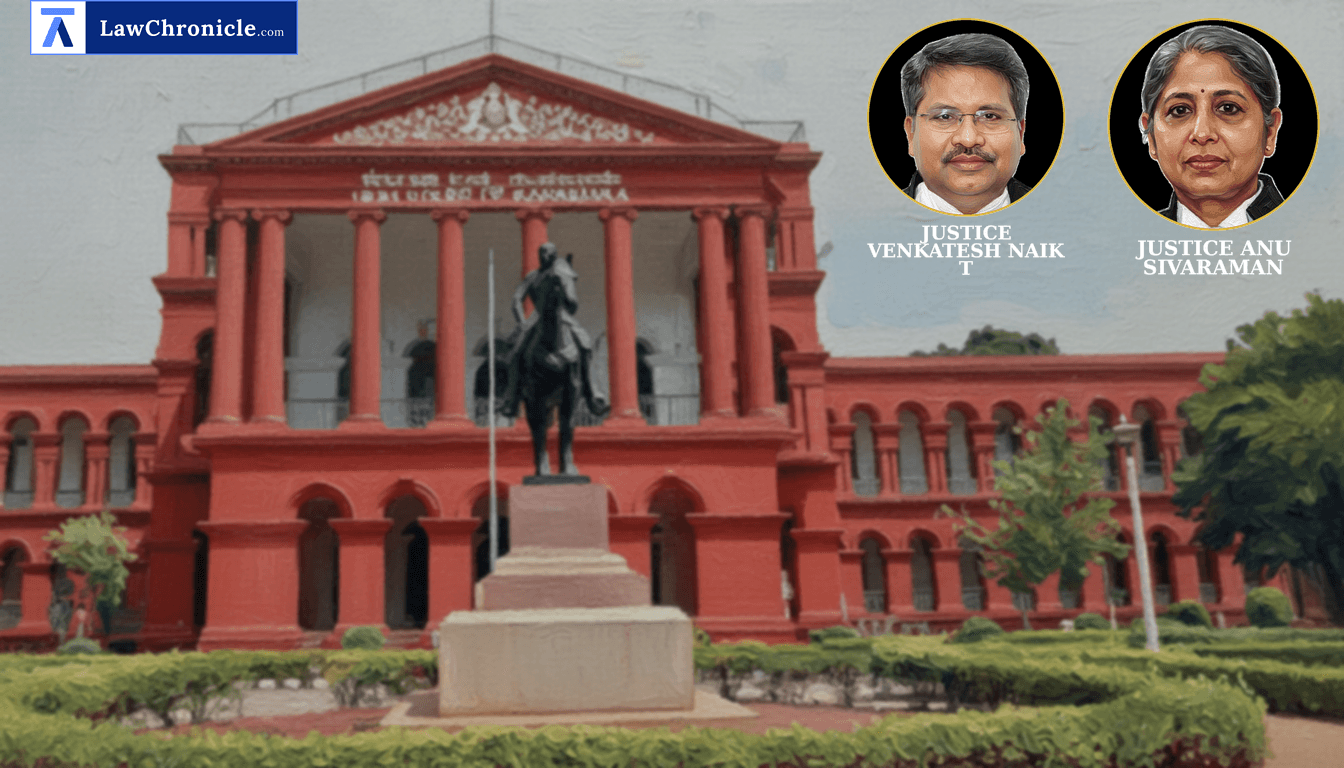
The High Court of Karnataka has sent a stern warning against professional misconduct by convicting an advocate for criminal contempt after he appeared in court in an inebriated state and hurled scandalous allegations against judicial officers. This ruling reinforces that the sanctity of the courtroom remains non-negotiable, and any attempt to intimidate the judiciary under the influence of alcohol or through baseless character assassination will invite immediate penal consequences.
In a suo-motu proceeding, a division bench comprising Justice Anu Sivaraman and Justice Venkatesh Naik T adjudicated upon the unruly conduct of an advocate appearing as a party-in-person. The bench took serious note of the reports submitted by a trial court judge detailing instances of shouting, yelling at staff, and appearing in an intoxicated condition during judicial proceedings, which the High Court found to be a deliberate attempt to lower the authority of the law.
Key Takeaways
Zero Tolerance for Inebriation in Courts
The Court established that appearing before a judicial forum in a drunken state constitutes a grave interference with the administration of justice and a violation of professional ethics.
Judicial Protection Against Scurrilous Attacks
The judgment reaffirms that while fair criticism is permitted, making baseless allegations of bribery against presiding officers to secure favorable orders is punishable under contempt law.
Accountability for Advocates
Legal professionals are held to a higher standard of decorum; being a party-in-person does not grant a license to disregard the procedural and moral codes of the courtroom.
Impact on Future Litigants
This decision serves as a deterrent against 'sociopathic' behavior in courtrooms, ensuring that the rule of law is not held hostage by disruptive individuals.
Court Rationale and Observations
The Court analyzed the definition of "criminal contempt" under Section 2(c) of the Contempt of Courts Act, 1971, noting that any act which scandalizes or lowers the authority of a court amounts to an offense. The bench observed that the accused's behavior, including interrupting senior counsel and smelling of alcohol as confirmed by a certificate of drunkenness spoiled the entire atmosphere of the court.
The Court, in its reasoning, observed: "The confidence, which the people repose in the courts of justice, cannot be allowed to, be tarnished, diminished or wiped out by the contemptuous behaviour of any person. If the judiciary is to perform its duties and functions effectively and true to the spirit with which they are sacredly entrusted, the dignity and authority of the courts have to be respected and protected at all costs."
Referring to Rajendra Sail v. M.P. High Court Bar Association and others, the bench noted that alleging bias or mala fides against a judge without basis is not protected by the defense of fair criticism. The Court further emphasized that under Article 19(1)(a) of the Constitution of India, freedom of speech is not absolute, especially when used to scandalize the institution, a principle upheld in Prashant Bhushan and another, in Re and Vijay Kurle, in Re and others.
The Court has following directions:
"The accused/contemnor is convicted for Criminal Contempt of Court punishable under Section 12(1) of the Contempt of Courts Act, 1971. ... we sentence the accused/contemnor to simple imprisonment for a period of 1-day (till raising of the Court) with a fine of Rs.2,000/- (Rupees Two Thousand Only) to be payable within 15 days from today, and in default of payment of fine, the accused shall undergo simple imprisonment for a period of one day. The accused/contemnor shall be taken to custody forthwith, to serve the sentence. Registrar (Judicial) shall issue conviction warrant against the accused as per Rule 16 of the High Court of Karnataka (Contempt of Court Proceedings) Rules, 1981."
Ratio
The judiciary is the guardian of the rule of law, and its foundation rests on public trust. Any deliberate, motivated, or calculated attempt to bring the image of the judiciary into disrepute through scandalous allegations or unprofessional conduct such as appearing in court in an inebriated state constitutes criminal contempt. Such actions are not protected as free expression or fair criticism and necessitate deterrent punishment to preserve the independence and majesty of the judicial system.
Background
The proceedings originated from reports sent by the Additional Civil Judge and JMFC-II, Karwar, to the Principal District and Sessions Judge, Uttara Kannada. The reports detailed an incident on April 8, 2022, where the accused advocate, a party-in-person in a Domestic Violence case, shouted at the Presiding Officer and alleged that the officer had received money from his wife.
A subsequent incident on April 20, 2022, involved the accused interrupting a Senior Counsel’s arguments while smelling of alcohol. A medical examination confirmed the consumption of alcohol. Although the accused initially submitted an apology, he later filed objections claiming he suffered from epilepsy and that the proceedings were intended to harass him. However, the High Court found his defense lacked merit and his conduct during the contempt hearings remained unrepentant and adamant, leading to his conviction under the Contempt of Courts Act, 1971 and the High Court of Karnataka (Contempt of Court Proceedings) Rules, 1981.
Case Details:
Case No.: CRIMINAL CONTEMPT PETITION NO. 10 OF 2022
Case Title: HIGH COURT OF KARNATAKA v. SRI. PANKAJ KAUSHIK
Appearances:
For the Petitioner(s): SRI. THEJESH P., HCGP
For the Respondent(s): SRI. PANKAJ KAUSHIK, ACCUSED/PARTY-IN-PERSON
Source: 2026 CaseBase(KAR) 19426
Similar Articles
 Breaking News


