


Dying Declaration Can Form Sole Basis Of Conviction If It Inspires Confidence: Andhra Pradesh High Court
 Copy Link
 Share
 Save
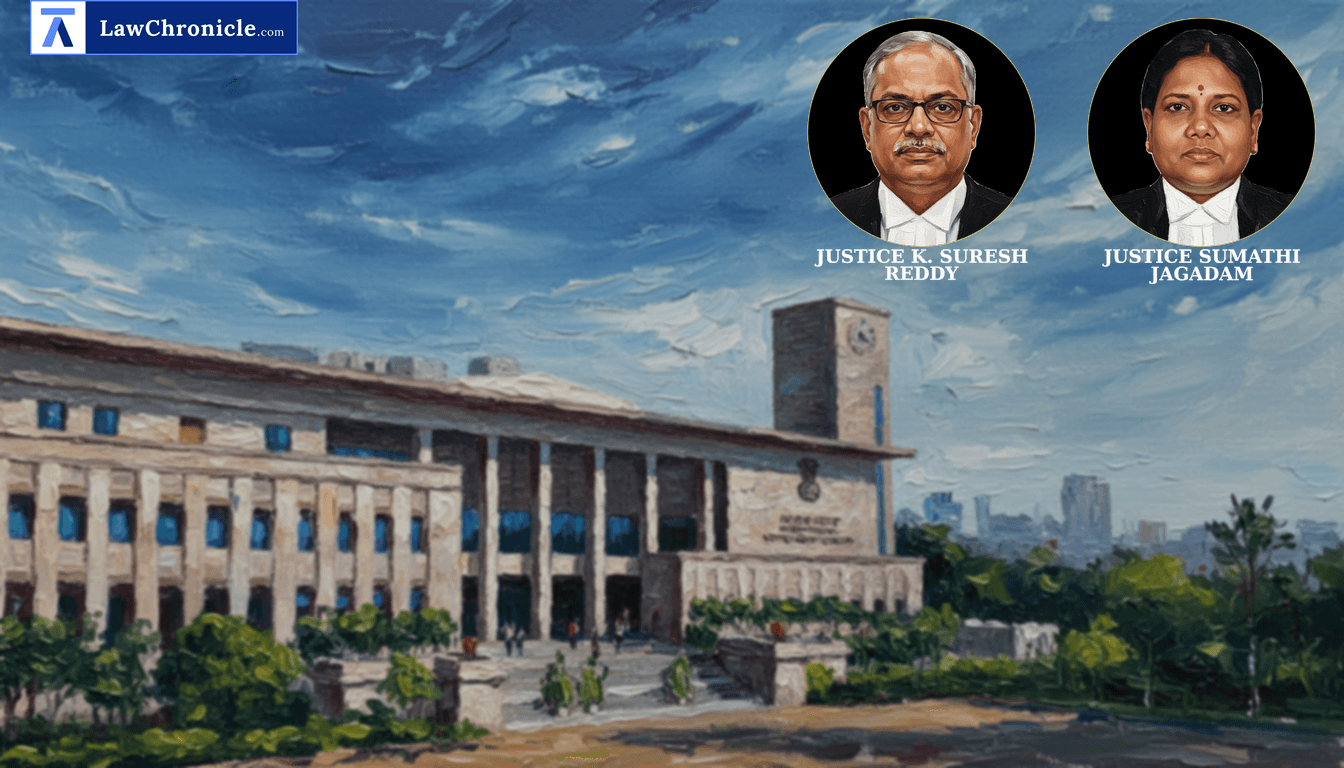
The Andhra Pradesh High Court has reinforced the bedrock of criminal jurisprudence by affirming that a dying declaration, if found truthful and voluntary, requires no further corroboration to sustain a murder conviction. The ruling underscores that physical incapacity to sign does not invalidate a thumb-impressed deathbed statement when medical evidence confirms the declarant was in a fit state of mind.
A Division Bench comprising Justice K Suresh Reddy and Justice Sumathi Jagadam adjudicated upon a criminal appeal challenging a life sentence for murder. The court was tasked with determining whether the conviction, largely based on a dying declaration and eyewitness testimonies, suffered from any legal or factual infirmity.
Key Takeaways
Primacy of Dying Declarations
Where a court is satisfied that a dying declaration is true and voluntary, it can form the sole basis of conviction without any further corroboration.
Validity of Thumb Impressions
Mere affixation of a thumb impression instead of a signature does not render a dying declaration suspicious if physical incapacity or medical weakness is established.
Rejection of Fabricated Defense Theories
Defense theories involving third-party motives, such as financial disputes with external entities, will be dismissed if unsupported by evidence or cross-examination.
Consistency in Testimony
The consistency between ocular evidence from eyewitnesses and the contents of a dying declaration provides sufficient ground for sustaining a conviction under Section 302 of the Indian Penal Code.
Court Observations and Directions
The Bench meticulously examined the evidentiary value of the deceased's statement recorded shortly before his death. The Court noted that the testimonies of the victim's family and neighbors were coherent and directly implicated the accused in the fatal stabbing. The Court addressed the appellant's contention regarding the thumb impression on the dying declaration, noting that the medical condition of the victim prevented him from signing his name.
The Court has the following directions:
"In the result, Criminal Appeal is dismissed, confirming the conviction and sentence recorded by the learned II Additional Sessions Judge, Amalapuram, against the appellant (Accused) for the offence U/s.302 IPC in S.C.No.220/2015 dated 07.01.2019. Needless to state that the period of sentence already undergone by the appellant, shall be given set off under Section 428 Cr.P.C."
The Court, in its reasoning, observed: "It can thus be seen that this Court has clearly held that dying declaration can be the sole basis of the conviction if it inspires the full confidence of the court. The Court is required to satisfy itself that the deceased was in a fit state of mind at the time of making the statement and that it was not the result of tutoring, prompting or imagination. It has further been held that, where the Court is satisfied about the dying declaration being true and voluntary, it can base its conviction without any further corroboration."
Ratio
A dying declaration is a substantive piece of evidence that can independently sustain a conviction if the court is satisfied it was made in a fit state of mind, without tutoring or imagination. The rule requiring corroboration for a dying declaration is a rule of prudence, not an absolute rule of law. If the declaration is coherent and consistent with the circumstances of the case, no legal impediment exists to prevent it from serving as the primary foundation for a guilty verdict.
Background
The prosecution's case originated from a land dispute between the appellant and the deceased, who was his brother-in-law. The appellant’s wife had entrusted the deceased with the management of a plot of land while she resided in Hyderabad. Upon the appellant's return from Mumbai, he attempted to dig up the land, which was successfully opposed by the deceased through local authorities. Driven by this grudge, the appellant intercepted the deceased on February 7, 2015, and stabbed him multiple times with a steel knife.
The deceased gave a statement to the police at the hospital, which was treated as a dying declaration after he succumbed to his injuries the following day. The trial court, under the Cr.P.C., convicted the appellant for murder and sentenced him to life imprisonment. The High Court, after reviewing the ocular evidence and , found no reason to interfere with the trial court's judgment, ultimately dismissing the appeal.
Case Details:
Case No.: CRL.A.No.455 OF 2019
Neutral Citation: 2026:APHC:44056
Case Title: K. Nageswara Rao v. State of AP
Appearances:
For the Petitioner(s): Sri Bala Krishna V, Advocate
For the Respondent(s): Sri Marri Venkata Ramana, Additional Public Prosecutor
Source: 2026 CaseBase(AP) 17831
Similar Articles



 Breaking News


