


Quality Over Quantity: Supreme Court Upholds Murder Conviction Based On Reliable Testimony
 Copy Link
 Share
 Save
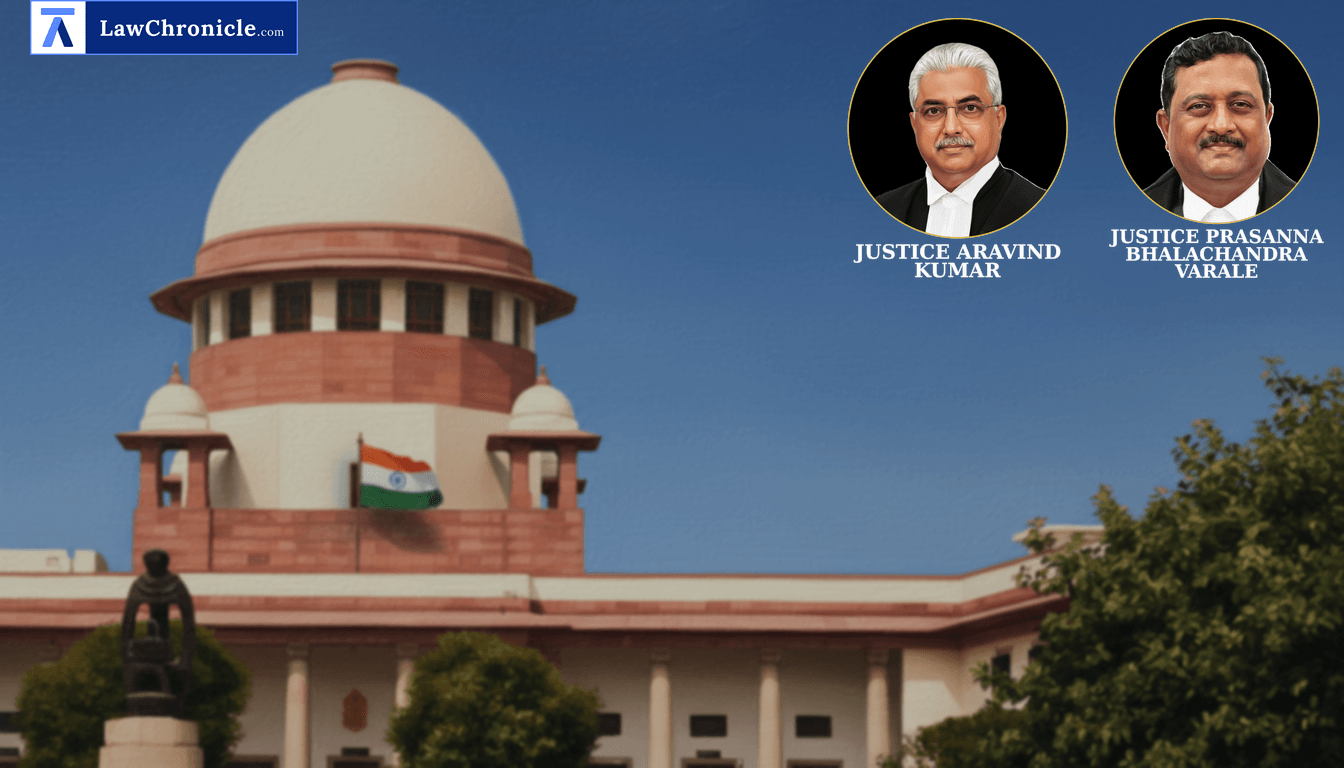
The Supreme Court reaffirmed the established legal principle that the quality of evidence outweighs the quantity of witnesses, upholding a life sentence for murder despite several eyewitnesses turning hostile during the trial.
A division bench comprising Justice Aravind Kumar and Justice Prasanna B. Varale adjudicated an appeal challenging the Gujarat High Court's dismissal of a challenge against a conviction under Section 302 of the Indian Penal Code and Section 135 of the Bombay Police Act. The Court scrutinized whether the concurrent findings of the lower courts were sustainable given the retraction of several material witnesses.
Establishing Motive and Intent
The Court observed that the prosecution successfully established a clear motive rooted in a dispute that occurred the night before the murder. The appellant had allegedly thrown a half-burnt cigarette into a bucket used by the deceased for washing utensils, leading to an altercation where a threat was issued.
The Court, in its reasoning, observed: "The proximity of time between the quarrel and the occurrence, coupled with the prior threat, clearly establishes the motive as well as the mens rea attributable to the appellant for the commission of the offence."
Credibility of the Dying Declaration
Central to the conviction was the testimony of the deceased’s brother, who arrived at the scene shortly after the assault. The Court found his account of the oral dying declaration made by the deceased to be trustworthy, noting that the declaration was repeated during the transit to the hospital.
The Court has the following directions:
"The appeal, being devoid of merit, is accordingly dismissed. However, having regard to the fact that the appellant has undergone a substantial period of sentence, liberty is granted to him to move an appropriate application for remission in accordance with the extant policy applicable to him. In the event such an application is preferred, we observe that the same shall be considered and disposed of expeditiously in accordance with law."
The Doctrine of Solitary Witness
Addressing the defense's argument regarding hostile witnesses, the Court emphasized that Indian law does not mandate a plurality of witnesses to secure a conviction. Relying on Namdeo v. State of Maharashtra ( "(2007) 14 SCC 150": 2007 CaseBase(SC) 299), the Court noted that a conviction can be founded on the testimony of a solitary witness if it is of 'sterling quality.'
Background:
The dispute began on December 11, 1998, when a quarrel erupted over a cigarette. The following morning, the appellant allegedly stabbed the deceased near his tea stall in Ahmedabad. While several witnesses, including panch witnesses and some purported eyewitnesses, turned hostile, the testimony of a rickshaw driver (PW-12) and the complainant (PW-1) remained consistent.
The Trial Court had convicted the appellant, a decision later affirmed by the Gujarat High Court. The Supreme Court, after an independent re-appreciation of the evidence, concluded that the prosecution had proved its case beyond reasonable doubt. The Court dismissed the appeal but granted the appellant liberty to seek remission due to the duration of time already served.
Case Details:
Case No.: CRIMINAL APPEAL NO. 212/2012
NeutralCitation: 2026 INSC 469
Case Title: MITESH @ T.V. VAGHELA v. THE STATE OF GUJARAT
Appearances:
For the Petitioner(s): K. Sarada Devi, Advocate
For the Respondent(s): Ms. Swati Ghildiyal, Counsel
Source: 2026 CaseBase(SC) 413
Similar Articles


 Breaking News


