


Employers cannot deny pay scales For lack of ACRs caused by Wrongful Discharge: Supreme Court
 Copy Link
 Share
 Save
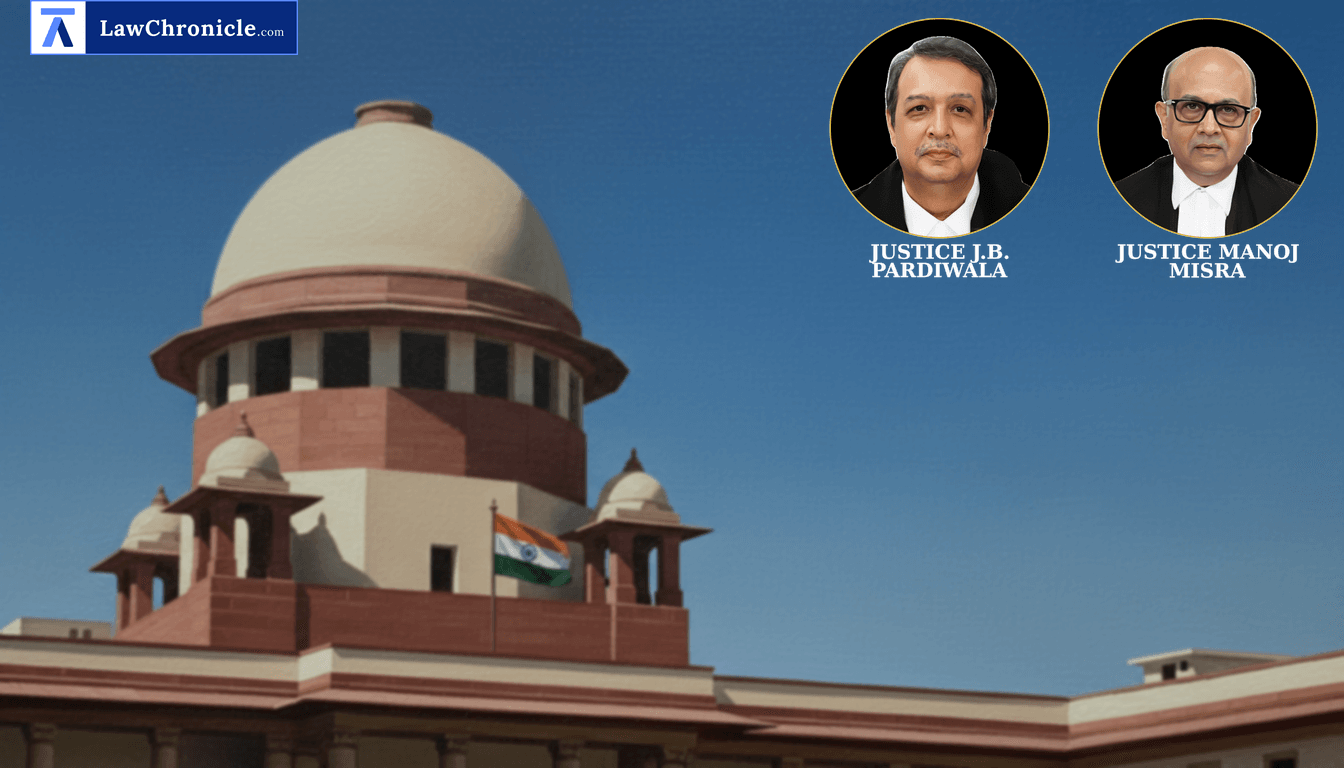
An employer cannot exploit its own illegal act of wrongfully discharging an officer to deny them career progression and pay scale advancements like Selection Scale or Super Time Scale for want of Annual Confidential Reports (ACRs). The Supreme Court has ruled that where ACRs are unavailable solely due to the employee being unlawfully kept out of service, the evaluation for consequential pay scales must be conducted based on the remaining valid ACRs.
A bench of Justice J.B. Pardiwala and Justice Manoj Misra addressed a clarification application filed by the High Court of Judicature for Rajasthan on its administrative side. The High Court sought clarification regarding whether the relief of reinstatement with "all consequential benefits" granted to a discharged judicial officer extended to the automatic grant of Selection Scale and Super Time Scale, despite six years of ACRs missing due to his wrongful termination.
Evaluating Career Progression Post-Reinstatement
Addressing the core dispute, the Supreme Court stressed that the lack of evaluation records was entirely attributable to the High Court's own illegal discharge order that was previously quashed. The Court emphasized that an authority cannot derive advantage from its own wrong to withhold career benefits from an exonerated officer.
The Court, in its reasoning, observed: "...where the non-availability of the requisite ACRs is attributable to the employer, the employee’s entitlement to the promotion/pay in question is required to be assessed on the basis of the remaining valid ACRs... the opponent’s entitlement to the Selection Scale and Super Time Scale is liable to be determined on the basis of his valid ACRs for the years 2013 and 2014 (Part I & Part II), respectively."
Clarifying its stand on ACR grading for promotion, the Supreme Court stated that the officer was entitled to the Selection Scale and Super Time Scale is liable to be determined on the basis of his valid ACRs for the years 2013 and 2014. The Bench accordingly directed the administrative side of Rajasthan High Court to re-fix the pay, revise all consequential benefits and disburse the arrears payable to the opponent within a period of three months from the date of this judgment.
Key Takeaways
- Protection Against Administrative Missteps: Employers cannot use missing administrative metrics as a shield to deny promotional pay scales when they caused the absence of records through illegal termination.
- Assessment on Surviving Records: In the event of uncommunicated or missing ACRs owing to wrongful dismissal, evaluations must rely strictly on the existing valid ACRs.
- Strict Adherence to Consequential Relief: Reinstatement orders awarding full consequential benefits legally obligate authorities to notionally compute service periods for subsequent pay scale eligibility.
Ratio
When the non-availability of required service performance entries (ACRs) is directly caused by an employer's wrongful termination or discharge, the employer is legally precluded from withholding career progression benefits; the employee's eligibility for promotional scales must be determined strictly based on available valid ACRs for the remaining period.
Background:
The judicial officer was appointed to the District Judge Cadre under the Rajasthan Judicial Service Rules, 2010 in 2013 but was discharged in 2016. Challenging his discharge, he eventually approached the apex court, which vide judgment dated March 15, 2022, set aside the discharge order and directed his reinstatement with all consequential benefits including continuity of service, seniority, and 50% back wages.
Following reinstatement, the officer sought grant of Selection Scale and Super Time Scale as his juniors had been granted the same. The High Court’s Full Court and Higher Judiciary Committee demurred, citing non-availability of ACRs for six years (2015 to 2021) and invoking Rules 49 and 50 of Rajasthan Judicial Service Rules, 2010 alongside its 2011 Resolution requiring minimum ACR entries. Consequently, the High Court moved the Supreme Court seeking clarification.
Analyzing the precedents, the Supreme Court relied on Union of India v. K.V. Jankiraman ( "(1991) 4 SCC 109": 1991 CaseBase(SC) 129) and Central Bank of India & Ors. v. Dragendra Singh Jadon ( "(2022) 8 SCC 378": 2022 CaseBase(SC) 746) to hold that an employee cannot be deprived of benefits when kept away from work for no fault of their own. Furthermore, relying on Prabhu Dayal Khandelwal v. Chairman, UPSC & Ors. ( "(2015) 14 SCC 427": 2015 CaseBase(SC) 273) and R.K. Jibanlata Devi v. High Court of Manipur & Ors., the Court reiterated that promotion and pay scale considerations must proceed on the strength of available valid Annual Confidential Reports (ACR) grading for promotion, while discarding uncommunicated ACRs, such as the 2015 ACR in line with Sukhdev Singh vs Union of India ( "(2013) 9 SCC 566": 2013 CaseBase(SC) 614) and Maneka Gandhi vs Union of India ( "(1978) 1 SCC 248": 1978 CaseBase(SC) 307).
Applying these principles, the apex court observed that the officer's valid ACRs for 2013 and 2014 contained "Very Good" and "Good" ratings. Holding him entitled to Selection Scale from July 16, 2018, and Super Time Scale from July 16, 2021, the Court disposed of the application under Constitution of India, 1950 and directed the re-fixation of pay and disbursement of arrears within three months.
Case Details:
Case No.: MISCELLANEOUS APPLICATION NO. 2228 OF 2026 [Arising out of Diary No. 17219 of 2024] IN CIVIL APPEAL NO. 2029 OF 2022
NeutralCitation: 2026 INSC 762
Case Title: HIGH COURT OF JUDICATURE FOR RAJASTHAN v. ABHAY JAIN
Source: 2026 CaseBase(SC) 708
Similar Articles
 Breaking News


