


Encroachers Precluded From Re-Agitating Settled Issues Under Res Judicata: Chhattisgarh HC
 Copy Link
 Share
 Save
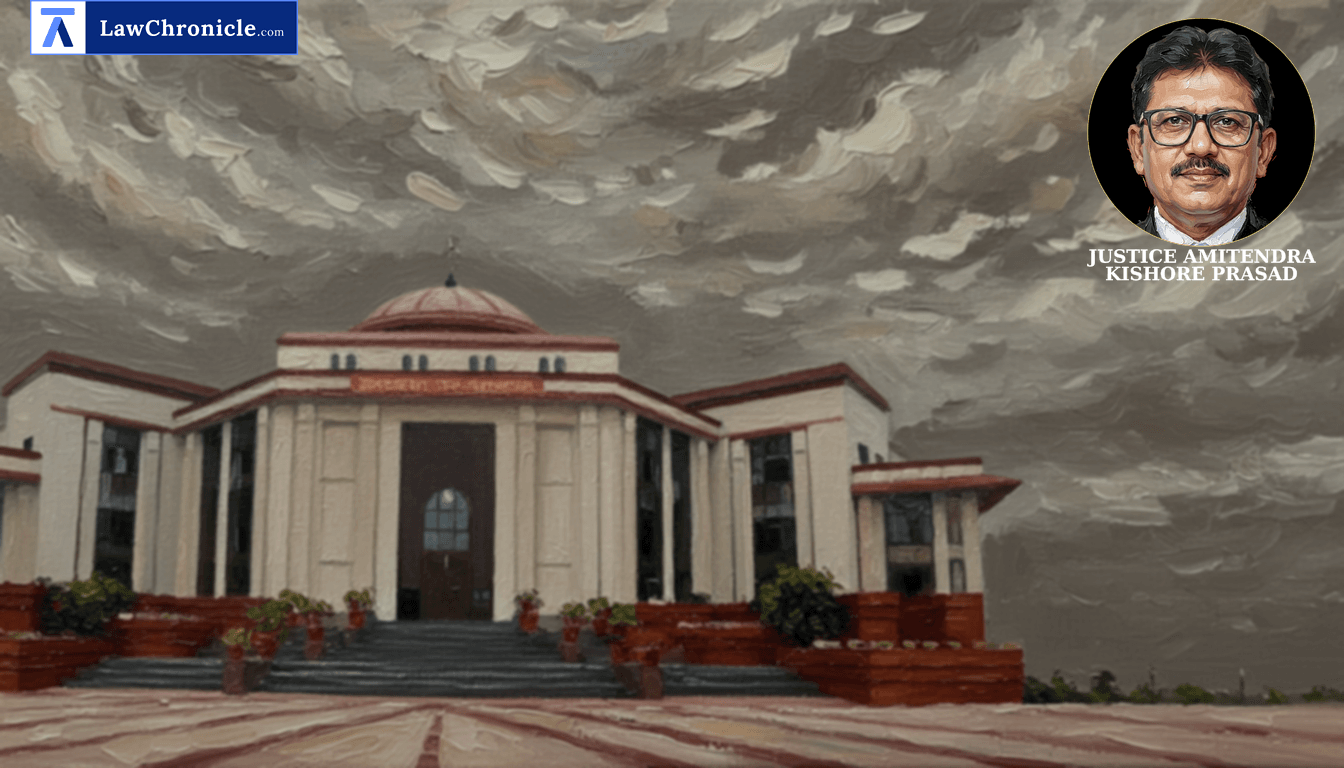
Chhattisgarh High Court has settled that parties who have unequivocally relinquished their claims or faced a final judicial determination cannot resurrect the same dispute through fresh litigation, as the principle of conclusiveness rooted in public policy mandates absolute finality. The Bench dismissed petitions challenging eviction notices, ruling that unauthorized occupants are legally estopped from re-litigating possession claims over land where their rights were previously rejected and affirmed by the Court.
A Single Judge Bench of Justice Amitendra Kishore Prasad heard the petitions assailing eviction notices issued by the Tehsildar, Korba. The Court was tasked with determining whether the petitioners could challenge notices for removal of encroachments from Khasra No. 55/1 after their claims had already been rejected in prior writ proceedings and before the Board of Revenue.
Key Takeaways
Finality of Litigation
Once a claim is rejected by a constitutional court and the order attains finality, the parties are barred from re-agitating the same issue under the doctrine of res judicata.
Scope of Allotment
Lawful allottees of Government Patta land must confine their possession strictly to the specific Khasra numbers granted to them; any occupation beyond such boundaries constitutes illegal encroachment.
Public Policy and Res Judicata
Res judicata is a rule of conclusiveness that prevents a party who has failed on an issue from reopening it at a subsequent stage, even if the earlier determination is perceived as wrong.
Mandatory Eviction of Encroachers
Illegal encroachment undermines the rule of law and upsets planned development, necessitating strict judicial orders for immediate removal once proceedings have concluded.
Judicial Affirmation of Revenue Orders
The Chhattisgarh High Court noted that the dispute regarding Khasra No. 55/1 had already reached finality. The Board of Revenue had previously affirmed the concurrent orders of the Tehsildar and SDO(R) declaring the petitioners as encroachers. This position was further cemented by a previous order of the High Court in WP(C) No. 4373 of 2023, where the petitioners had relinquished their claims to the specific land.
The Chhattisgarh High Court observed that "The rule of res judicata prevents the parties to a judicial determination from litigating the same question over again. This Court, in categorical terms, has held in W.P.(C) No. 4373/2023 and other connected petitions that the claim of the petitioners in respect of Khasra No. 55/1 cannot be considered, as the order of the Board of Revenue dated 16.4.2018 is neither perverse nor illegal and suffers from no jurisdictional error."
Ratio
The principle of res judicata, founded on public policy and justice, prevents parties from litigating the same question again once a judicial determination has attained finality. A party who has once succeeded or failed on a particular issue cannot be permitted to reopen or re-agitate the same issue in subsequent proceedings, as this conclusiveness is essential to ensuring the end of litigation and preventing the abuse of the process of law.
Background
The petitioners, claiming to be homeless urban residents, were allotted Patta for residential purposes on Government Abaadi land under Khasra No. 74/1 in Village Ratakhar. However, a private respondent alleged that the petitioners had encroached upon his private land under Khasra No. 55/1. Following a demarcation report in 2014, the Tehsildar ordered the restoration of possession to the private owner.
This order was challenged through multiple layers of the revenue hierarchy. While the Divisional Commissioner had initially remanded the matter for fresh demarcation, the Board of Revenue set aside that remand, affirming the petitioners were indeed encroachers on Khasra No. 55/1. The petitioners then approached the High Court in WP(C) No. 4373 of 2023, where the court directed a demarcation of their allotted land (Khasra No. 74/1) but explicitly rejected their claim regarding Khasra No. 55/1 after the petitioners stated they did not wish to press it.
When the Tehsildar issued fresh eviction notices dated 23.04.2026 under Section 250 of the Chhattisgarh Land Revenue Code, 1959, the petitioners filed the present writ petitions. The Chhattisgarh High Court relied on Securities and Exchange Board of India Vs. Ram Kishori Gupta and another ( "2025 SCC OnLine SC 748": 2025 CaseBase(SC) 407) and B.S. Lalitha and others Vs. Bhuvanesh and Others ( "2026 SCC OnLine SC 860": 2026 CaseBase(SC) 432) to reiterate that res judicata applies even to administrative and quasi-judicial proceedings. Referencing Ahmedabad Municipal Corporation Vs. Nawab Khan Gulab Khan and Others ( "(1997) 11 SCC 121": 1996 CaseBase(SC) 12), the Bench emphasized that public property must be protected from illegal encroachment. Finding the challenge vexatious and an attempt to evade statutory consequences, the Court dismissed the petitions.
Case Details:
Case No.: WPC No. 2365 of 2026 and WPC No. 2367 of 2026
Neutral Citation: 2026:CGHC:46854
Case Title: Kanhaiya Yadav v. State of Chhattisgarh & Others
Appearances:
For the Petitioner(s): Mr. Rajnish Singh Baghel, Advocate and Ms. Chetna Sharma, Advocate
For the Respondent(s): Mr. Shobhit Mishra, Dy. GA (State); Mr. Hardik Jaiswal, Advocate (Respondent No. 5); Mr. Awadh Tripathi, Advocate (Respondent No. 6)
Source: 2026 CaseBase(CTH) 21294
Similar Articles
 Breaking News


