


Ex Parte Decree Remains Valid If Party Fails To Justify Absence In Suit: Gujarat HC
 Copy Link
 Share
 Save
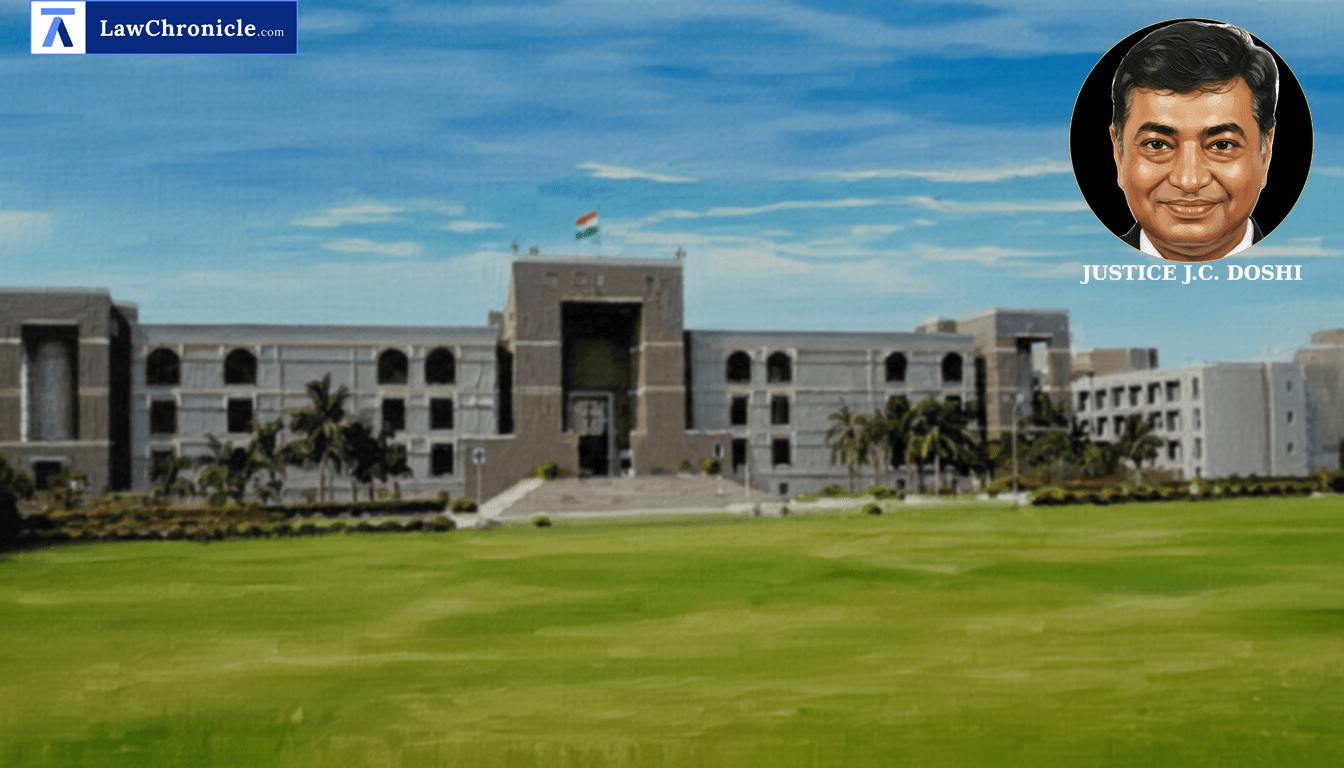
In a stern message to litigants, the Gujarat High Court has ruled that a decree passed ex parte holds the same legal sanctity as a contested one, refusing to set aside a money recovery order solely because the defendant chose to remain absent despite service of summons.
Justice J. C. Doshi, presiding over the First Appeal, addressed a challenge against an ex parte judgment and decree for money recovery. The appellant/defendant sought to set aside the decree, citing negligence of their advocate and claiming a violation of the principle of audi alteram partem. The Court, however, focused on whether the defendant had satisfied the legal requirements under Section 96 and the principles governing Order 9 of the Code of Civil Procedure, 1908.
The Sanctity of Ex Parte Decrees
Justice Doshi emphasized that an ex parte decree is not inherently defective. Relying on the precedent in Vijay Singh Versus Shanti Devi ( "2017 (8) SCC 837": 2017 CaseBase(SC) 48), the Court noted that as long as an ex parte decree is not recalled or set aside, it remains legal and binding upon the parties with the same force as a decree passed on contest. The Court found that the defendant had not only been duly served with summons but had initially appeared and sought adjournments before choosing to abandon the proceedings.
Legal Scrutiny Under Section 152 for Typographical Errors
Addressing the appellant's argument regarding 'non-application of mind' by the trial court due to references to unrelated facts (like the purchase of potatoes) in the judgment, the Court observed that these were mere clerical slips already rectified. The trial court had used its powers under Section 152 of the Code of Civil Procedure, 1908 to correct these errors, including the interest rate discrepancy, via a fresh order.
The Court, in its reasoning, observed: "These typographical errors, having been duly rectified, cannot be characterised as non-application of mind. Similarly, the discrepancy between the rate of interest mentioned in the reasoning part of the judgment (6% per annum) and the operative part of the judgment (18% per annum) was also a typographical error and was rectified... This too cannot amount to non-application of mind."
Key Takeaways:
Justification for Absence is Mandatory
A defendant cannot seek to set aside an ex parte decree in appeal without proving they were prevented by a 'sufficient cause' from appearing, especially when summons were duly served.
Section 152 Rectification is Not Non-Application of Mind
The correction of typographical errors or unrelated factual references through a rectification order does not render the original judgment void or prove lack of judicial consideration.
Unchallenged Evidence Leads to Valid Decree
Where a defendant fails to cross-examine or lead evidence, the plaintiff’s unchallenged documentary evidence (such as invoices and ledger accounts) is sufficient to discharge the burden of proof.
Ratio Decidendi:
An ex parte decree passed following the due service of summons and the defendant's subsequent failure to participate is a valid and legal decree. In a First Appeal under Section 96 of the Code of Civil Procedure, 1908, the appellant must demonstrate 'sufficient cause' for non-appearance or prove that the materials on record were insufficient for passing a decree; mere clerical errors corrected under Section 152 do not constitute a lack of application of mind.
Background:
The dispute originated from a Special Civil Suit for money recovery. The plaintiff, engaged in the brass parts business, claimed that the defendant failed to pay Rs. 42,06,250/- for materials supplied between January and March 2017. Despite the service of summons, the defendant did not file a written statement and their advocate remained absent. The trial court proceeded ex parte, initially decreeing 18% interest, which was later rectified to 6% per annum.
The High Court analyzed the interplay between Order 9 Rule 6 and Order 17 Rule 2 of the Code of Civil Procedure, 1908, citing the landmark ruling in Sangram Singh Versus Election Tribunal, Kotah ( "AIR 1955 SC 425": 1955 CaseBase(SC) 1). It was observed that while a defendant has the right to appear at an adjourned hearing, they cannot 'set back the hands of the clock' without showing good cause. Since the defendant refused to deposit even a portion of the decreed amount during the appeal, the Court found no merit in remanding the matter.
Case Details:
Case No.: R/FIRST APPEAL NO. 2986 of 2021
NeutralCitation: 2026:GUJHC:42509
Case Title: SWASTI TAPA PATRA W/O CHANDRA SHEKHAR PATRA Versus MANSUKHBHAI AAMBABHAI TALPARA
Appearances:
For the Petitioner(s): MR SM KIKANI for MR MS PADALIYA
For the Respondent(s): MS MEGHA JANI, SR. ADVOCATE with MR MEET D PANSURIA
Source: 2026 CaseBase(GUJ) 349
Similar Articles

 Breaking News


