


Extension of Arbitral Tribunal under Section 29A | Power Vests In Civil Court, Not High Court: SC
 Copy Link
 Share
 Save
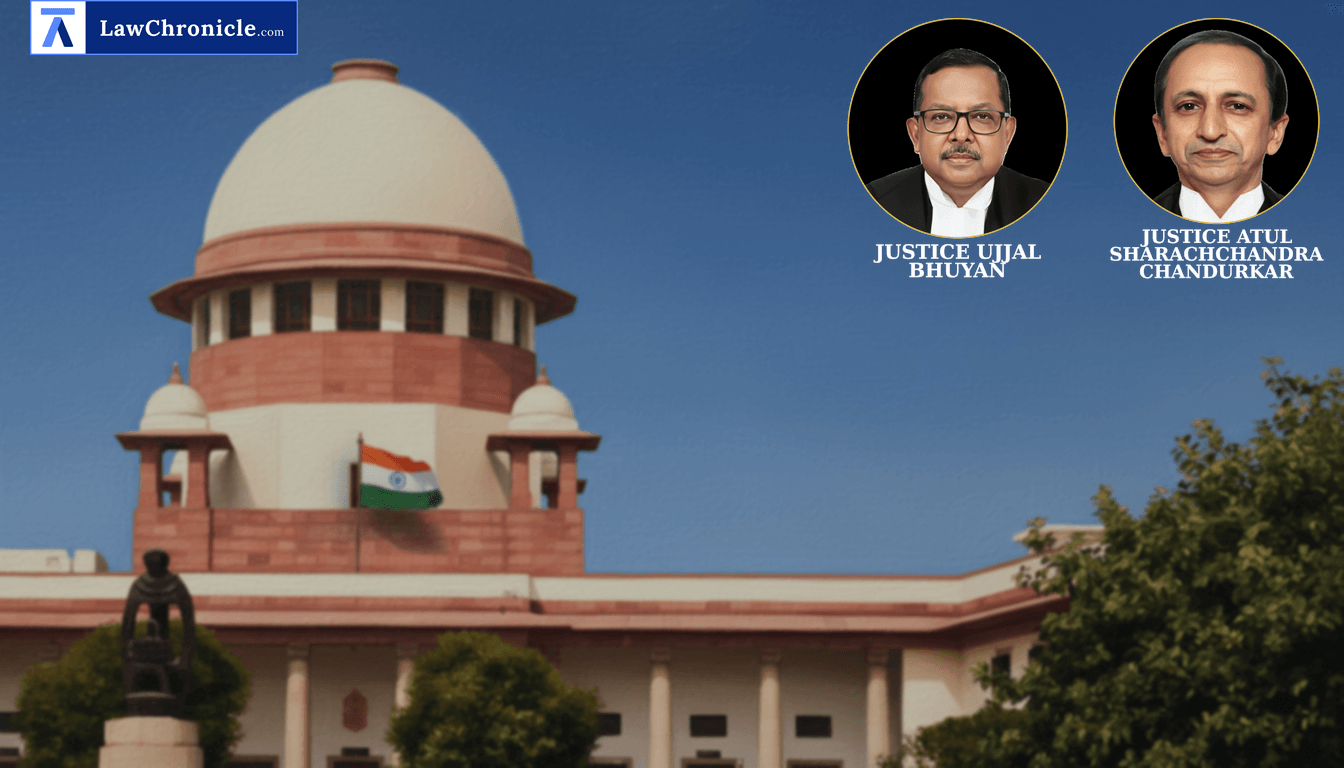
The Supreme Court has reminded that only the principal civil court of original jurisdiction, and not the High Court exercising Section 11 powers, holds the authority of extension of Arbitral Tribunal under Section 29A of the Arbitration and Conciliation Act, 1996.
A Division Bench comprising Justice Ujjal Bhuyan and Justice Atul S. Chandurkar settled a critical jurisdictional query under the Arbitration and Conciliation Act, 1996, clarifying that appointing an arbitrator under Section 11 does not grant the High Court residual supervisory powers to extend arbitral mandates.
Key Takeaways
- Section 29A Power Restored To Civil Courts: High Courts acting as appointing authorities under Section 11 do not retain supervisory jurisdiction to extend mandates.
- Moratorium under IBC Does Not Bar Corporate Debtor's Claims: Section 14 of the Insolvency and Bankruptcy Code, 2016 prevents claims against the corporate debtor but allows actions that enforce claims to bolster its financial health.
- Waiver and Acquiescence Bind Litigants: Participating in arbitral proceedings without timely objection under Section 16(2) waives any contractual right to insist on a multi-member panel.
Extension of Arbitral Tribunal
Addressing the interplay between Section 11 and Section 29A, the Supreme Court held that once an arbitral tribunal is constituted, Section 11 jurisdiction stands exhausted. The Court explicitly ruled that the High Court erred in holding that it possessed Section 29A jurisdiction merely by virtue of having appointed the arbitrator. The Court, in its reasoning, observed that "...The Supreme Court or the High Court referred to in Section 11 cannot be deemed to be the ‘court’ as defined in Section 2(1)(e)... Section 11 will have no bearing on the working of the provisions in Chapter V and VI where Section 29A is located and held that the power under sub-section (4) of Section 29A vests in the ‘court’ as defined in Section 2(1)(e) of the 1996 Act."
Regarding the moratorium under Section 14 of the Insolvency and Bankruptcy Code, 2016, the Apex Court affirmed that recovery proceedings pursued by a corporate debtor do not fall under the statutory bar.
Ratio
The power to grant an extension of an arbitral tribunal's mandate under Section 29A(4) of the Arbitration and Conciliation Act, 1996 exclusively resides with the 'court' as defined under Section 2(1)(e), namely, the principal civil court of original jurisdiction in a district or a High Court exercising ordinary original civil jurisdiction. Exercising power under Section 11 does not confer residual supervisory jurisdiction on the High Court over the arbitration proceedings.
Background
The dispute stemmed from a Distribution Franchisee Agreement entered into in 2013 between a distribution licensee and a franchisee, containing an arbitration clause requiring a three-member panel. When disputes arose, the High Court was approached under Section 11, and with the consent of both parties, a sole arbitrator was appointed in Union of India Vs. Pam Development Private Limited. Following the arbitrator's inability to continue, another sole arbitrator was appointed by consent in subsequent proceedings.
During the arbitral proceedings, corporate insolvency resolution proceedings were initiated against the special purpose vehicle under the Insolvency and Bankruptcy Code, 2016. Furthermore, the arbitration mandate lapsed after extensions, leading the parties to seek extension of time before the High Court under Section 29A. The licensee objected, claiming that the tribunal was improperly constituted as a sole arbitrator rather than a three-member panel, and questioned the court's jurisdiction under Section 29A.
The High Court held that it possessed Section 29A jurisdiction and extended the mandate, while rejecting the objections regarding coram and locus standi. In appeal, the Supreme Court examined precedents including Rohan Builders (India) (P) Ltd. Vs. Berger Paints (India) Ltd., C. Velusamy Vs. K. Indhera ( "(2026) 5 SCC 340": 2026 CaseBase(SC) 93), Lancor Holdings Ltd. Vs. Prem Kumar Menon, Jagdeep Chowgule Vs. Sheela Chowgule ( "(2026) 5 SCC 667 : 2026 SCC OnLine SC 124 : 2026 INSC 92": 2026 CaseBase(SC) 84), Union of India Vs. Pam Development Private Limited, State of West Bengal Vs. Associated Contractors ( "(2015) 1 SCC 32": 2014 CaseBase(SC) 599), and Chief Engineer (NH) PWD (Roads) Vs. M/s. BSC & C and C JV ( "SLP(C) No. 10544 of 2024, decided on 13.05.2024": 2024 CaseBase(SC) 5128).
While setting aside the High Court's finding on Section 29A jurisdiction, the Supreme Court noted that the District Court had already granted a six-month extension pursuant to interim orders, ensuring that the arbitral proceedings could seamlessly conclude.
Case Details:
Case No.: Civil Appeal No. 9313 of 2026
Neutral Citation: 2026 INSC 1165
Case Title: South Bihar Power Distribution Company Ltd. v. India Power Corporation Ltd. & Anr.
Appearances:
For the Petitioner(s): Mr. Sundaram, Senior Advocate; Mr. Raju Ramachandran, Senior Advocate
For the Respondent(s): Mr. Atmaram Nadkarni, Senior Advocate
Source: 2026 CaseBase(SC) 9500
Similar Articles
 Breaking News


