


Extension of Time to File Chargesheet Must Follow Due Process: SC
 Copy Link
 Share
 Save
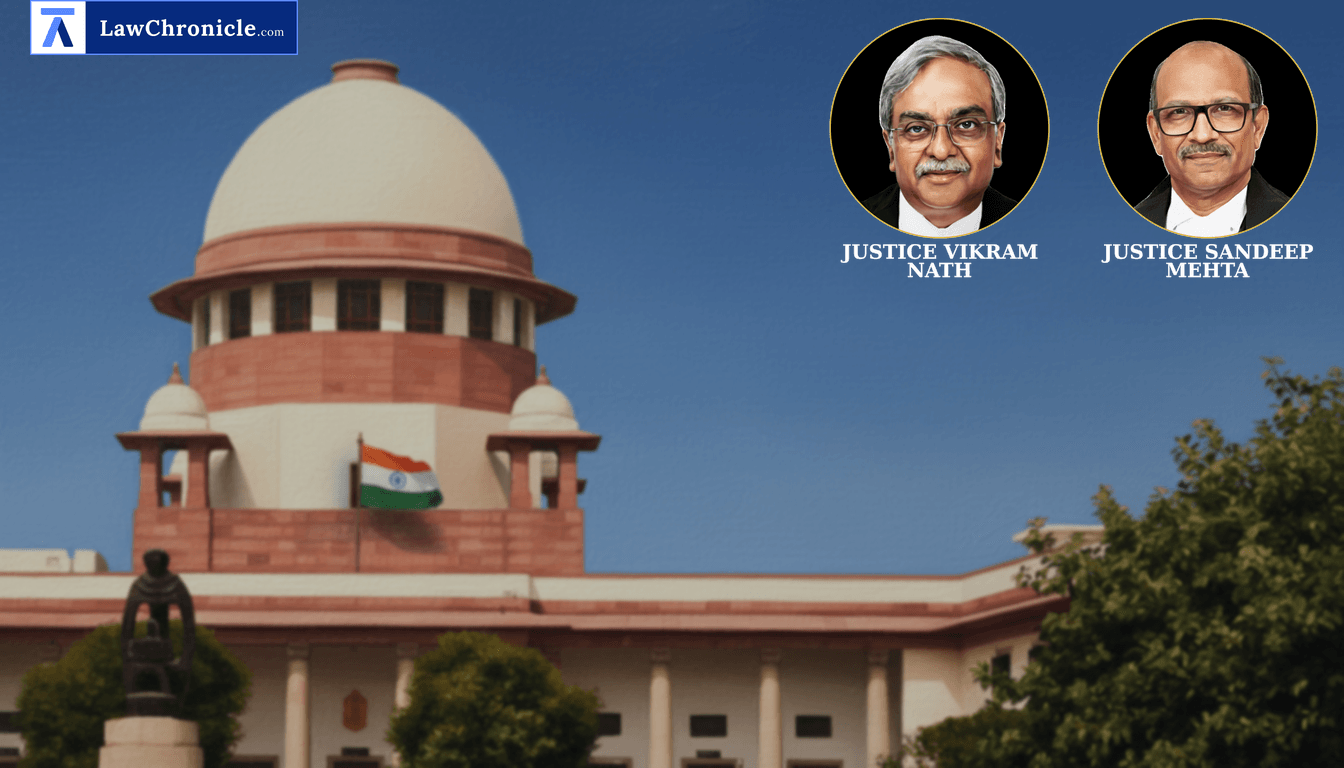
The Supreme Court has reiterated that the right to default bail is an indefeasible right linked to personal liberty, and any extension of the investigation period must involve notice to the accused and a judicial application of mind. A bench comprising Justice Vikram Nath and Justice Sandeep Mehta set aside a Jharkhand High Court order that had dismissed a default bail plea on the grounds that a chargesheet was filed within an illegally extended timeframe.
While addressing the mechanical nature of the trial court's orders, the bench observed that the failure to inform the accused about an extension application is not merely a procedural lapse but a gross illegality. The Court emphasized that the statutory mandate under Section 167(2) of the Code of Criminal Procedure, 1973 regarding the 90-day limit for investigation cannot be bypassed through perfunctory orders.
The Court, in its reasoning, observed: "The failure to procure the presence of the accused either physically or virtually before the Court and the failure to inform him that the application made by the Public Prosecutor for the extension of time is being considered, is not a mere procedural irregularity. It is gross illegality that violates the rights of the accused under Article 21."
The Court has the following directions:
"The appellant shall be released on default bail under Section 167(2) of the Code of Criminal Procedure, 1973 upon furnishing bail bonds and sureties to the satisfaction of the trial Court. The trial Court shall be entitled to impose suitable conditions to secure the presence of the accused during the trial."
The Mandatory Nature of Section 167(2) CrPC
The apex court highlighted that under the Code of Criminal Procedure, 1973, there is a clear restriction on the custody of an accused beyond 60 or 90 days. If the investigation remains incomplete, an indefeasible right to seek default bail arises. The Court noted that any direction to extend this period encroaches upon personal liberty as guaranteed under Article 21 of the Constitution of India and must be preceded by the recording of justifiable reasons.
Lack of Judicial Application of Mind
Examining the trial court's order sheets, the Supreme Court found that the Special Judge had extended the period for investigation based on a "bald submission" by the Public Prosecutor. The bench remarked that the orders were verbatim repetitions and lacked any specific analysis of the progress of the investigation or the necessity for continued detention. Referring to Jigar v. State of Gujarat, the Court noted that the Public Prosecutor must submit a report disclosing specific reasons for detention beyond 90 days, which the court must then evaluate.
Background:
The appellant was arrested in November 2023 for alleged offences under Sections 124A, 153A, and 120B of the Indian Penal Code, 1860 and various sections of the Unlawful Activities (Prevention) Act, 1967. As the 90-day period under Section 167(2) of the Code of Criminal Procedure, 1973 was nearing expiry on February 5, 2024, the Investigating Officer moved an application for extension on February 2, 2024.
The Special Judge allowed this extension on the same day without notifying the appellant or his counsel. Unaware of this, the appellant filed for default bail on February 8, 2024. The trial court rejected the bail plea on February 20, citing the prior extension. The Jharkhand High Court later dismissed the appellant's challenge, reasoning that since the chargesheet was filed within the extended period, the default bail plea had "lost its efficacy." The Supreme Court disagreed, holding that the original extension was void, thus crystallizing the appellant's right to bail.
Case Details:
Case No.: Criminal Appeal No. of 2026 (Arising out of SLP(Crl.) No. 11860 of 2025)
NeutralCitation: 2026 INSC 456
Case Title: Md. ARIZ HASNAIN @ ARIZ HASNAIN v. STATE OF JHARKHAND
Appearances:
For the Respondent(s): Shri Rajiv Shankar Dwivedi, learned standing counsel
Source: 2026 CaseBase(SC) 554
Similar Articles



 Breaking News


