


Filing FIR Or Seeking Maintenance Not Abetment To Suicide: SC
 Copy Link
 Share
 Save
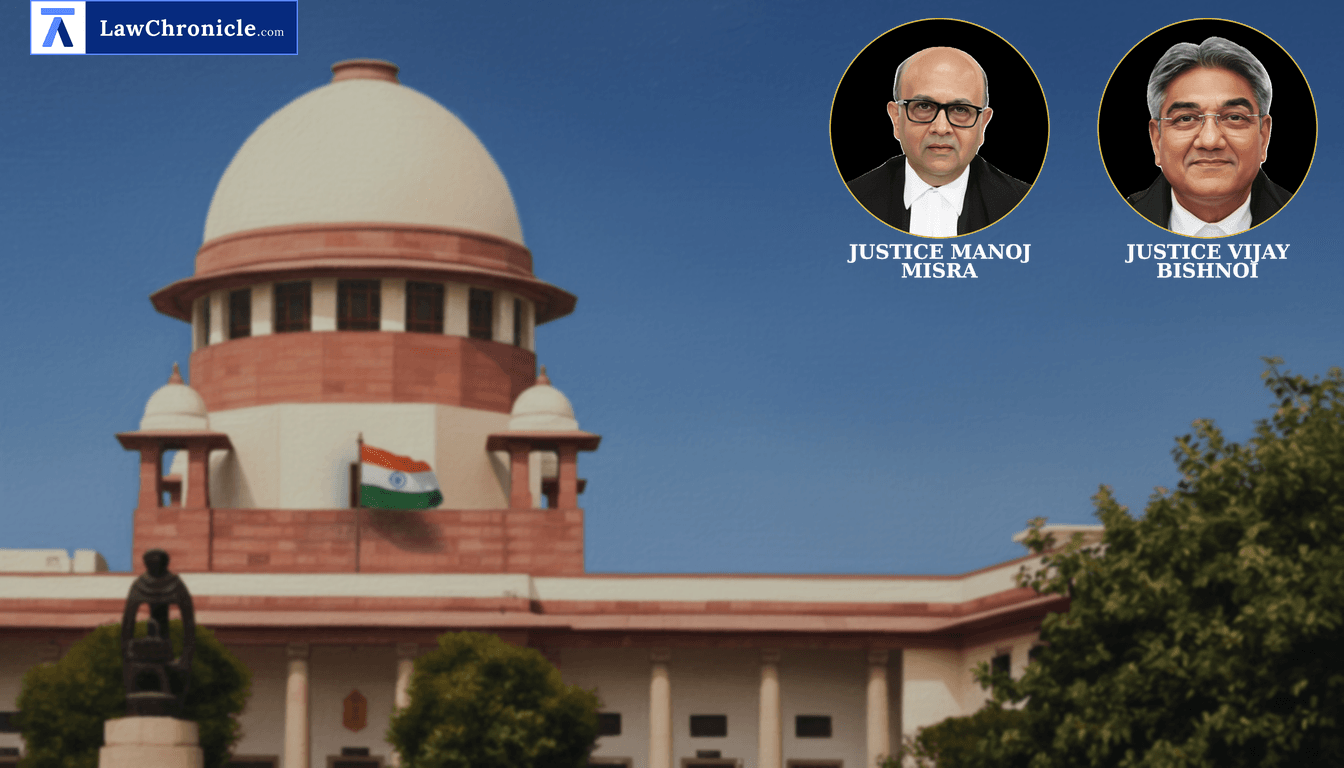
Initiating legal proceedings or lodging a criminal complaint against a spouse does not constitute instigation or abetment to suicide if the affected party ends their life out of frustration or fear of facing prosecution. Settling the parameters of criminal liability in matrimonial breakdowns, the apex court held that individuals exercising their legal rights to seek remedy or protection cannot be held culpable under suicide abetment laws merely because the opposite party takes a drastic step.
A bench comprising Justice Manoj Misra and Justice Vijay Bishnoi allowed an appeal against an order of the High Court of Gujarat, which had refused to quash a First Information Report (FIR) registered under Sections 306 and 114 of the Indian Penal Code, 1860 against the in-laws and brother-in-law of a deceased man.
Key Takeaways
Legal Recourse Is Not Abetment: Taking recourse to statutory remedies like lodging an FIR or seeking maintenance cannot be treated as instigation to commit suicide.
Objective Evaluation of Suicide Notes: Courts must examine suicide notes in conjunction with surrounding facts rather than relying solely on allegations made by an emotionally distressed individual.
Test of an Ordinary Person: To establish a prima facie case under Section 306, the alleged conduct must be such that it would drive an ordinary, reasonable person to take their own life, not an overly sensitive individual.
High Court's Duty Under Section 482: High Courts must not refrain from examining the underlying facts in depth when the cause of suicide is explicitly detailed in the FIR and suicide note.
Court's Analysis on Abetment and Legal Recourse
The Supreme Court observed that the basic ingredients of abetment under Section 107 of the Indian Penal Code, 1860 were completely absent from both the FIR and the deceased's suicide note. The Court emphasized that setting the criminal justice system in motion to enforce legal rights does not amount to criminal instigation.
The Court, in its reasoning, observed: "In our view, lodging an FIR, even if it is false, against a person, per se, does not amount to instigating that person to commit suicide. Besides, here the FIR was lodged by the deceased’s wife who had suffered injuries. Otherwise also, every individual has a right to take recourse to appropriate proceedings under law to protect his or her rights. Therefore, if a person sets the criminal justice delivery system in motion, he cannot be held liable for abetment to commit suicide, if the person against whom proceedings were initiated commits suicide."
Analyzing the evidentiary value of statements left behind by deceased individuals, the Court clarified that emotional dejection or frustration alone does not automatically translate into criminal guilt for those named.
The Court further noted: "While assessing whether a prima facie case of abetment to commit suicide is made out or not, the court must not merely consider the allegations in the suicide note but also the surrounding facts of the case. Merely because a dejected husband, or lover, out of frustration, ends his life and puts the blame on the accused, in his suicide note, is not enough to conclude that a prima facie case is made out against those who are blamed. The court would have to consider whether the conduct of the accused complained of in ordinary circumstances would have driven an ordinary person, not an over sensitive person, to take that drastic step to end his life."
The Court has following directions:
"The impugned judgment and order of the High Court is set aside. The impugned FIR and all consequential proceedings are hereby quashed."
Ratio
Initiation of legal proceedings or exercise of statutory rights does not, per se, constitute instigation or abetment to commit suicide under Section 107 of the Indian Penal Code, 1860, nor does it establish a prima facie case under Section 306, unless the conduct complained of would naturally drive an ordinary person to end their life. In non-presumptive cases outside Section 113A of the Evidence Act, 1872, emotional dejection or accusation in a suicide note without concrete acts of instigation or severe harassment cannot form the legal basis for criminal prosecution.
Background
The dispute originated from a strained marriage solemnized in 2009. On March 6, 2020, the wife lodged an FIR under Sections 498A and 323 of the Indian Penal Code, 1860 against her husband (the deceased), alleging physical assault and harassment, supported by a medical examination revealing multiple contusions. On March 21, 2020, the brother of the deceased filed a counter-FIR under Sections 306 and 114 of the Indian Penal Code, 1860 against the wife's parents and brother, alleging that their harassment, the false domestic violence FIR, and a maintenance notice had driven the husband to commit suicide.
The in-laws approached the High Court of Gujarat under Section 482 of the Code of Criminal Procedure, 1973 to quash the suicide abetment FIR. The High Court dismissed the application. Aggrieved, the appellants appealed to the Supreme Court. The Supreme Court examined the suicide note and police reports, confirming no homicidal angle existed. Finding that the deceased was frustrated due to marital discord and the legal actions initiated against him, and noting that the appellants resided separately and held no overbearing influence over him, the apex court set aside the High Court's order and quashed the FIR and consequential proceedings.
Case Details:
Case No.: Criminal Appeal No(s). /2026 (SLP (Crl.) No(s). 18705/2025)
Neutral Citation: 2026 INSC 886
Case Title: Patel Joshnaben Pravinkumar Patel & Ors. v. State of Gujarat & Anr.
Source: 2026 CaseBase(SC) 909
Similar Articles




 Breaking News


