


Government Duty To Hear Affected Parties Is Non-Delegable In Staff Fixation Disputes: Kerala HC
 Copy Link
 Share
 Save
The Kerala High Court has quashed government and university orders that bypassed mandatory hearing requirements for teaching staff, ruling that the executive cannot delegate its adjudicatory duty to statutory bodies when seniority and livelihoods are at stake. This decision reinforces the principle that procedural safeguards established by previous judicial mandates must be strictly followed to prevent administrative arbitrariness in educational appointments.
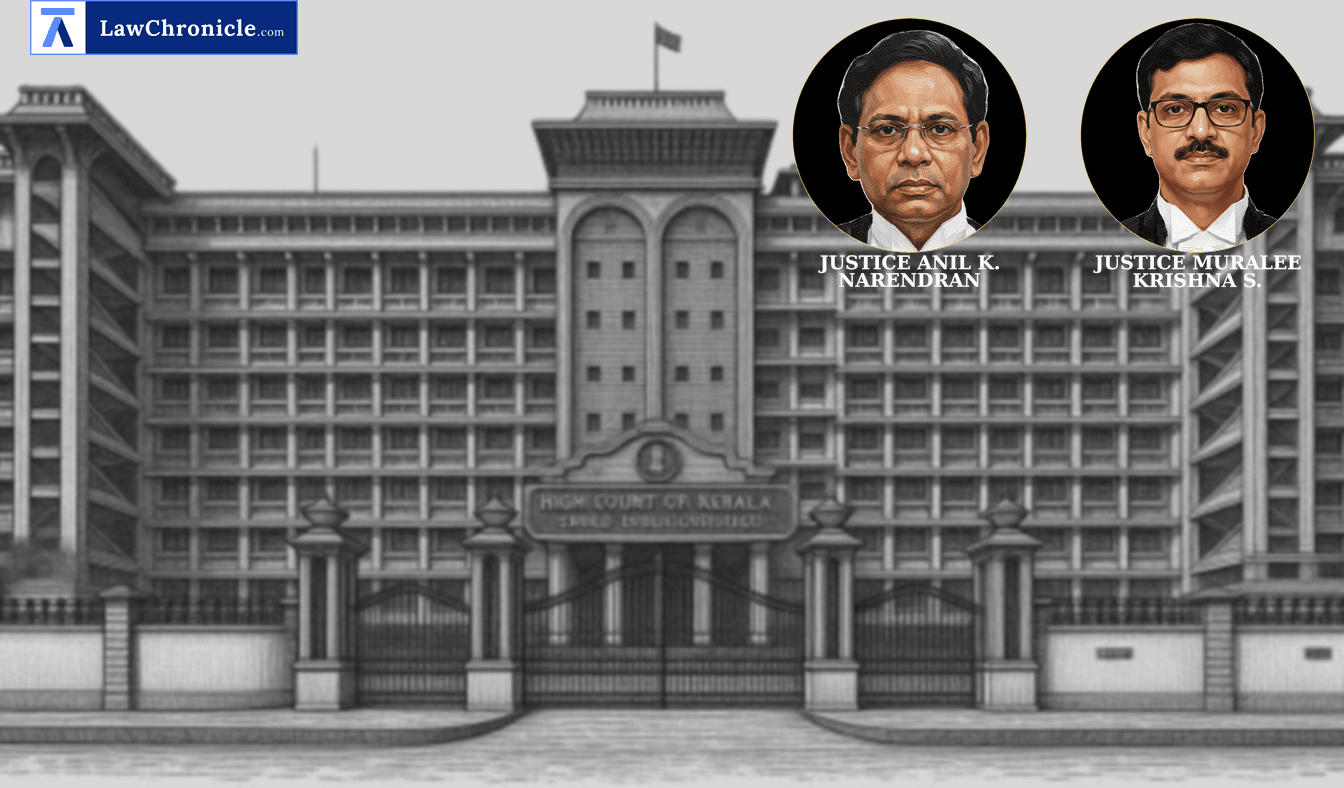
In a verdict delivered by a Division Bench comprising Justice Anil K. Narendran and Justice Muralee Krishna S., the Court addressed a critical breakdown in administrative procedure regarding the staff fixation and appointment regularisation at Sree Vidhyadhiraja Homoeopathic Medical College.
Key Takeaways
Non-Delegable Executive Duty
When a court directs the Government to take a decision, that duty cannot be unilaterally relegated to a University or any other statutory body.
Mandatory Right to Hearing
Decisions affecting the seniority and rank of long-serving employees cannot be finalized without affording an opportunity for representation to all affected parties.
Judicial Mandate Supremacy
Administrative orders that contradict or dilute specific procedural clarifications issued in previous judicial appellate judgments are legally unsustainable.
Retroactive Regularisation Limits
Administrative proposals for staff fixation must be scrutinized against established service rules and cannot be approved 'in toto' without examining individual eligibility and seniority claims.
Court Rebukes Delegation of Adjudicatory Functions
The Bench observed that the Government had failed to comply with the specific directions issued in W.P.(C) No. 18669 of 2006 and clarified in W.A. No. 1684 of 2015. While the High Court had previously directed the State Government to implement staff pattern decisions, the executive instead delegated this responsibility to the University via a 2016 order. The University subsequently approved appointments and promotions without hearing the affected petitioner, who claimed her seniority was being compromised.
The Court has the following directions:
"Exts.P16 and P19 orders passed by the Government and University respectively are liable to be set aside to the extent of approval of appointment granted to the appellant and respondents 7 to 9, and the Government has to reconsider the matter and pass appropriate orders after affording an opportunity to all the parties concerned to put forward their contentions on merits, as directed in W.P.(C) No. 18669 of 2006, which was later clarified in W.A. No. 1684 of 2015."
The Court, in its reasoning, observed: "The direction in W.P.(C) No. 18669 of 2006 and W.A. No. 1684 of 2015 was to the Government to take action to implement its decision in the light of the proposal to be submitted by the Manager. It was based on the decision of the Government that further action has to be taken by the University. But the Government delegated this duty to the University in Ext.P16 order, and the University passed Ext.P19 order without hearing all the parties."
Ratio
When a judicial direction mandates the State Government to adjudicate a proposal for staff fixation and specifically requires an opportunity of hearing for affected parties, the Government cannot delegate such a function to a University; any subsequent order passed by the University without hearing the concerned stakeholders is a violation of natural justice and judicial mandates.
Background
The appellant, Dr. Smitha M., was appointed as a Tutor in 2003 under the Kerala State Homoeopathic Medical Colleges Service Rules, 2001. Her appointment was approved by the University of Kerala with effect from January 10, 2003. However, following a series of litigations regarding staff patterns under the Direct Payment System, a fresh order was issued shifting her entry date to 2006, allegedly due to lack of requisite experience under CCH norms. This move effectively pushed her below respondents 7 to 9 in the seniority list.
The appellant contended that despite a Division Bench ruling in W.A. No. 1684 of 2015 requiring the Government to hear all similarly situated persons before finalizing any proposal, the Government issued an order delegating the decision-making power to the Kerala University of Health Sciences (Kerala High Court Act, 1958). The University then approved the Manager’s proposal without hearing her, leading to the current challenge under Section 5(i) of the Kerala High Court Act, 1958.
Case Details:
Case No.: WA NO. 1781 OF 2025
Neutral Citation: 2026:KER:82808
Case Title: DR.SMITHA M. v. STATE OF KERALA
Appearances:
For the Petitioner(s): Smt. Lakshmi Ramadas, Shri. M.R. Sabu, Smt. Aparna Rajan, Sri. Sreedhar Ravindran, Sri. P. Ravindran (Sr.)
For the Respondent(s): Shri. S. Ganesh, SC, Kerala University of Health Sciences, Shri. Sajeev Kumar K. Gopal, Sri. Jestin Mathew, Shri. P. Sreekumar (Sr.), Smt. Krishna Prabha, Sri. Chethan Krishna, Government Pleader
Source: 2026 CaseBase(KER) 33072
Similar Articles
 Breaking News


