


Gujarat HC Dismisses Recovery Suit Appeal, Says Mere Assertion Is No Proof
 Copy Link
 Share
 Save
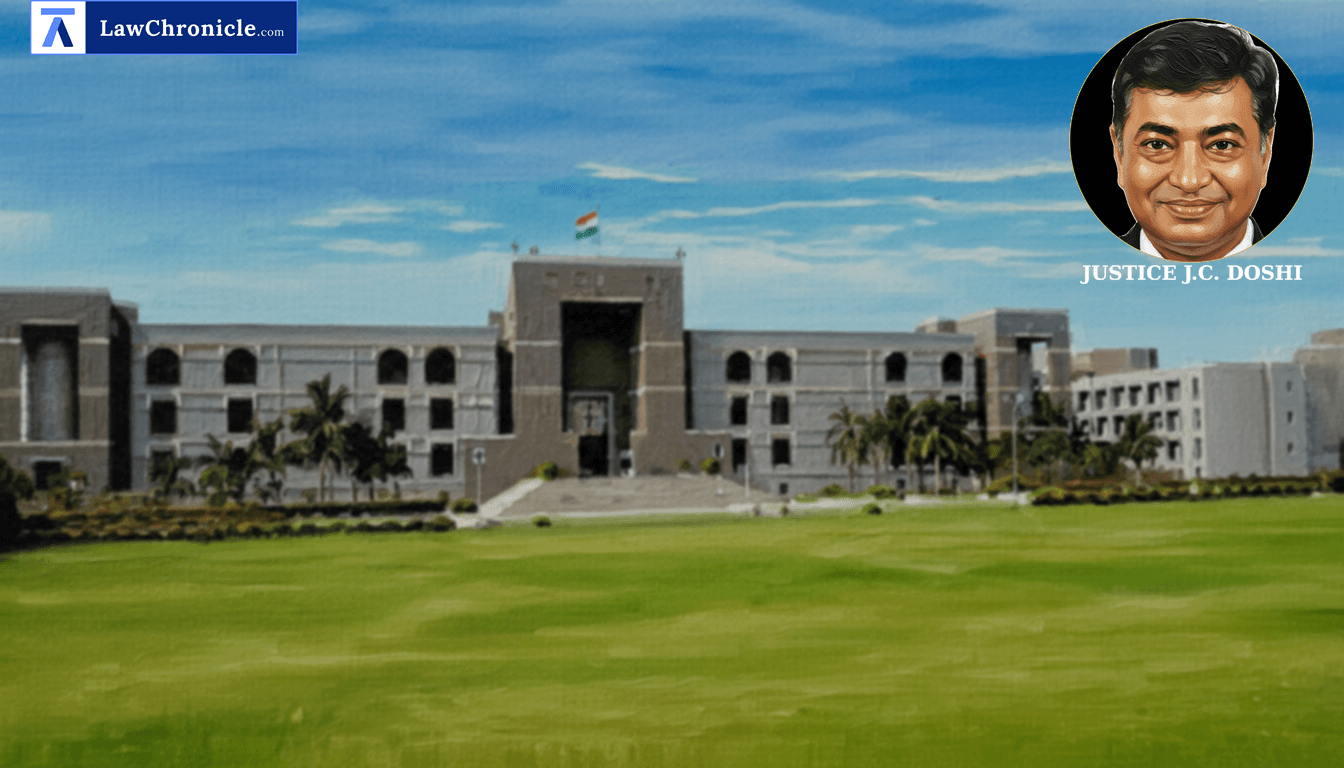
Substantiating financial claims with cogent documentary evidence remains a non-negotiable prerequisite for recovery suits, as the Gujarat High Court reaffirms that neither photocopies of accounts nor oral testimonies can substitute for original records and primary proof. This ruling underscores the stringent application of the 'burden of proof' doctrine, holding that even the absence or weakness of a defendant's case cannot relieve a plaintiff from the primary obligation of establishing their claim through admissible evidence.
In an ex parte hearing, Justice J. C. Doshi presided over a first appeal filed under Section 96 of the Code of Civil Procedure, 1908. The Court was tasked with determining whether a sub-contractor was entitled to additional recovery amounts after the trial court had only partially decreed the suit based on the defendant's specific admissions.
Failure to Discharge Burden of Proof Under Evidence Act
The Court conducted a rigorous analysis of the evidentiary standards required in civil recovery matters. It noted that the plaintiff had failed to produce essential documents such as original books of accounts, vouchers, or bills to support the claim for over Rs. 5 Lakhs. Relying on the principles enshrined in Section 101 and Section 102 of the Indian Evidence Act, 1872, the Court emphasized that the burden of proving a fact rests entirely on the party asserting its existence.
The Court, in its reasoning, observed: "Sections 101 and 102 of the Indian Evidence Act, 1872, cast the burden upon the plaintiff to prove the facts asserted by him... the burden of proving fact always lies upon the person who asserts it. Unless such burden is discharged, the other party is not required to be called upon to prove his case."
Inadmissibility of Photocopies as Primary Evidence
A pivotal point of the dispute involved a document marked as Exhibit 106, a photocopy of accounts. The Court rejected the appellant's reliance on this document, clarifying that a mere admission of handwriting by the defendant's son did not equate to an admission of the document's contents. Citing established legal positions, the Court noted that the plaintiff had not followed the legal procedure to introduce secondary evidence, such as directing the defendant to produce the original document.
The High Court's Observations and Final Decision
The Court found that the plaintiff's own counsel had suggested during cross-examination that only Rs. 35,096/- was outstanding, which was admitted by the defendant. The Court viewed this as a significant limitation on the plaintiff's claim.
The Court has the following directions:
"In view of the above, this Court finds no substance in the present first appeal. Accordingly, the first appeal stands dismissed. Registry is directed to return back the R & P, if any, to the concerned Court forthwith."
Background:
The dispute originated from a 1992 sub-contract where the plaintiff was engaged by the defendant to construct police quarters at Mandvi, Kachchh, for a project granted by the State Government. Upon completion, the plaintiff filed Special Civil Suit No. 27 of 1997, claiming Rs. 5,06,029/- under various heads, including unpaid security deposits, running bills, and interest at 30% per annum. The defendant resisted the suit, citing outstanding 'sales tax' dues but admitting a liability of Rs. 35,096/-.
The Trial Court at Bhuj concluded that the plaintiff had not produced corroborative evidence for the full amount and decreed the suit only to the extent of the admitted liability with 6% interest. The plaintiff appealed this decision, arguing that admissions made during cross-examination and documentary exhibits established the full debt. However, the High Court observed that the plaintiff failed to weave these elements into a legally sustainable proof of debt, eventually dismissing the appeal and upholding the trial court's findings.
Key Takeaways:
Strict Adherence to Burden of Proof
Proof of financial liability must be established independently by the plaintiff; the court will not grant a decree solely based on the weakness of the defendant’s evidence.
Limitations of Photocopies
Photocopied documents (secondary evidence) cannot be relied upon unless the party establishes the necessary legal foundation for their admission, such as proving the loss or unavailability of the original.
Admission of Handwriting vs. Admission of Content
Acknowledging that a document is in one's handwriting does not constitute a legal admission that the facts or figures contained in that document are correct or binding.
Ratio Decidendi:
In a suit for recovery of money, the plaintiff must prove their claim through cogent, reliable, and primary documentary evidence like books of accounts or vouchers. Under Section 101 and 102 of the Indian Evidence Act, 1872, the burden of proof never shifts to the defendant until the plaintiff has successfully established a prima facie case. Furthermore, entries in books of account are not sufficient by themselves to charge any person with liability without independent corroborative evidence as per Section 34 of the Indian Evidence Act, 1872.
Case Details:
Case No.: R/FIRST APPEAL NO. 1564 of 2006
NeutralCitation: 2026:GUJHC:40492
Case Title: HIRJI JADVA VARSANI Versus PINDORIYA & CO.
Appearances:
For the Petitioner(s): MR ANKIT Y BACHANI
For the Respondent(s): MS VIDHI J BHATT
Source: 2026 CaseBase(GUJ) 332
Similar Articles
 Breaking News


