


Gujarat HC Rules Tribunal Undervalued Disability in Motor Accident Claim, Raises Compensation
 Copy Link
 Share
 Save
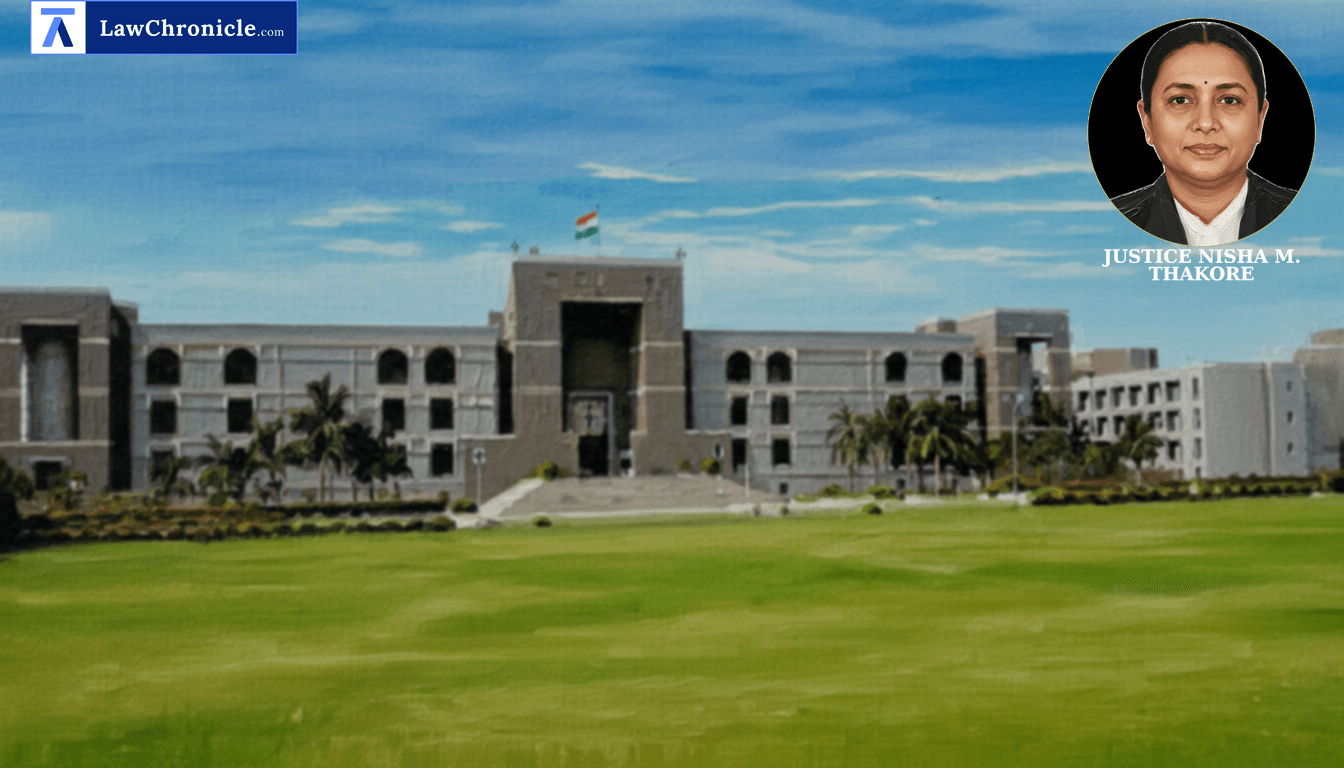
The Gujarat High Court in Karshan Hasam Koli v. Dharamshi Mema Bararia & Ors. enhanced the compensation, holding that the Tribunal erred in assessing the claimant’s functional disability at 50%. The Court noted that medical evidence established 70% permanent disability in both lower limbs, coupled with non-union of fractures, which rendered the claimant incapable of performing his cleaning job that required continuous mobility. Consequently, the Court treated the disability as amounting to 100% functional disability.
A bench of Honourable Ms. Justice Nisha M. Thakore heard an appeal under Section 173 of the Motor Vehicles Act, 1988 challenging a Motor Accident Claims Tribunal award under Section 166 of the Motor Vehicles Act, 1988 and addressed contesting contentions on income, disability and quantum of compensation arising from a 6 January 2008 collision.
The Court allowed the first appeal and enhanced the compensation, observing the Tribunal had erred in certain factual and legal assessments. The Court accepted that the claimant worked as a cleaner and had produced medical and disability evidence; it re-evaluated income on the basis of minimum wage norms and adjusted future prospects and multiplier accordingly before directing deposit and disbursement of the enhanced award.
The Court, in its reasoning, observed: At this stage, it would be appropriate to consider the guiding principles laid down by the Hon'ble Supreme Court in the case of Raj Kumar v. Ajay Kumar and another ( "2011 (1) SCC 343": 2010 CaseBase(SC) 368) as rightly submitted by the learned advocate for the appellant, while considering the permanent disability and the extent of such permanent disability in light of the impact caused on the earning capacity of the injured, the Courts or the Tribunals are required to bear in mind the nature of disablement, whether being permanent or temporary. The Courts are further directed to take into consideration factor in case of permanent disablement as to whether it was permanent total disablement or permanent partial disablement. The Courts are also directed to take into consideration that if the disablement percentage is expressed with reference to any specific limb, then the effect of such disablement of the limb on the functioning of the entire body was required to be taken into consideration for the purpose of determination of actual permanent disability suffered by the person. As regards functional disability, the Courts have been directed to first ascertain as to what activities the claimant used to carry out inspite of the permanent disability and what he could not do as a result of permanent disability. The Courts are also directed to bear in mind the avocation, profession, and nature of work of the person before the accident as also his age. It has been further directed to consider find out as to whether the claimant is totally disabled from earning any kind of livelihood or whether inspite of permanent disability, the claimant could still effectively carry on the activities and functions, which he was earlier carrying on or whether he was prevented or restricted from discharging his previous activities and functions, but could carry on some other or lesser scale of activities and functions so that he continues to earn or can continue to earn his livelihood.
Background
The appellant claimant had moved the Tribunal after sustaining grievous injuries in the 2008 accident and the Tribunal had awarded Rs.4,85,000 in May 2014. The challenge before the High Court contended that the Tribunal had undervalued the claimant's income, declined to apply appropriate minimum wage standards and had assessed functional disability at 50% despite medical evidence. The claimant testified that he earned Rs.4,000 per month as a cleaner; the Tribunal adopted a notional income of Rs.2,500 for lack of documentary proof. The medical records and a disability certificate dated 4 August 2012 recorded non‑union of fractures in both lower limbs and clinical findings that the claimant "cannot walk / nor stand" and was largely dependent, with the treating surgeon assessing 70% disability in each lower limb and stating that as a cleaner his functional disability was 100%.
The High Court held that in fixing notional income and prospects the Tribunal had omitted to apply settled principles permitting reliance on notified minimum wages where income documentary proof was absent, as explained in Govind Yadav vs. New India Assurance Company Limited, and therefore readjusted the notional income using State minimum wage rates notified under the Minimum Wages Act, 1948. The Court further examined the impact of the permanent disability on the claimant's vocation in light of the principles in Raj Kumar v. Ajay Kumar and another ( "2011 (1) SCC 343": 2010 CaseBase(SC) 368) and the guidance on future prospects in National Insurance Company Limited v. Pranay Sethi ( "2017 (16) SCC 680": 2017 CaseBase(SC) 551), applying a 40% addition for future rise in income and a multiplier of 18 which the parties had not contested.
Relying on the medical evidence and the treating surgeon's findings, the Court accepted that the injuries caused life‑long impairment that effectively deprived the claimant of his ability to perform his pre‑accident manual work and concluded the claimant suffered 100% functional disability for vocational purposes. The Court therefore fixed notional monthly income at Rs.2,700 by applying the State minimum wage notified for the period in question under the Minimum Wages Act, 1948, added 40% as guided by National Insurance Company Limited v. Pranay Sethi ( "2017 (16) SCC 680": 2017 CaseBase(SC) 551) to reach prospective monthly income of Rs.3,780, applied the agreed multiplier of 18 and recomputed future loss. The Court also increased the heads of non‑pecuniary damages, awarding Rs.50,000 for pain and suffering and Rs.50,000 for loss of amenities, while confirming transportation and medical expense awards.
The High Court modified the Tribunal's award and held the claimant entitled to a total of Rs.9,36,480 with interest at 10% per annum from the date of filing the claim petition until realization, directed respondent insurers to deposit the enhanced amount and instructed the Tribunal to disburse the award in accordance with Supreme Court guidelines after verifying court fee issues.
The judgment quoted the treating surgeon's findings that the patient "cannot walk / nor stand" and recorded the medical opinion that "The above accidental injuries have resulted into permanent physical disability of 70% of Right Lower Limb and 70% of Left Lower Limb. As a cleaner his functional disability is 100% i.e. permanent & total." The Court referred to National Insurance Company Limited v. Pranay Sethi ( "2017 (16) SCC 680": 2017 CaseBase(SC) 551) for the proposition on applying a percentage addition for future prospects, to Raj Kumar v. Ajay Kumar and another ( "2011 (1) SCC 343": 2010 CaseBase(SC) 368) for the guiding principles on assessing functional disability and to Govind Yadav vs. New India Assurance Company Limited for the discretionary use of minimum wages under the Minimum Wages Act, 1948 where direct proof of income was absent.
Case Details:
Case No.: C/FA/1526/2015
NeutralCitation: 2026:GUJHC:30566
Case Title: KARSHAN HASAM KOLI Versus DHARAMSHI MEMA BARARIA & ORS.
Appearances: For the Petitioner(s): MR MEHUL S SHAH(772); MR VISHAL C MEHTA(6152)
For the Respondent(s): MR NIKUNT K RAVAL(5558); MR VIBHUTI NANAVATI(513)
Source: 2026 CaseBase(GUJ) 228
Similar Articles
 Breaking News


