High Courts Cannot Arbitrarily Grant Lumpsum Motor Accident Compensation: SC
 Copy Link
 Share
 Save
Cracking down on mechanical appellate orders, the Supreme Court ruled that High Courts must systematically assess every individual head of claim when deciding motor accident compensation appeals. The Bench emphasized that arbitrary lumpsum enhancement of motor accident compensation without evaluating individual heads of damages constitutes an exercise of guesswork rather than sound judicial procedure.
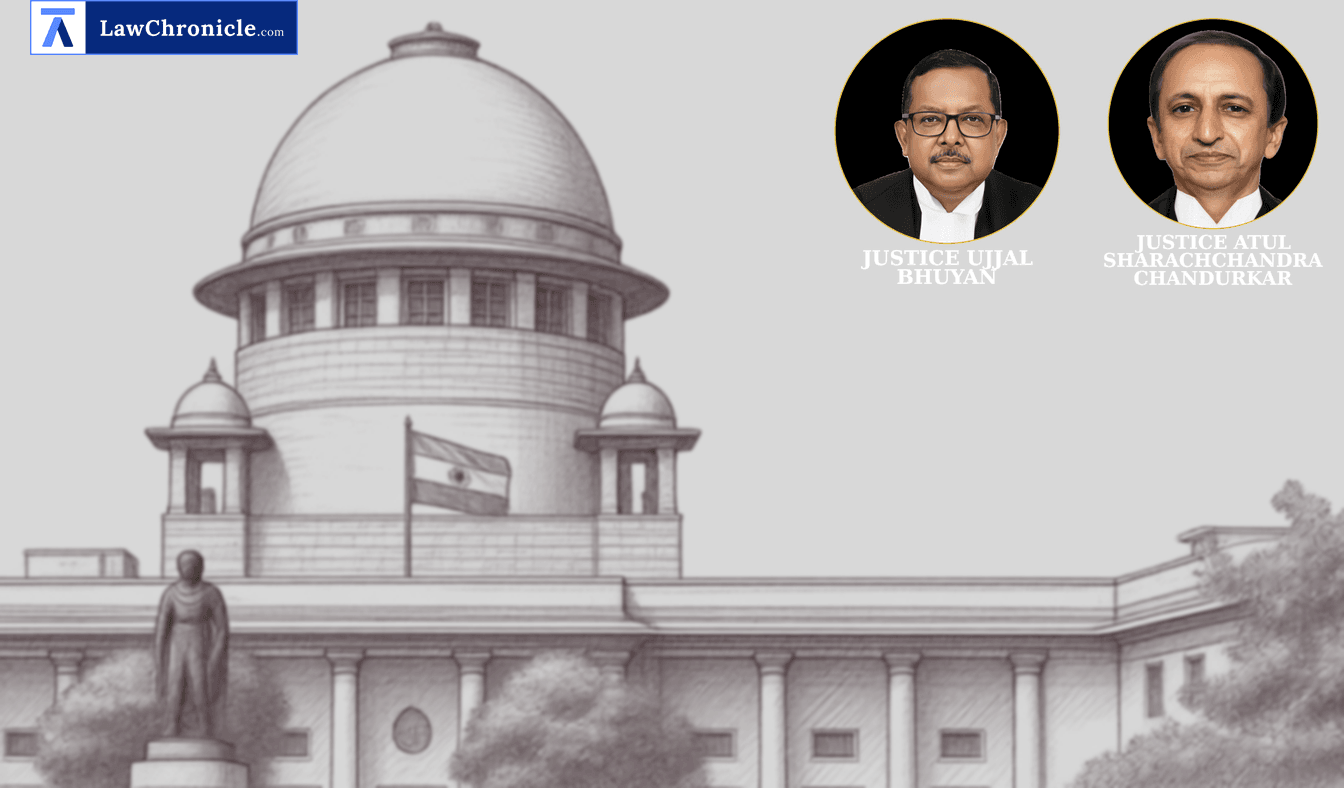
A bench comprising Justice Ujjal Bhuyan and Justice Atul S. Chandurkar heard an appeal seeking enhancement of compensation under Section 166 of the Motor Vehicles Act, 1988. The Apex Court scrutinized an order of the Madhya Pradesh High Court which had granted a generic lumpsum enhancement without providing a head-wise breakdown of the revised amount.
Key Takeaways
- Mandatory Head-Wise Calculation: Appellate courts cannot grant arbitrary composite additions; they must re-determine compensation across specific pecuniary and non-pecuniary heads.
- Minimum Wages as Benchmark: In the absence of documentary proof of income, standard notional income cannot be fixed arbitrarily and must align with prevailing minimum wages for unskilled workers.
- Functional Disability Assessment: Permanent physical impairment must be evaluated against the nature of the claimant's occupation to determine actual loss of earning capacity.
- Interest Disallowance for Delay: Claimants remain disentitled to interest for periods during which their proceedings stood dismissed for non-prosecution.
Court's Analysis and Determination of Just Compensation
The Supreme Court observed that the High Court erred in awarding a composite increase without providing any analytical basis. Applying the law laid down in Raj Kumar Vs. Ajay Kumar and another ( "2010 INSC 703": 2010 CaseBase(SC) 368), the bench recalculated the compensation across all statutory parameters. The Apex Court noted that since no formal proof of monthly income was available, the notional income had to be computed based on the minimum wages applicable to an unskilled worker at the time of the accident. Evaluating the claimant's occupational requirement of travelling to collect and sell milk, the Bench assessed his functional disability at 50%, relying on the precedent set in Indra Bai vs. Oriental Insurance Company Ltd. and Another ( "2023 INSC 624": 2023 CaseBase(SC) 544). Furthermore, future prospects were added at 40% in line with the ruling in National Insurance Company Limited vs. Pranay Sethi and Others ( "2017 INSC 1068": 2017 CaseBase(SC) 551).
The Supreme Court explained its stance that "In our view, the High Court ought to have adverted to each head under which compensation was awarded by the Tribunal and then determined whether such grant was just or not. A composite increase in the amount of compensation without indicating the basis for the same could be termed as an exercise of guesswork rather than applying the law laid down in this regard."
Ratio
Appellate courts deciding motor accident claims must strictly evaluate and record findings on each distinct head of pecuniary and non-pecuniary damages rather than awarding ad-hoc, composite enhancement amounts. Where clear proof of income is lacking, minimum wage rates prescribed for unskilled labor must form the baseline for determining loss of earning capacity.
Background
The dispute originated from a road accident on April 24, 2013, when the appellant's motorcycle was hit by a rashly driven truck. The appellant sustained permanent physical disability to his right leg, certified at 50%. The Motor Accident Claims Tribunal awarded ₹2,33,130/- as compensation, considering a nominal income of ₹4,000/- per month and a reduced functional disability of 20%.
Upon appeal under Section 173(1) of the Motor Vehicles Act, 1988, the MP High Court partially enhanced the compensation by a lumpsum amount of ₹2,00,000/-. Displeased with the non-reasoned enhancement, the appellant approached the Supreme Court.
Allowing the appeal, the Supreme Court modified the award and increased the total compensation to ₹11,75,106/- with 7% interest per annum from the date of filing the petition, while maintaining the exclusion of interest for the period during which the appeal remained dismissed for default.
Case Details:
Case No.: Civil Appeal No. 13804 of 2026
Neutral Citation: 2026 INSC 1255
Case Title: Mohammad Sabir v. Ramesh Prasad and Others
Appearances:
For the Petitioner(s): Mr. N.K. Mody, Senior Advocate
For the Respondent(s): Mr. Sanathana Bhaarath, Advocate
Source: 2026 CaseBase(SC) 10315
Subscribe to Our Newsletter for receiving Weekly Updates on your E-Mail
Similar Articles
 Breaking News