

Imran Khan Asked to Leave India: Analysing the Law on OCI and Protests
 Copy Link
 Share
Share Save
Save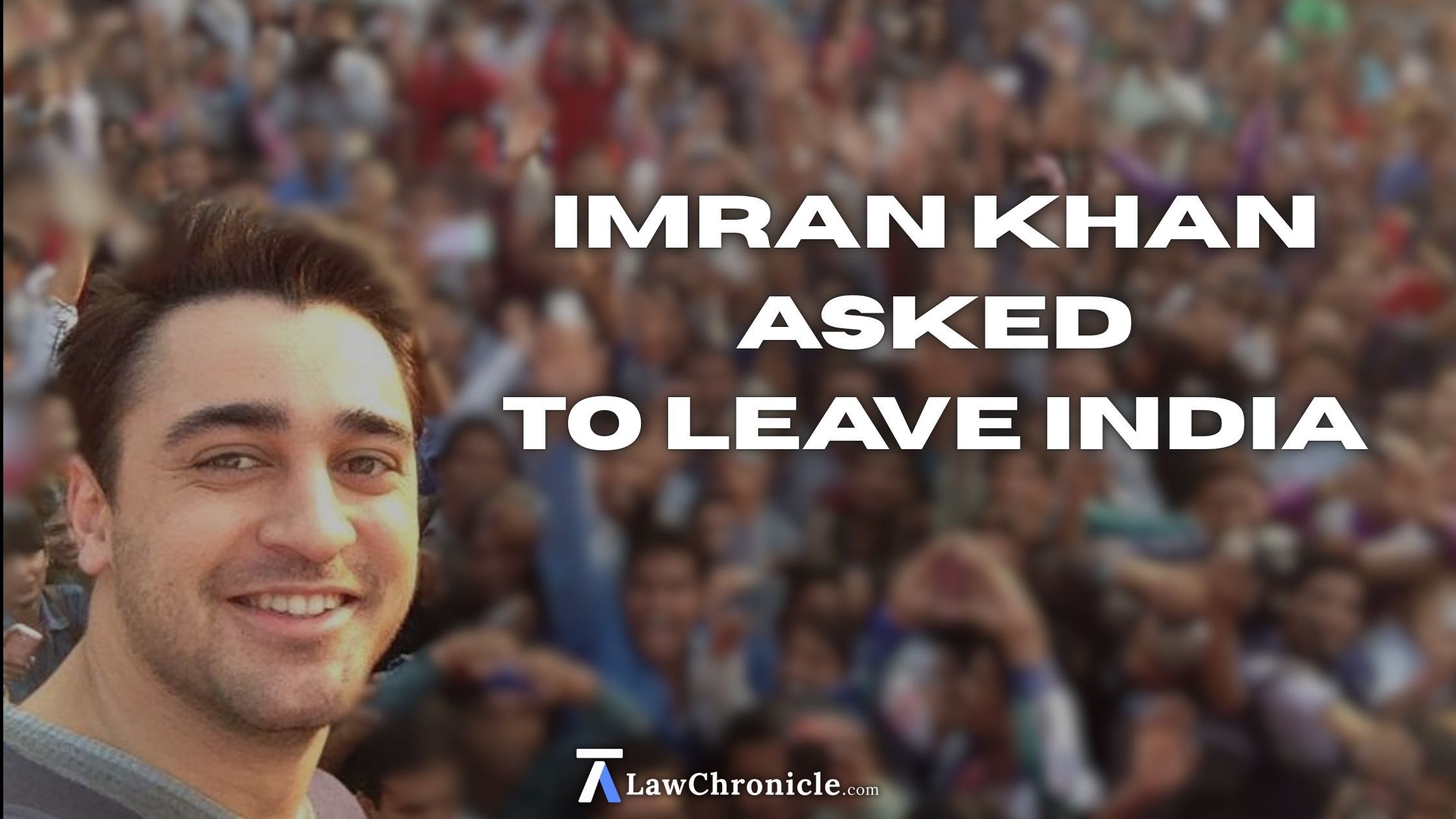
Several news reports are circulating that Actor Imran Khan has been asked to leave India by October 28, 2026, days after he took part in a Cockroach Janta Party (CJP) protest in Mumbai. Reports state that the direction was issued under Sections 7 and 29 of the Immigration and Foreigners Act, 2025, on the basis that he is not an Indian citizen. Here is a look at what happened, and what the law provides on Overseas Citizen of India (OCI) status, on directing a foreigner to leave, and on the punishment of protesters.
News: Imran Khan Asked to Leave India
According to media reports, Imran Khan arrived in India from Germany earlier this month and joined a CJP protest in Bengaluru on October 8. On October 10, he was at August Kranti Maidan in Mumbai, where the CJP had called for the resignation of Chief Election Commissioner Gyanesh Kumar. The CJP's demand relates to alleged irregularities in the Special Intensive Revision (SIR) of electoral rolls and the use of Form 6, which is used to register new voters.
Mumbai Police detained more than 400 people at the venue and elsewhere in the city, including Imran Khan, his partner Lekha Washington and his cousin Zayn Marie Khan. They were later released. In Delhi, around 1,000 people were reportedly detained while attempting to march to Jantar Mantar. CJP workers said they had emailed the police seeking permission for the Mumbai protest and received no response. Imran Khan allegedly told reporters that he had no demands, that he was present as a citizen of India, and that he was not affiliated with any organisation.
On October 13, BJP leader Kirit Somaiya wrote to the Union Home Secretary seeking a Look Out Circular (LOC) against Imran Khan under the Immigration and Foreigners Act, 2025. He claimed that Imran Khan is a US citizen who reportedly holds an OCI card. Reports state that a complaint was lodged at Gamdevi police station and forwarded to the Foreigners Regional Registration Office (FRRO), which issued the notice. The Mumbai Police stated that action had been taken under the relevant provision of the Immigration Act over Khan's participation in the protest despite not being an Indian citizen.
What is an OCI card?
In terms of citizenship OCI stands for Overseas Citizen of India. An OCI card is not Indian citizenship. Section 7A of the Citizenship Act, 1955 allows the Central Government to register certain persons of Indian origin as Overseas Citizens of India. Cardholders get a lifelong, multiple-entry visa. They remain foreign nationals and cannot vote or contest elections. Section 7B provides that OCI cardholders receive only such rights as the Central Government notifies, and excludes the political and public-office rights of citizens. A Ministry of Home Affairs notification dated March 4, 2021 requires OCI cardholders to obtain a special permission or permit for:
- research;
- missionary, Tabligh, mountaineering or journalistic activities;
- internships in, or employment with, foreign diplomatic missions or foreign government organisations; and
- visits to protected, restricted or prohibited areas.
This also means that the notification places OCI cardholders on a par with foreign nationals in matters it does not specifically cover. Attending a public protest is not listed among the activities needing special permission. However, the OCI rules do not expressly require prior permission to attend a public protest.
Under Section 2(f) of the Immigration and Foreigners 2025 Act, a "foreigner" is a person who is not a citizen of India. An OCI cardholder is therefore a foreigner for the purposes of that Act. Courts have also treated the foreigners' law as applicable to OCI cardholders.
OCI registration can be cancelled under Section 7D of the Citizenship Act. The grounds include registration obtained by fraud, disaffection towards the Constitution, a sentence of imprisonment of two years or more within five years of registration, and violation of laws specified by notification.
Law on Asking a Foreigner to Leave India
The Immigration and Foreigners Act, 2025 came into force on September 1, 2025. It repealed the Foreigners Act, 1946, the Registration of Foreigners Act, 1939, the Passport (Entry into India) Act, 1920 and the Immigration (Carriers' Liability) Act, 2000. Here is a look at some relevant aspects:
- Section 7 (orders, directions or instructions): The Central Government may, by order, prohibit, regulate or restrict the entry, departure, presence or continued presence of foreigners, generally or of a particular foreigner. Section 7(2)(c) allows an order that a foreigner "shall not remain in India". Section 7(2)(f) allows conditions on a foreigner, including restrictions on movement, association, and engaging in "activities of a specified description". Under Section 7(4), any authority specified for the purpose may issue clause (f) orders for a particular foreigner.
- Section 29 (power of removal): The Central Government may, by general or special order, direct the removal of a foreigner from India "for contravention of any of the provisions of this Act or any rule or order made thereunder or an adverse security report". Officers of the Government then have all reasonable powers necessary to enforce the direction.
- Delegation: Under Section 28, the Central Government may, by notification, delegate its powers to a subordinate officer or authority, or to a State Government or its officers. The FRRO functions as part of the Bureau of Immigration under Section 5(4).
- The 2025 Order: The Immigration and Foreigners Order, 2025 (S.O. 3986(E), September 1, 2025) lists grounds for refusing a foreigner entry into or stay in India. These include convictions for specified offences, membership of an organisation declared unlawful under the Unlawful Activities (Prevention) Act, 1967, and entry or stay being barred by a specific order of the Central Government. Participation in a protest is not listed as a ground. Paragraph 8 allows a civil authority to impose conditions on a foreigner's residence, movements and associations by written order.
- If the direction is not complied with: Under Section 20, a failure to comply with a direction is deemed a contravention of the Act. Section 23(b) provides imprisonment of up to three years, or a fine of up to ₹3 lakh, or both, for contraventions with no specific punishment. Section 25 allows certain offences to be compounded. Section 26 allows a police officer of Head Constable rank or above to arrest without warrant a person who has contravened Section 3 or any rule or order made under it. Section 7(2)(d) and paragraph 13 of the Order allow the cost of removal to be recovered from the foreigner. Section 16 places the burden of proving that a person is not a foreigner on that person.
Law to Punish Protesters
There is no standalone statute punishing a peaceful protest. Liability arises from the conditions under which an assembly takes place:
- Section 163 of the Bharatiya Nagarik Suraksha Sanhita, 2023 (BNSS), which replaced Section 144 of the Code of Criminal Procedure, allows an Executive Magistrate to prohibit assemblies in urgent cases of nuisance or apprehended danger.
- Disobedience of such an order is punishable under Section 223 of the Bharatiya Nyaya Sanhita, 2023 (BNS). The punishment is up to six months' imprisonment or a fine of up to ₹2,500 or both, and up to one year or a fine of up to ₹5,000 or both where the disobedience causes danger to human life, health or safety, or tends to cause a riot or affray. Courts can take cognizance only on a written complaint by the public servant concerned.
- Under Section 189 of the BNS, an assembly of five or more persons becomes an unlawful assembly if it has one of the purposes listed in that section. Section 148 of the BNSS empowers magistrates and senior police officers to disperse it.
- State police legislation, such as the Maharashtra Police Act, 1951, is also commonly invoked in city-level restrictions on assemblies.
A direction to leave India is not a punishment under any of these provisions. It is an administrative power over foreigners under the 2025 Act.
Constitutional Position of Foreigners in India
The freedoms of speech and of peaceful assembly under Article 19(1)(a) and (b) of the Constitution of India belong to citizens. Foreigners are protected by Constitution's Article 14 (equality) and Article 21 (life and personal liberty). In Hans Muller of Nurenburg v. Superintendent, Presidency Jail, Calcutta (1955 CaseBase(SC) 120) and Louis De Raedt v. Union of India (1991 CaseBase(SC) 80), the Supreme Court held that the Government's power to expel foreigners is absolute and unlimited, and that a foreigner's fundamental right is confined to Article 21, which does not include a right to reside and settle in India.
Judicial Treatment of OCI Cardholders
In 2025, the Delhi High Court (Justice Sachin Datta) held in Ashok Swain's case that the OCI cancellation order could not stand without a reasonable opportunity of being heard under Section 7D. In John Robert Roughton III v. Union of India (2025 CaseBase(DEL) 9), it held that deportation and blacklisting of an OCI cardholder without notice of grounds or a hearing failed the requirements of Section 7D. The Kerala High Court has held that foreigners must be heard before orders restricting their movement are passed. These rulings arose under the Foreigners Act, 1946. Section 34 of the 2025 Act states that its provisions are in addition to, and not in derogation of, other laws, which leaves the Citizenship Act safeguards in place.
 Breaking News