


Insurance Company Must Pay Third Party Even If Driver Lacks Valid License: Meghalaya HC
 Copy Link
 Share
 Save
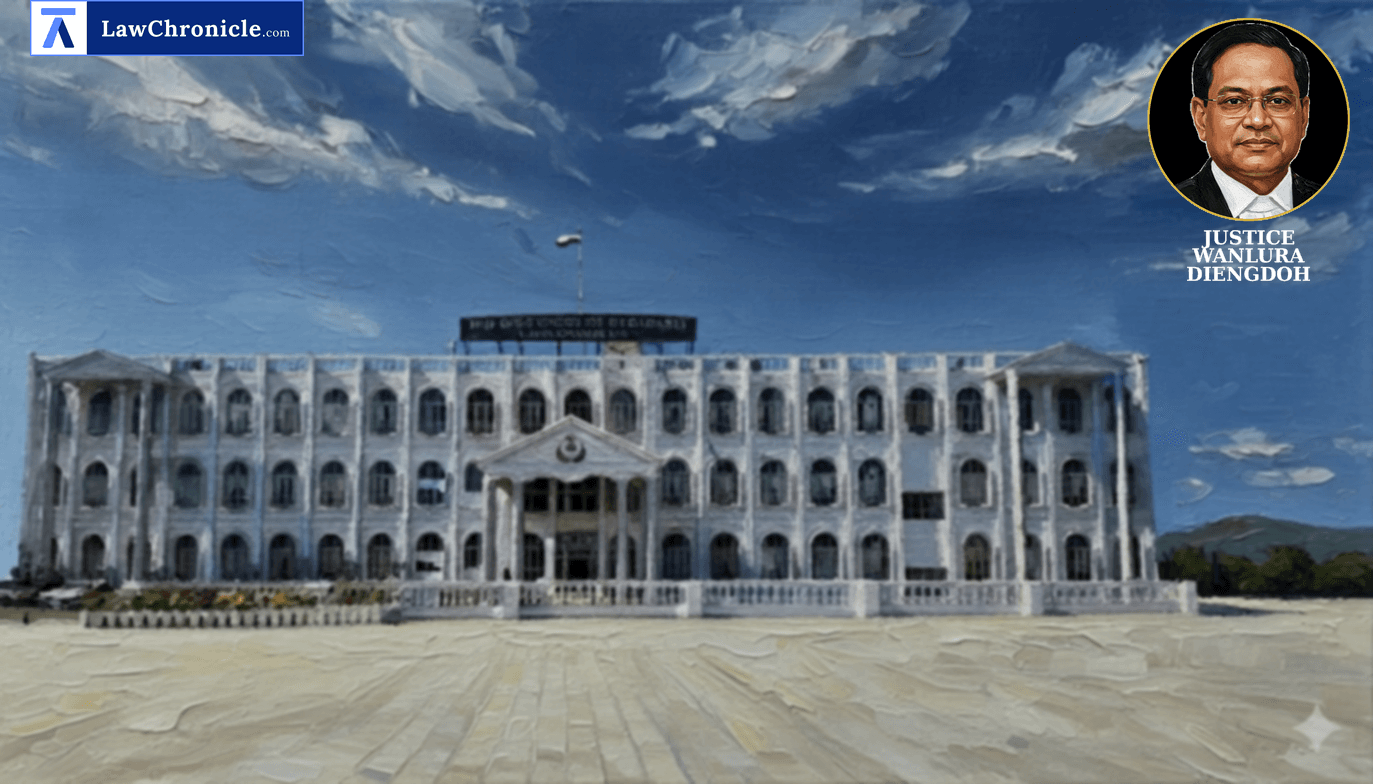
The Meghalaya High Court has reaffirmed the robust protection afforded to third-party claimants in motor accident disputes, ruling that an insurance company cannot escape its statutory liability even when a driver's license is found to be invalid or non-existent. In a significant application of the 'Pay and Recover' principle, the Court held that the burden of proving a total absence of a license rests heavily on the insurer, and any ambiguity in evidence must weigh in favor of the victim.
Justice W. Diengdoh presided over the appeal filed by the United India Insurance Company Ltd. challenging a Motor Accident Claims Tribunal (MACT) award. The central legal conflict revolved around whether the insurer could be absolved of liability because the driver of a Bolero Pick-Up, which caused a fatal accident in 2014, allegedly did not possess a valid driving license at the time of the incident.
Insurer's Failure to Prove Total Absence of License
The appellant insurance company argued that since the Investigating Officer (I/O) testified that the driver failed to produce a license upon surrendering, it constituted a total lack of license rather than a mere 'invalid' one. They relied on Pappu and Ors. v. Vinod Kumar Lamba and Anr. ( "(2018) 3 SCC 208": 2018 CaseBase(SC) 1184) to assert that the owner had failed to meet the foundational facts required to fasten liability on the insurer. However, the Court scrutinizing the I/O’s testimony observed a critical nuance: the driver stated he did not possess a 'valid' license, which the Court interpreted as leaving room for the existence of an invalid or fake license rather than a complete absence.
Application of the 'Pay and Recover' Doctrine
Drawing from New India Assurance Co., Shimla v. Kamla & Ors. ( "(2001) 4 SCC 342": 2001 CaseBase(SC) 432) and National Insurance Co. Ltd. v. Swaran Singh & Ors. ( "(2004) 3 SSC 297": 2004 CaseBase(SC) 114), the High Court emphasized that the insurer is statutorily bound to satisfy third-party claims arising from a valid insurance policy. Even if there is a breach of policy conditions such as allowing an unlicensed person to drive the insurer must first pay the compensation to the victim and subsequently seek recovery from the vehicle owner.
The Court, in its reasoning, observed: "The fact is that the driver never said he does not have any licence, but that he does not have any valid driving licence. The words valid driving licence carries a meaning which can be assumed that the said driver does possess a driving licence, albeit it may be an invalid or a fake one, but certainly, it does not mean that there was no driving licence at all. This leaves room for this Court to infer in a fashion that, following the general principle in this regard, the benefit of doubt should go to the advantage of the claimant."
Regarding the discharge of burden, the Court referred to Rukmani & Ors v. New India Assurance Co. & Ors ( "(1998) 9 SCC 160": 1997 CaseBase(SC) 844), noting that mere statements by police officers without summoning the driver or producing RTO records are insufficient to discharge the insurer's burden under the Motor Vehicles Act, 1988.
Court's Directions
While the Court upheld the liability, it adjusted the final payout to account for interim payments. The Court has the following directions:
"the quantum of award cannot be disturbed, except to the fact that the sum of ₹ 50,000/- already paid as No-Fault Liability has to be deducted from the total sum awarded and that the appellant/Insurance Company has to first satisfy the same and then can take recourse to recover the same from the Owner of the said offending vehicle. The sum awarded, which will now be calculated at ₹ 18,34,000/-, together with interest is to be paid to the respondent No. 1/claimant within 30 days from the date of passing of this order."
Key Takeaways
Strict Burden of Proof on Insurers
Insurers must produce definitive evidence from transport authorities to prove a driver had no license; mere police testimony regarding non-production of documents is insufficient.
Preservation of Third-Party Interests
Victims of road accidents are protected by the 'Pay and Recover' rule, ensuring they receive compensation from the insurer regardless of private contractual breaches between the owner and the company.
Nuance Between 'No License' and 'Invalid License'
Courts will distinguish between a complete lack of a license and an 'invalid' license, often providing the benefit of doubt to the claimant to ensure social security objectives of the Motor Vehicles Act, 1988 are met.
Ratio
An insurance company remains statutorily liable to satisfy a third-party award under the Motor Vehicles Act, 1988 even in cases of alleged license default. Unless the insurer proves a conscious and fundamental breach of policy by the owner through rigorous evidence (beyond mere non-production of a license to police), the 'Pay and Recover' principle applies, requiring the insurer to compensate the victim first and litigate against the owner later.
Background:
The dispute arose from a 2014 accident where a Bolero Pick-Up hit and killed Iadalin Kharmalki. The MACT Shillong awarded ₹ 18,84,400 to the mother of the deceased. The insurance company appealed, primarily seeking exoneration on the grounds that the driver lacked a license. The High Court analyzed precedents like United India Insurance Co. Ltd., v. Gian Chand and Ors. and Skandia Insurance Co. Ltd. v. Kokilaben Chandravadan ( "(1987) 2 SCC 654": 1987 CaseBase(SC) 360) regarding owner responsibility and insurer defenses. Ultimately, the Court modified the award only to deduct ₹50,000 already paid under 'no-fault liability', maintaining the insurer's primary responsibility to pay the claimant.
Case Details:
Case No.: MACApp. No. 4 of 2024
NeutralCitation: 2026:MLHC:749
Case Title: United India Insurance Company Ltd. v. Neris Kharmalki & Ors.
Appearances:
For the Petitioner(s): Mr. S. Jindal, Adv.
For the Respondent(s): Mr. S. Pandit, Adv. (For R 1); Mr. D. Das, Adv. (For R 2); Mr. S.P. Mahanta, Sr. Adv. with Ms. S. Chettri, Adv., Ms. D.D. Fancon, Adv. (For R 3)
Source: 2026 CaseBase(MEG) 21
Similar Articles

 Breaking News


