


Insurers Must Pay Third-Party Claims Even if Driver's License Is Fake: Karnataka HC
 Copy Link
 Share
 Save
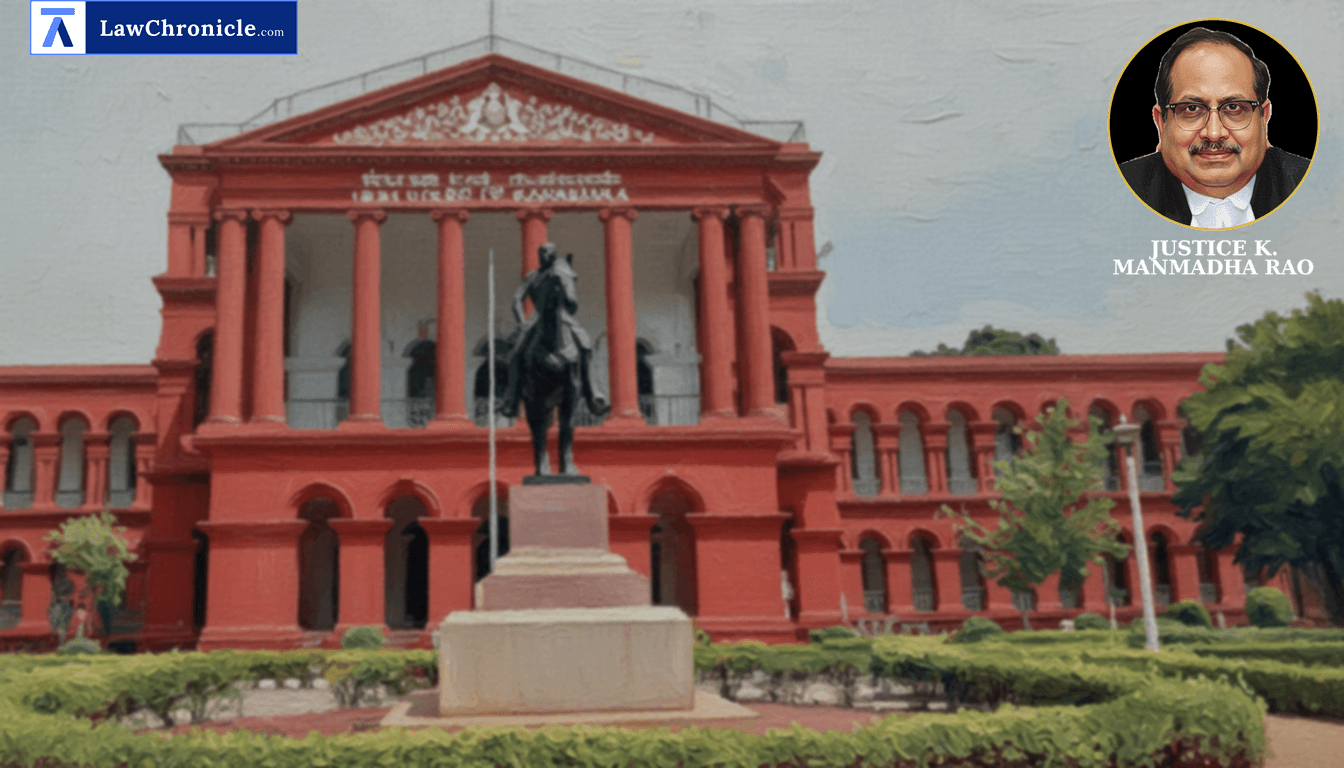
The Karnataka High Court has reinforced the 'pay and recover' doctrine, ruling that insurance companies cannot escape their statutory liability towards third parties solely on the grounds of a driver possessing a fake license. In a significant clarification of motor accident jurisprudence, the Court held that while a breach of policy conditions allows an insurer to seek reimbursement from the vehicle owner, it does not permit the summary dismissal of claims filed by innocent accident victims.
A single-judge bench comprising Justice Dr. K. Manmadha Rao delivered this judgment while hearing an appeal filed by a claimant seeking enhancement of compensation and challenging the total exoneration of the insurance company by the Motor Accident Claims Tribunal (MACT).
Key Takeaways
Statutory Third-Party Protection
Insurance companies are legally mandated to satisfy awards for third parties first, regardless of internal policy breaches between the insurer and the insured.
Pay and Recover Doctrine Upheld
Where a driver's license is found to be fake or invalid, the insurer must pay the claimant and subsequently initiate recovery proceedings against the vehicle owner.
Medical Evidence for Disability
A Wound Certificate alone is insufficient to prove long-term functional disability; the testimony of a treated doctor or medical expert is mandatory for quantifying such loss.
Adverse Inference against Owners
The failure of a vehicle owner to appear or produce valid documents despite notice leads to an irresistible conclusion of policy violation regarding driver licensing.
Medical Expert Opinion Mandatory for Disability Claims
The Court observed that while the appellant sustained multiple fractures, the absence of medical testimony was fatal to his claim for higher compensation. The Court, in its reasoning, observed: "It is a well-settled principle of law under motor accident jurisprudence that while a Wound Certificate (Ex.P5) is a public document proving the immediate receipt of an injury, it cannot be used as a substitute for an expert medical opinion to quantify long-term physical impairment or functional disability. To claim compensation under ‘Loss of Future Income due to Disability’, ‘Loss of Amenities’, or ‘Future Medical Expenses’, the claimant is legally mandated to examine either the treated doctor or a qualified medical specialist from the relevant department."
Insurer's Liability Towards Third Parties
Although the second respondent (Insurance Company) successfully proved that the driver’s license was fake through RTI replies from the Regional Transport Office, the Court found the Tribunal's decision to dismiss the claim against the insurer to be legally erroneous. The Court noted that under Section 149 of the Motor Vehicles Act, 1988, the insurer's liability to a third party remains intact.
The Court has the following directions:
"(i) The appeal is allowed-in-part;
(ii) The judgment and award passed by the Tribunal in MVC.No.1211/2019, dated 28.11.2023, passed by the Principal Senior Civil Judge & CJM and MACT, at Mangaluru, D.K. is modified;
(iii) The appellant - claimant is entitled for global compensation of Rs.1,00,000/- along with interest at the rate of 6% per annum as awarded by the Tribunal from the date of filing of the petition till realization;
(iv) The compensation amount along with accrued interest if any, shall be deposited by the respondent No.2 - Insurance Company, within eight weeks from the date of filing of the petition till realization and recover the same from the owner of the offending vehicle;
(v) Registry is directed to return the Trial Court Records to the Tribunal, along with certified copy of the judgment and award passed by this Court forthwith without any delay."
Ratio
As per Sub-Sections (1), (4), and (7) of Section 149 of the Motor Vehicles Act, 1988, when an insurance company establishes a breach of policy conditions, such as a fake driving license, the insurer must still satisfy the claim in respect of third parties in the first instance and subsequently recover the amount from the insured owner. A Wound Certificate serves only as evidence of immediate injury and cannot substitute expert medical testimony required to prove functional disability for the purpose of enhancing compensation.
Background
The case arose from a 2019 accident where the appellant, traveling in a KSRTC bus, sustained fractures after a rashly driven lorry collided with the bus. The appellant sought a compensation of Rs. 5,00,000/- under Section 166 of the Motor Vehicles Act, 1988. The Insurance Company contested the claim, producing evidence that the lorry driver's license was not in the name of the individual mentioned in the police report and was effectively fake. The Tribunal had awarded a global compensation of Rs. 1,00,000/- but held only the vehicle owner liable, dismissing the claim against the insurer.
In its analysis, the High Court relied on Pappu And Others Vs. Vinod Kumar Lamba And Another ( "(2018) 3 SCC 208": 2018 CaseBase(SC) 1184) and National Insurance Company Limited Vs. Swaran Singh And Others ( "(2004) 3 SCC 297": 2004 CaseBase(SC) 114), alongside the full bench decision in New India Assurance Company Limited Vs. Yellavva And Another, to modify the liability. While it refused to increase the compensation amount due to the lack of medical evidence, it directed the insurer to pay the award and recover it from the owner.
Case Details:
Case No.: MFA No. 297 of 2024
Case Title: Santhosh Kumar v. M/s. Sandhu Road Lines Pvt. Ltd. and Another
Appearances:
For the Petitioner(s): Smt. Pooja Parvathy, Advocate for Sri. Ravishankar Shastry G., Advocate
For the Respondent(s): Sri. H.S. Lingaraj, Advocate for R2
Source: 2026 CaseBase(KAR) 17430
Similar Articles


 Breaking News


