


Andhra Pradesh HC: Insurers Must Prove Driver Disqualification To Avoid Accident Liability
 Copy Link
 Share
 Save
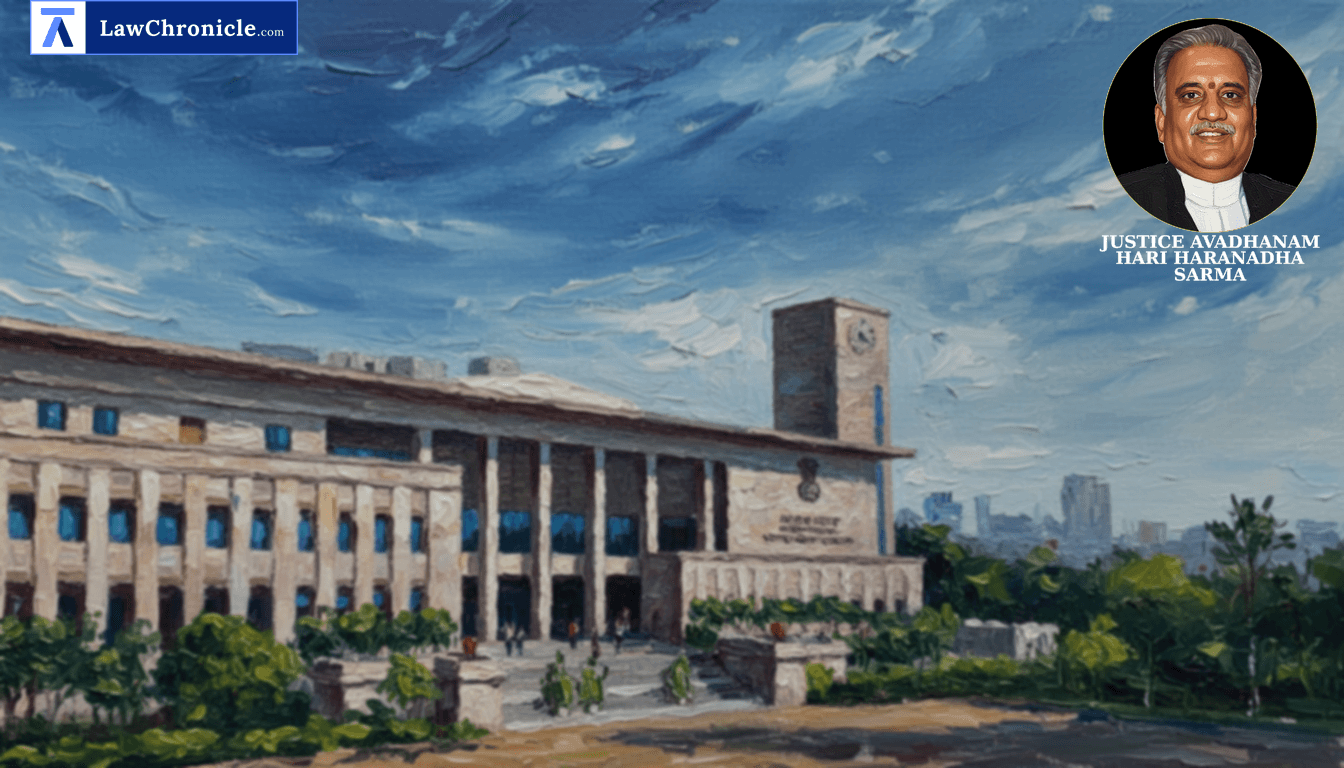
The High Court of Andhra Pradesh has reinforced the stringent burden of proof placed on insurance companies, ruling that a mere mention of licensing violations in a police charge sheet is insufficient to escape the liability of indemnifying third-party accident victims. This decision underscores the judiciary's commitment to the social welfare objectives of motor accident law, ensuring that technical breaches do not deprive victims of their rightful compensation.
In a proceeding presided over by Justice A. Hari Haranadha Sarma, the Court heard an appeal challenging a Tribunal's decision that had exonerated an insurance company based on the alleged absence of a driving license. The Court was tasked with determining whether the Motor Vehicles Act, 1988 permits an insurer to avoid liability solely on the basis of a criminal investigation report without independent verification or evidence of a fundamental policy breach.
Insurer Fails to Discharge Burden of Proof
During the proceedings, the Court noted that while the insurance company (Respondent No. 3) contended that the rider of the offending motorcycle lacked a valid license, it failed to produce any corroborative evidence. The insurer primarily relied on the fact that the police had filed a charge sheet under Section 181 of the Motor Vehicles Act, 1988. However, the Court observed that the company did not issue notices to the owner or driver to produce the license, nor did it examine officials from the Regional Transport Authority (RTA).
The Court, in its reasoning, observed: "The 3rd respondent Insurance Company simply relied on the charge sheet filed in terms of Section 181 of M.V. Act. However, whether the charge sheet itself constitutes proof is a serious aspect... RW.1 specifically stated that she had a document to show that the 1st respondent is not holding any driving licence. Having stated so much, why said document was not filed is not known. Therefore, in the facts and circumstances of the case, it is clear that the absence of a valid driving license has not been proved by the Insurance Company."
Judicial Precedents on 'Pay and Recover'
Justice Sarma highlighted the settled legal position established by the Supreme Court in Shamanna and Another Vs. Divisional Manager, Oriental Insurance Company Limited and Ors. ( "(2018) 9 SCC 650": 2018 CaseBase(SC) 796) and National Insurance Company Limited Vs. Swaran Singh ( "(2004) 3 SCC 297": 2004 CaseBase(SC) 114). These precedents clarify that in cases of third-party risks, the insurer must first indemnify the victim and can only subsequently seek recovery from the insured if a fundamental breach of policy such as the employment of an unlicensed driver is conclusively proven. The Court reiterated that the burden of proving such a breach lies squarely on the insurance company.
Enhanced Compensation and Liability Directions
The Court found that the initial compensation of Rs. 80,000 awarded by the Motor Accidents Claims Tribunal was inadequate, failing to account for various heads such as extra nourishment and attendant charges. Consequently, the High Court enhanced the total compensation to Rs. 1,00,000.
The Court has following directions:
"(i) Dismissal of the claim against the respondent No.3 vide order and decree dated 16.09.2014 in M.V.O.P.No.179 of 2011 passed by the learned MACT is set-aside.
(ii) M.V.O.P.No.437 of 2007 is allowed against the all the respondents and the order is modified as follows:
(a) Claimant is entitled for a compensation of Rs.1,00,000/- with interest at the rate of 6% per annum from the date of petition till the date of deposit/realization.
(b) Respondent Nos.1 to 3 are jointly and severally liable. However, Respondent No.3/ Insurance Company is liable in view of the Insurance Policy.
(iii) Time for payment/deposit of the compensation amount is two (2) months."
Key Takeaways:
Charge Sheets Are Not Conclusive Proof: A police charge sheet alleging lack of a license is insufficient evidence for an insurer to deny a claim in a civil tribunal.
Mandatory Independent Verification: Insurers must take proactive steps, such as issuing notices or examining RTA records, to prove a breach of policy conditions.
Primacy of Third-Party Protection: The 'Pay and Recover' principle ensures that victims receive immediate relief regardless of internal disputes between the insurer and the insured regarding license validity.
Social Welfare Interpretation: Courts will interpret the Motor Vehicles Act, 1988 in a manner that effectuates its objective as social welfare legislation rather than allowing technicalities to stall compensation.
Ratio Decidendi:
The burden of proving a breach of insurance policy conditions, specifically the absence of a valid driving licence, lies entirely on the insurer. A mere reference to statutory violations in a criminal charge sheet does not discharge this burden; the insurer must provide substantive evidence of the breach to be exonerated from its liability toward third parties.
Background:
The case originated from a 2009 accident where the appellant, an employee of BSNL, sustained serious injuries, including a deep lacerated wound and skin degloving, after his motorcycle was hit by an offending vehicle. The Motor Accidents Claims Tribunal (MACT), Vizianagaram, had initially awarded Rs. 80,000 but dismissed the claim against the New India Assurance Company, citing the police charge sheet which alleged the rider had no license. The appellant challenged this dismissal and the quantum of compensation in the High Court. Relying on Baby Sakshi Greola vs. Manzoor Ahmad Simon and Anr. ( "2025 AIAR (Civil) 1": 2024 CaseBase(SC) 897), Yadava Kumar Vs. Divisional Manager, National Insurance Company Limited and Anr. ( "2010(10)SCC 341": 2010 CaseBase(SC) 527), Rajkumar Vs. Ajay Kumar and Another, Sidram vs. United India Insurance Company Ltd. and Anr., and R.D. Hattangadi V. Pest Control (India) (P) Ltd., the High Court analyzed the principles of quantifying damages for pain, suffering, and medical expenses, eventually setting aside the Tribunal's exoneration of the insurer.
Case Details:
Case No.: Motor Accident Civil Miscellaneous Appeal No: 1/2015
NeutralCitation: 2026:APHC:27158
Case Title: SIRIGIDI NANAJI v. VUTA SHIVA AND OTHERS
Appearances:
For the Petitioner(s): G Sai Narayana Rao
For the Respondent(s): Taddi Nageswara Rao, Amancharla Satish Babu
Source: 2026 CaseBase(AP) 250
Similar Articles
 Breaking News


