


Intelligence Officer Competent to Impose Entry Tax Penalty: Kerala HC
 Copy Link
 Share
 Save
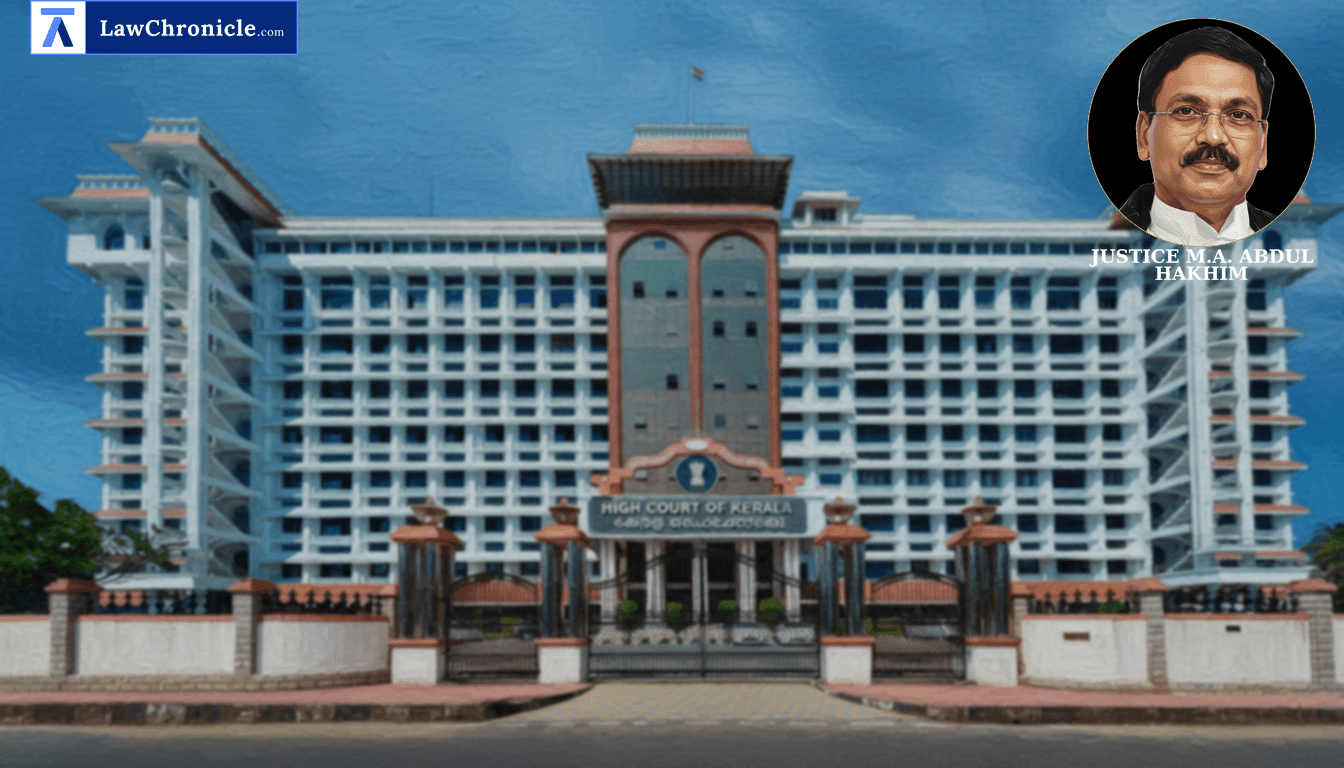
The Kerala High Court has fortified the state's taxation powers by ruling that Intelligence Officers are fully authorized to act as 'Assessing Authorities' for the purposes of imposing penalties under the entry tax regime. Terminating a 25-year-old litigation, the Court clarified that commercial products like 'soluble glass' fall squarely within the tax net as a form of sodium silicate, rejecting technical distinctions aimed at tax avoidance.
Justice M.A. Abdul Hakhim presided over the matter, which had returned to the High Court following a remand from the Supreme Court. The case involved a challenge to penalty orders issued against a major corporation under the Kerala Tax on Entry of Goods into Local Areas Act, 1994.
Key Takeaways
Intelligence Officer Authority Validated
Statutory definitions of 'Assessing Authority' include enforcement officials like Intelligence Officers, preventing jurisdictional challenges to penalty proceedings.
Substance Over Form in Taxation
Commercial nomenclature like 'soluble glass' cannot exempt a product if it falls under the broader chemical classification (sodium silicate) listed in the legislative schedule.
Pre-deposit Mandate for Appeals
Section 13(3) requirements for tax remittance prior to an appeal remain a formidable hurdle for litigants seeking to challenge penalty orders.
Court Upholds Taxability of Soluble Glass
The petitioner argued that 'soluble glass' was not taxable as it was allegedly omitted from the initial Finance Bill and notifications. However, the Court scrutinized the Kerala Finance Act, 1997 and the final Enactment to conclude that the legislature intended to cover all forms of the chemical. The Court noted that the entry in the Schedule specifically referred to sodium silicate (Na2 Si O4) in all its forms, whether called soluble glass, water glass, or sodium glass.
Regarding the competency of the 1st Respondent to issue the penalty, the Court relied on the precedent set in Key Foods v. State of Kerala, which established that Intelligence Officers are empowered to act as Assessing Authorities for penalty imposition.
The Court, in its reasoning, observed: "Since soluble glass is another form of sodium silicate and since soluble glass is specifically included in Ext.P3 Enactment, the contention of the learned Counsel for the Petitioner that soluble glass was not taxable during the relevant time is unsustainable."
On the issue of jurisdiction, the Court further observed: "The said point is covered against the Petitioner as per the Division Bench decision of this Court in Key Foods (supra). It is specifically held that the Intelligence Officer will also come under the Assessing Authority to impose penalty under the Kerala Tax on Entry of Goods into Local Areas Act."
The Court has the following directions:
"Accordingly, the Original Petition is dismissed."
Ratio
The Intelligence Officer of the Department of Commercial Taxes is an 'Assessing Authority' within the meaning of the Kerala Tax on Entry of Goods into Local Areas Act, 1994 and possesses the legal competency to impose penalties under Section 15 of the Act. Furthermore, if a statute taxes a chemical substance 'in all its forms,' specific commercial variants named in the final Enactment are taxable even if they were not explicitly highlighted in the preceding Finance Bill.
Background
The dispute originated in 1999 when M/S. Hindustan Lever Ltd. challenged a penalty order (Ext.P16) and the rejection of their appeals by the Appellate Assistant Commissioner due to non-compliance with the pre-deposit condition under Section 13(3) of the Kerala Tax on Entry of Goods into Local Areas Act, 1994. The petitioner contended that soluble glass was distinct from sodium silicate and thus exempt from tax during 1997-98.
Initially, the High Court had allowed the petition in 2014, following the decision in Thressiamma L. Chirayil v. State of Kerala ( "2007 (1) KLT 303": 2006 CaseBase(KER) 15) which had declared the entry tax violative of Article 301 of the Constitution of India. However, the State appealed to the Supreme Court. Following the landmark ruling in Jindal Stainless Limited and Another v. State of Haryana and Others, which upheld the constitutional validity of entry taxes, the Apex Court remanded this matter to the High Court to specifically address the legality of the penalty under Section 13(3).
Case Details:
Case No.: OP NO. 28302 OF 1999
Neutral Citation: 2026:KER:74153
Case Title: M/S. Hindustan Lever Ltd. V. Intelligence Officer And Others
Appearances:
For the Petitioner(s): Shri. Aditya Unnikrishnan, Sri. R. Sreejith, Smt. Arya Anil, Smt. Niloofar O. Nizam, Sri. Anil D. Nair, Smt. Priyadarsini S., Smt. Binisha Baby, Advocates.
For the Respondent(s): Smt. Harima Hariharan, Government Pleader.
Source: 2026 CaseBase(KER) 23359
Similar Articles

 Breaking News


