


Interested Witness Testimony and Botched Investigation Entitle Accused to Benefit of Doubt: SC
 Copy Link
 Share
 Save
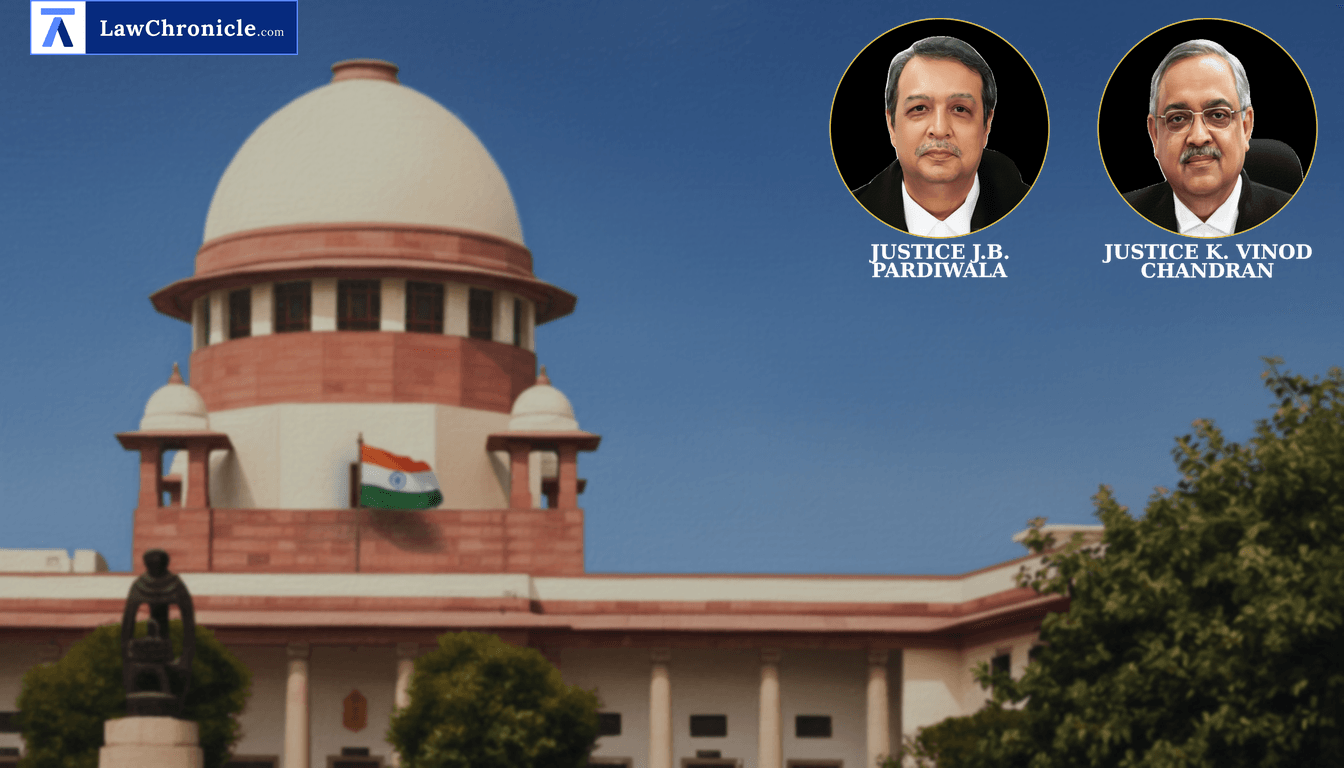
Unreliable testimony from interested witnesses combined with a glaringly botched police investigation led the Supreme Court to acquit two men convicted of murder. The Apex Court emphasized that where serious discrepancies taint oral evidence, the hypothesis of innocence must prevail.
A bench of Justice J.B. Pardiwala and Justice K. Vinod Chandran set aside the judgment of the High Court, which had affirmed the conviction of the appellants under Section 302 read with Section 34 of the Indian Penal Code, 1860 and Section 27 of the Arms Act, 1959.
Key Takeaways
Strict Scrutiny Of Related Witnesses: Interested witness testimony being close relatives requires rigorous examination when tainted with contradictions rather than automatic reliance.
Fatal Investigatory Lapses: Failure to prepare a crime scene map, seize blood-stained clothes, or recover alleged weapons severely undermines the prosecution's narrative.
Hypothesis Of Innocence Applies: Even in direct evidence cases, lingering doubts created by medical and investigative discrepancies trigger the benefit of doubt.
Interested Witness Testimony Weightage
The Supreme Court scrutinized the testimony of the prosecution witnesses and noted severe contradictions regarding the movement of the deceased's body, the injuries on alleged eyewitnesses, and omissions in their statements recorded under Section 161 of the CrPC. The Bench observed that the Investigating Officer failed to perform basic steps such as mapping the spot, seizing blood-stained clothes, or making attempts to recover the weapons used.
The Apex Court observed that "Related witnesses merely for their relationship with the deceased cannot be called interested witnesses. But when, from the circumstances, as in the present case, where there is found a ring of falsity in their testimonies, a closer scrutiny is warranted... Due to the discrepancies and the inconsistencies, we are unable to place faith on the oral testimony of eyewitnesses. In that circumstance, the reasonable doubt regarding a hypothesis of innocence assumes relevance."
The Court ordered the release of the appellants from custody if not required in any other case. If they were on bail, their bail bonds would stand cancelled."
Ratio
When oral testimonies of relative eyewitnesses suffer from material contradictions and lack corroboration from a deficient investigation, the court must closely scrutinize the evidence; if a reasonable hypothesis of innocence arises, the benefit of doubt must be extended to the accused.
Background
The prosecution alleged that a dispute regarding drainage blockage led to a brawl wherein A2 shot the deceased, and A1 fired at other family members. The trial court convicted the appellants under Section 302 read with Section 34 of the Indian Penal Code, 1860 and Section 27 of the Arms Act, 1959, while acquitting three co-accused. The High Court subsequently affirmed the conviction.
On appeal, the Supreme Court evaluated the medical evidence and highlighted that the postmortem doctor testified the fatal gunshot injury would not cause instantaneous death, making the immediate transport of the body to the police station instead of a hospital highly suspicious. The Apex Court also discussed the principles laid down in Sharad Birdhichand Sarda v. State of Maharashtra ( "(1984) 4 SCC 116": 1984 CaseBase(SC) 194) regarding the availability of a hypothesis of innocence. Finding the interested eyewitness testimony unreliable and the investigation lacking crucial physical corroboration, the Supreme Court allowed the appeal and acquitted both appellants.
Case Details:
Case No.: Criminal Appeal No. 1223 of 2022
Neutral Citation: 2026 INSC 971
Case Title: Ashok Upadhyay and Anr. v. The State of Bihar
Source: 2026 CaseBase(SC) 5882
Similar Articles


 Breaking News


