


Is falsus in uno falsus in omnibus applicable in India? Supreme Court Answers
 Copy Link
 Share
 Save
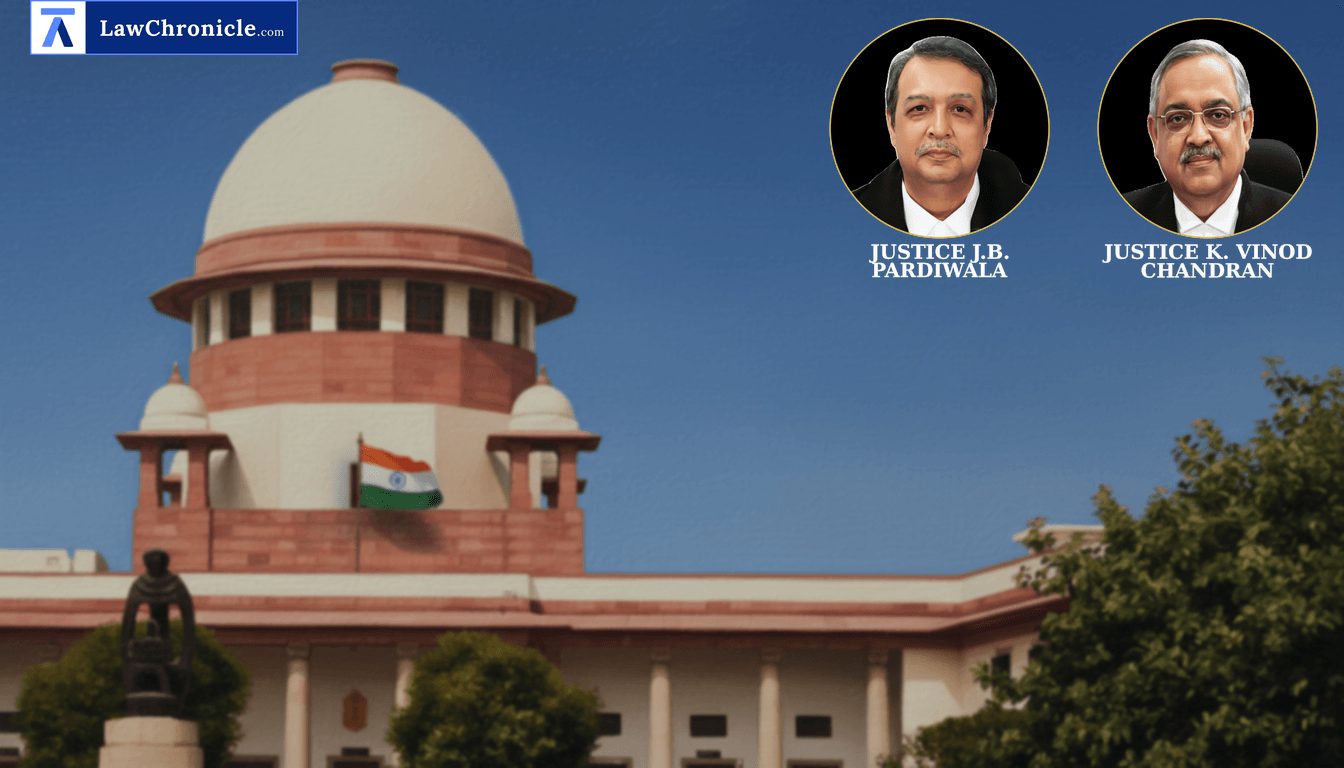
Is falsus in uno falsus in omnibus applicable in India? A bench of Justice J.B. Pardiwala and Justice K. Vinod Chandran set aside the High Court judgment that had absolved the co-accused on the flawed premise that they did not fire the fatal shot or that their specific roles were unnatural.
While holding that the doctrine of falsus in uno, falsus in omnibus does not apply to Indian criminal jurisprudence, the Supreme Court reversed the acquittal of two accused in a murder case, reiterating that courts must separate the grain from the chaff when evaluating witness testimonies.
Key Takeaways
Rejection of Falsus In Uno Doctrine: Partial falsehood or exaggeration by witnesses against some accused cannot lead to the rejection of their entire testimony against others.
Scope of Common Intention: Overt acts like holding down a victim or exhorting the shooter are sufficient to attract common intention under Section 34 or Section 149 of the IPC.
Surmises In Judicial Reasoning Deprecated: High Court's finding that a person holding a victim shot at close range would necessarily sustain injuries was held to be a mere surmise unsupported by expert evidence.
Restoration of Conviction: Conviction and sentence passed by the Trial Court against A6 and A12 restored.
Court Observations and Directions
The Supreme Court observed that the High Court erred in acquitting the accused who actively participated in the ambush. Addressing the application of witness testimony evaluation, the Court noted that courts have a duty to sift through evidence carefully rather than discarding it in its entirety.
Answering to the initial question, the Supreme Court explained that "The principle of ‘falsus in uno, falsus in omnibus’ is not applicable to India and as has been famously held, here, the Courts have a duty to separate the grain from the chaff in analyzing evidence. Carrying out such a measure, we are inclined to find the presence of A1, A6 and A13 as spoken of by PW1, PW10 and PW11 at the incident spot and the shooting having occurred as narrated by them."
Regarding the active participation of co-accused under shared intention, the Apex Court clarified that an individual holding a victim or exhorting the main shooter shares the common intention and object of the unlawful assembly.
Ratio
The maxim 'falsus in uno, falsus in omnibus' has no application in Indian courts. Where witness testimony contains exaggerations or false implications regarding certain individuals, the court must separate the truthful grain from the false chaff to determine the criminal liability of co-accused. Active overt acts such as holding the victim or exhorting the shooter demonstrate common intention under criminal law.
Background
The prosecution alleged that 17 persons ambushed three brothers near their house, targeting and shooting one of them dead while injuring another with a lathi. The Trial Court convicted four accused (A1, A6, A12, and A13) while acquitting others. A13 was summoned during the trial under Section 319 of the Code of Criminal Procedure,1973.
On appeal, the High Court confirmed the conviction of A1 (the shooter) but acquitted A6, A12, and A13. It reasoned that A13 did not fire his gun, A6 would have sustained injuries if he had held the victim at close range, and A12's exhortation was difficult to identify at night. The injured de-facto complainant challenged the acquittals before the Supreme Court.
Reversing the High Court's order two of the appellants, the Supreme Court held that the medical evidence corroborated the entry wound and bullet trajectory, rendering the High Court's reasoning regarding potential injury a mere surmise. The Apex Court also found other appellant's exhortation consistently recorded in the initial statement. However, the acquittal of another appellant was sustained due to material omissions in earlier statements regarding his presence. Consequently, the appeals were partly allowed, restoring the conviction of two.
Case Details:
Case No.: Criminal Appeal Nos.1303-1305 of 2022
Neutral Citation: 2026 INSC 972
Case Title: Santosh Singh v. The State of Madhya Pradesh and Ors.
Source: 2026 CaseBase(SC) 6693
Similar Articles



 Breaking News


