


Supreme Court Upholds Life Sentences, Rules Armed Group's Members Vicariously Liable Under Section 149 IPC
 Copy Link
 Share
 Save
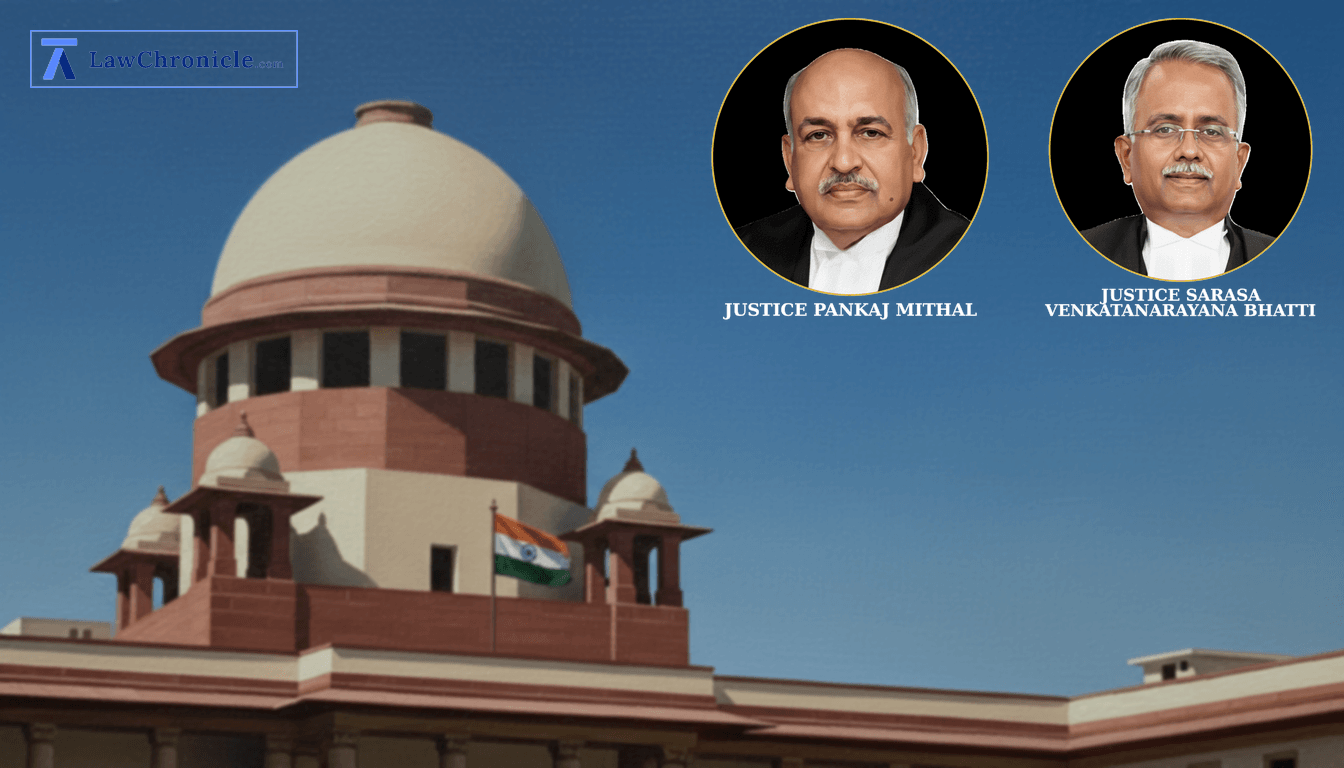
A bench of Justice Pankaj Mithal and Justice S.V.N. Bhatti heard appeals by four convicts challenging their conviction and life sentences for the murder of Balkishan and related offences under the Indian Penal Code. The appellants sought to overturn the trial court and High Court findings that they were members of an unlawful armed assembly and vicariously liable for the killing under Sections 302/149 and 148 IPC.
The bench dismissed the appeals and confirmed the convictions and sentences imposed by the courts below. The Court held that the prosecution proved motive, presence and participation of the accused as part of an unlawful assembly, and that application of Section 149 IPC was warranted even where every member was not shown to have committed a specific overt act. The Court emphasised settled principles on group liability and reliance on contemporaneous ocular and forensic evidence. The Court, in its reasoning, observed: "It is settled in law that in view of Section 149 IPC, every member of the unlawful assembly is vicariously liable for acts done by anyone of them to achieve a common object. Therefore, two things are essential to attract Section 149 IPC. The first is 'unlawful assembly' and the second is 'common object'. The presence of the accused persons as part of the unlawful assembly is sufficient for conviction even if no overt act is imputed to each one of them individually. In the case at hand, all the accused persons had alighted from the bus together armed with firearms, thus, they were part of the unlawful assembly and had arrived at the bus stand with a common object. The movement of the accused persons in the above manner is sufficient enough to draw an inference that they had a common object. Therefore, the presence of the accused persons in the unlawful assembly to achieve a common object makes all of them vicariously liable for the acts of the unlawful assembly." The Court further recorded that "the appeals are accordingly dismissed confirming the conviction and the sentence imposed upon the appellants."
Background
The offence occurred on 03.06.2000 at Tihuli bus stand. The deceased, Balkishan, who chaired a watershed committee, waited at the bus stand to travel to a meeting when six accused alighted from a bus "with firearms." The main accused Vikram allegedly fired the first shot, injuring the deceased’s left elbow; the group chased him to the house of Rattan Lal (PW-6), dragged him into the courtyard and shot him at close range, causing instant death. An FIR was lodged the same day by Budha Ram (PW-2), brother of the deceased. Two chargesheets were filed and trials were merged; one accused (Vikram) remained absconding and one (Govind Singh) later died.
At trial and on appeal, the State relied on motive arising from longstanding political rivalry, contemporaneous ocular evidence that the accused "alighted from the bus together armed with firearms," recovery of empty cartridges from the courtyard, and post-mortem and ballistic reports showing multiple firearm wounds and pellets consistent with 12-bore fire to establish participation. The defence challenged the reliability of witnesses (many of whom were relatives of the deceased), pointed to alleged contradictions and improvements in ocular testimony, absence of direct eye-witness evidence of firing inside the house by the accused other than Vikram, non-recovery of weapons from several appellants, and alleged procedural lapses in investigation including non-compliance with Sections 157 and 174 CrPC and the possibility of an ante-timed FIR.
The High Court, by its impugned order dated 09.11.2010, had dismissed the appeals and affirmed conviction and life sentences. The Supreme Court considered the totality of evidence: motive, consistent testimony about arrival and arming of the group, auditory evidence of multiple shots heard by PW-6, recovery of cartridges and ballistic reports, and the post-mortem that recorded multiple entry and exit wounds and recovery of about 40 pellets. The Court held that the absence of proof that each accused fired a shot did not preclude conviction under Section 149 where the accused acted as an unlawful assembly with a common object. The Court rejected the contention that procedural lapses alone vitiated the prosecution, noting the alleged lapses were not proved by production of magistrate records.
Resultantly, the Supreme Court dismissed the appeals, confirmed convictions under Sections 148 and 302/149 IPC, and directed the appellants, who were on bail, to surrender forthwith to undergo the remaining part of their sentences. The appellants had been acquitted earlier of charges under the Scheduled Castes and Scheduled Tribes (Prevention of Atrocities) Act, 1989.
Case Details:
Case No.: Criminal Appeal Nos. 1819-1821 of 2011; Criminal Appeal No. 1176 of 2012
NeutralCitation: 2026 INSC 224
Case Title: Dablu etc. v. State of Madhya Pradesh; Vinod @ Ajay v. State of Madhya Pradesh
Appearances:
For the Petitioner(s): Shri S. Mahendran, Advocate; Shri Prafulla Kumar Behera, Advocate
For the Respondent(s): Shri Shreeyash U. Lalit, Advocate
Source: 2026 CaseBase(SC) 198
Similar Articles


 Breaking News


