


Jharkhand High Court Mandates ₹20 Lakh Alimony for Deserted Wife Post-Second Marriage
 Copy Link
 Share
 Save
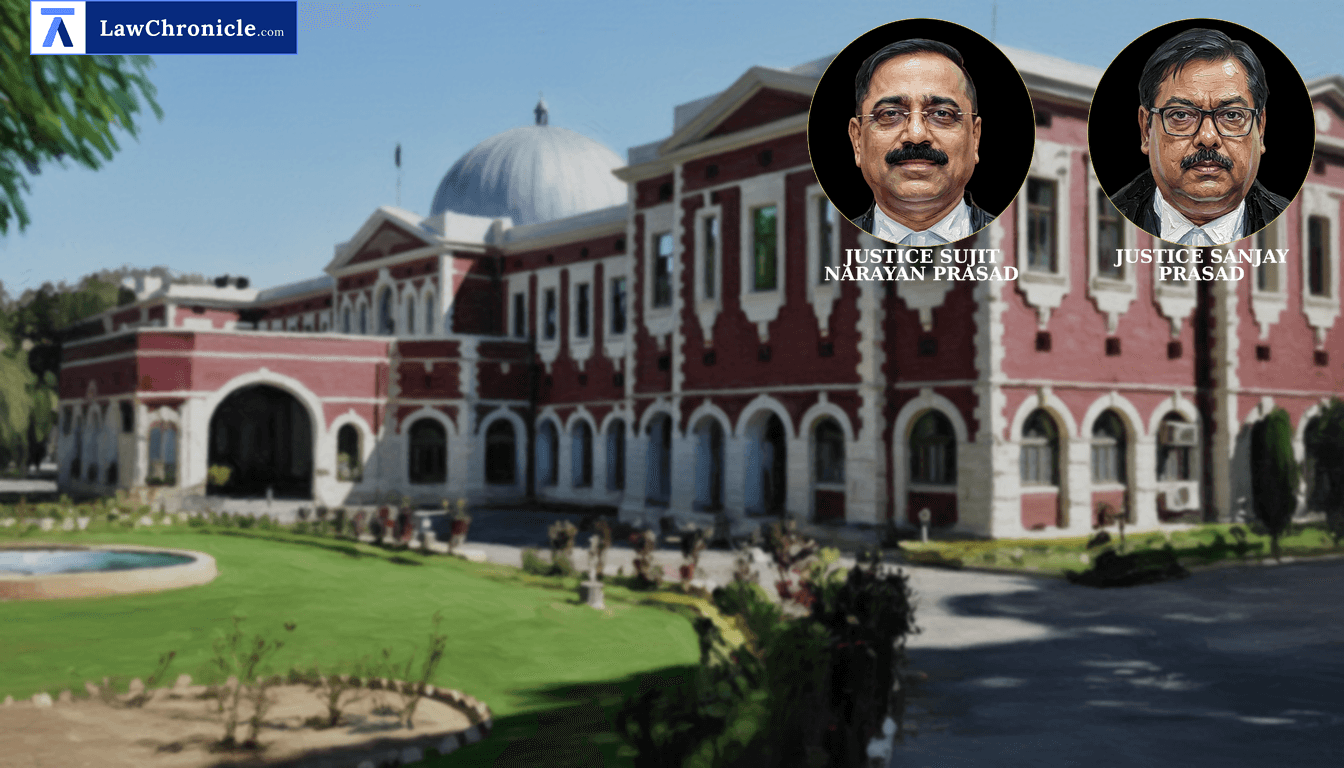
The Jharkhand High Court has reinforced the protective ambit of matrimonial laws, ruling that a husband’s subsequent marriage does not absolve him of the primary obligation to ensure his former spouse lives with dignity and financial security. In a significant intervention, the Court enhanced the permanent alimony to ₹20 Lakhs, emphasizing that maintenance is a right flowing from the marital bond rather than an act of charity.
Bench Composition and Appellate Context
A Division Bench comprising Justice Sujit Narayan Prasad and Justice Sanjay Prasad adjudicated an appeal filed under Section 19 of the Family Courts Act, 1984. The appellant-wife challenged a 2016 decree from the Family Court, Jamshedpur, which had granted a divorce to the respondent-husband on the grounds of cruelty under Section 13(1)(i-a) of the Hindu Marriage Act, 1955. While the appellant did not press the case on merits due to the husband’s second marriage, the proceedings focused on determining just and fair permanent alimony under Section 25 of the Hindu Marriage Act, 1955.
Key Takeaways
- Benchmark for Alimony Calculation: The Court utilized the '25 percent of net salary' benchmark to determine the adequacy of a lump-sum settlement for a non-earning spouse.
- Life Expectancy as a Factor: In calculating the quantum, the Bench explicitly factored in the average life expectancy of Indian women (70 years) to ensure long-term sustenance.
- Statutory Deductions vs. Voluntary Expenses: The ruling clarifies that only statutory liabilities like income tax are considered for 'free income' assessment, disregarding voluntary loan EMIs or premiums.
- Parental Financial Status Irrelevant: The Court reaffirmed that the financial position of the wife's parents is immaterial to the husband's duty to provide maintenance.
Judicial Observations on Maintenance Principles
The Court noted that the initial maintenance of ₹3,000 per month was "wholly inadequate and meagre." The Bench highlighted that the objective of Section 25 is to prevent destitution. The Court, in its reasoning, observed: "The grant of maintenance ensures that a woman is not forced to rely on her parents or relatives for basic needs, but can live with dignity and autonomy. Only when adequate maintenance is granted, she can hope to secure independent accommodation, meet her daily expenses and denying or reducing maintenance on the assumption that her parents can support her effectively undermines the very purpose of law of maintenance."
The Court further relied on the framework established in Rajnesh versus Neha ( "(2021) 2 SCC 324": 2020 CaseBase(SC) 717) regarding financial disclosures. The Bench stated: "Maintenance, after all, is not a matter of charity but of right - a continuing obligation flowing from the marital relationship, which the husband cannot evade merely by pointing to the wife’s limited earning capacity."
Directions Issued by the Court
The Court has the following directions:
"The aforesaid amount shall be paid by the respondent-husband in four equal installments within a period of 12 months from the date of passing of the order and first installment shall be paid within a period of two months from today."
"This Court... grants liberty to the appellant-wife that if the amount is not credited to her account, as per the direction passed by this Court, the appellant-wife will be at liberty to approach the court of law in accordance with law."
Ratio
Section 25 of the Hindu Marriage Act, 1955 is an enabling provision that empowers the court to grant permanent alimony to remove the hardship of a spouse with no independent income. The quantum must be fair, reasonable, and commensurate with the husband's earning capacity and the wife's standard of living during the marriage, ensuring the dependent spouse is not reduced to destitution regardless of the status of their parents or the husband's subsequent marriage.
Background
The marriage took place in 2003. The husband alleged that the wife was ill-tempered, avoided household work, and had attempted suicide, leading him to file for divorce in 2008. The wife countered with allegations of dowry harassment and filed cases under Section 498A of the I.P.C.. After the Family Court allowed the divorce in 2016, the husband married another woman in 2018. The High Court intervened during the appeal after finding the husband was evading proceedings. Evidence from the husband's employer, Tata Motors, confirmed a gross monthly salary of approximately ₹47,498. The Bench applied principles from Kalyan Dey Chowdhury v. Rita Dey Chowdhury Nee Nandy ( "(2017) 14 SCC 200": 2017 CaseBase(SC) 654), Vinny Parmvir Parmar v. Parmvir Parmar ( "(2011) 13 SCC 112": 2011 CaseBase(SC) 251), and U. Sree v. U. Srinivas ( "(2013) 2 SCC 114": 2012 CaseBase(SC) 480) to calculate a lump sum of ₹20,00,000 as permanent alimony, modifying the lower court's decree while affirming the dissolution of marriage.
Case Details:
Case No.: First Appeal No. 114 of 2016
Neutral Citation: 2026:JHHC:30304-DB
Case Title: Reena Devi v. State of Jharkhand & Others
Appearances:
For the Petitioner(s): Mr. Jitendra Nath Upadhyay, Advocate
For the Respondent(s): Mr. Dilip Kumar Karmakar, Advocate (for Resp. 2); Mr. Gaurang Jajodia, AC to GP-II (for State); Mr. Sankalp Goswami, Advocate (for Resp. 3)
Source: 2026 CaseBase(JHKD) 3193
Similar Articles
 Breaking News


