Justice M.M. Sundresh - Explore Notable Judgments, Family, Retirement Date
 Copy Link
 Share
Share Save
Save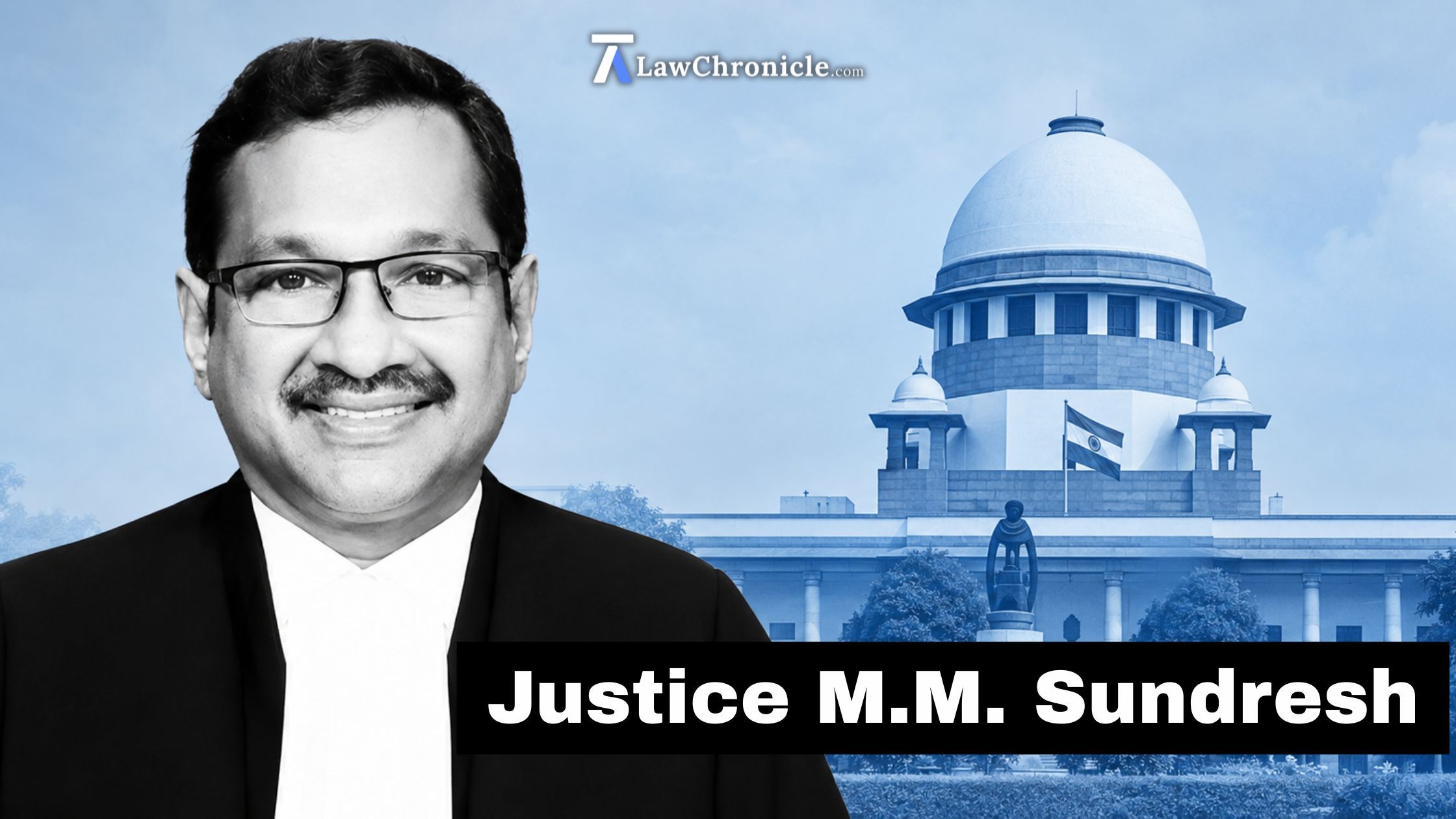
Justice M.M. Sundresh is a sitting Judge of the Supreme Court of India, having assumed office on 31st August 2021. Born on 21st July 1962 in Erode, Tamil Nadu, he rose from the Bar at the Madras High Court to the Supreme Court of India, over a legal career spanning nearly four decades. Prior to his elevation to the Supreme Court, he served as a Judge of the Madras High Court for over twelve years. He was serving as President of the Tamil Nadu State Judicial Academy at the time of his elevation. Across both courts, Justice Sundresh has built a reputation for judgments marked by a strong constitutional and human-rights orientation, particularly in the areas of criminal law, undertrial justice, juvenile justice, and civil liberties.
Early Life and Education
Justice Sundresh was born in Erode, Tamil Nadu, to Advocate V.K. Muthusamy, who practised as a Senior Advocate at the Madras High Court. He completed his schooling and pre-university education in Erode before moving to Chennai to pursue higher studies. He obtained his Bachelor of Arts degree from Loyola College, Chennai, and subsequently earned his law degree from Madras Law College.
Justice M.M. Sundresh - Legal Career
Justice Sundresh enrolled as an Advocate with the Bar Council of Tamil Nadu and Puducherry in 1985, beginning a practice that spanned civil, criminal, and writ jurisdictions before the Madras High Court. He trained in the chambers of advocate S. Sivasubramaniam, who himself later became a Judge of the Madras High Court, as well as in the chambers of his father, V.K. Muthusamy.
Between 1991 and 1996, he served as Government Advocate for the State of Tamil Nadu, appearing on behalf of the State Government in a range of matters, and also acted as counsel for the Tamil Nadu Small Scale Industries Development Corporation.
He was elevated from the Bar as an Additional Judge of the Madras High Court on 31st March 2009, and was confirmed as a Permanent Judge on 29th March 2011. Over his twelve-year tenure at the Madras High Court, he is reported to have disposed of over a lakh cases. Following a recommendation by the Supreme Court Collegium, he was elevated as a Judge of the Supreme Court of India, taking oath on 31st August 2021.
At the Supreme Court, Justice Sundresh has authored a substantial body of judgments, with the majority of his output concentrated in criminal law, followed by property, civil, constitutional, and service law matters.
Notable Cases and Judgments by Justice M.M. Sundresh
At the Supreme Court
- Satender Kumar Antil v. CBI (2022 CaseBase(SC) 640): Sitting with Justice Sanjay Kishan Kaul, Justice Sundresh authored a judgment addressing the plight of undertrial prisoners in India, highlighting that a large majority of prison inmates were undertrials, many of them poor, illiterate, or women, and calling upon the Union to consider a dedicated bail law modelled on comparable legislation in other jurisdictions.
- Om Prakash v. State of Uttarakhand (2025): Along with Justice Aravind Kumar, Justice Sundresh set aside a life sentence on the ground of juvenility, holding that a plea of juvenility can be raised at any stage of litigation, and underscoring the constitutional obligation to protect children's rights and prioritise rehabilitation over punishment.
- Section 6A of the Citizenship Act, 1955, In re (2024 CaseBase(SC) 959): As part of a five-judge Constitution Bench, Justice Sundresh joined the majority opinion upholding the constitutional validity of Section 6A, which deals with citizenship provisions arising from the Assam Accord.
- Shubha v. State of Karnataka (2025 CaseBase(SC) 505): In an appeal concerning a woman convicted for the murder of her fiancé, the bench led by Justice Sundresh permitted the convict to pursue a pardon petition before the Governor, in a judgment that reflected on the pressures of familial expectation and personal autonomy.
- Parvinder Singh v. Enforcement Directorate (2026 CaseBase(SC) 602) and Priyanka Sarkariya v. Union of India (2026 CaseBase(SC) 323): These decisions dealt respectively with procedural safeguards for the accused under the Bharatiya Nagarik Suraksha Sanhita and the validity of preventive detention orders under COFEPOSA.
- He has also been part of the nine-judge Constitution Bench currently examining foundational questions on religious freedom and denominational autonomy arising out of the Sabarimala reference.
At the Madras High Court
- Solaimalai v. The Chairman, Tamil Nadu Forest Plantation Corporation Ltd. (2019): Justice Sundresh, along with Justice N. Sathish Kumar, took cognisance of large-scale elephant poaching in Tamil Nadu, ordering a CBI probe and directing the constitution of an expert committee for wildlife and forest protection.
- He was also part of benches that addressed the continuation of online education during the pandemic, the validity of Kazi-issued Talaq certificates, and directions relating to inclusion of the National Anthem in school curricula across Tamil Nadu.
Personal Life
Justice MM Sundresh comes from a family with a legal lineage. His father, V.K. Muthusamy, was a Senior Advocate at the Madras High Court, in whose chambers Justice Sundresh also trained during his early years at the Bar.
Justice M.M. Sundresh is due to retire on 20th July, 2027.
 Breaking News