


Kerala HC: Age Determines Seniority for School Principals When Appointment Dates Match
 Copy Link
 Share
 Save
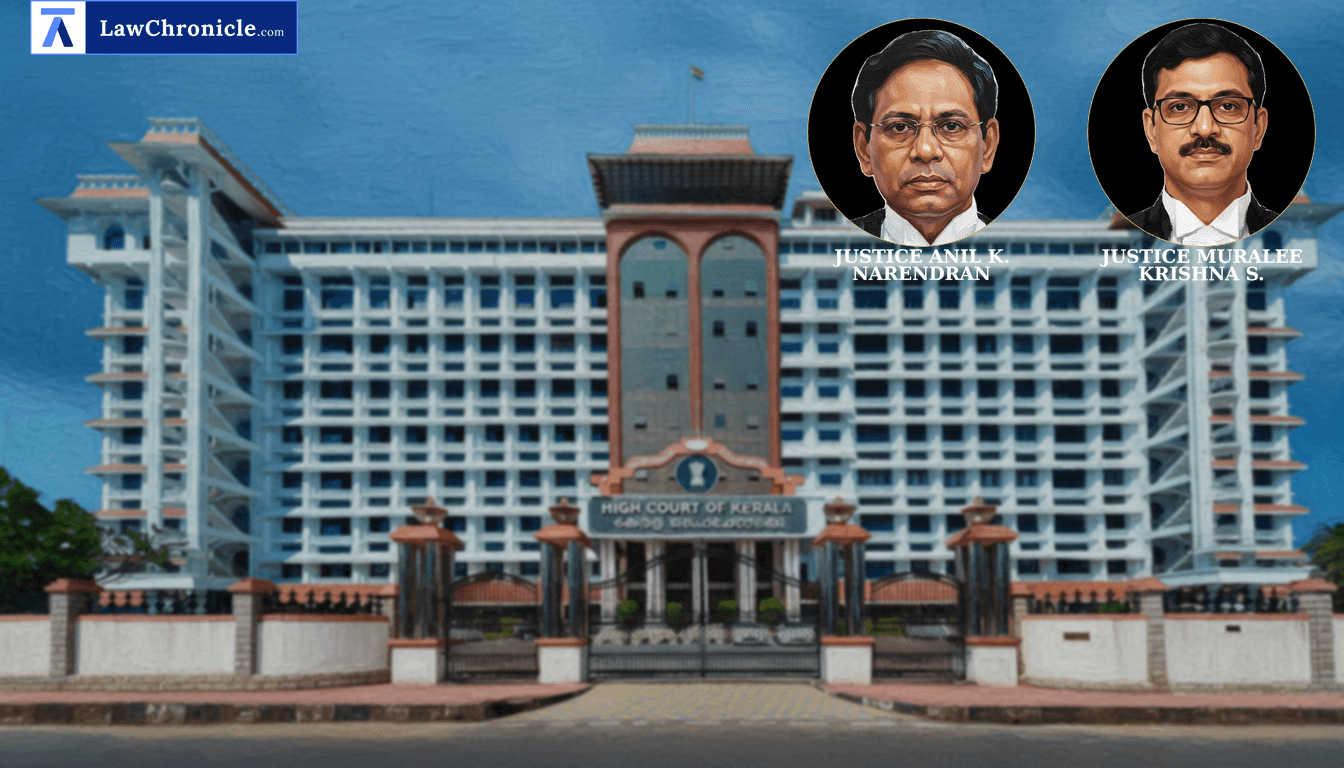
In a decisive clarification of service jurisprudence for educational institutions, the Kerala High Court has ruled that when two teachers are appointed to the Higher Secondary cadre on the same day, seniority for the post of Principal must be determined by age in the absence of specific statutory rules. The ruling reinforces the principle that where special service rules like the Kerala Education Rules, 1959 are silent on tie-breaking mechanisms, general service principles regarding seniority must prevail to prevent arbitrary administrative decisions.
Justice Anil K. Narendran and Justice Muralee Krishna S. presided over the appeal, which centered on a seniority dispute between two teachers in an aided Higher Secondary School. The bench was tasked with determining the criteria for calculating seniority when both the date of by-transfer appointment to the post of Higher Secondary School Teacher (Junior) and the subsequent promotion to Higher Secondary School Teacher were identical for rival claimants.
Key Takeaways
Age as a Tie-Breaker
In cases of identical appointment dates, the elder candidate is legally entitled to seniority if the specific governing rules are silent on the matter.
Limited Scope of Chapter XIV A
The Court clarified that Rule 37 of Chapter XIV A of Kerala Education Rules, 1959 does not directly apply to Higher Secondary School Teachers, who are primarily governed by Chapter XXXII.
Filling Regulatory Lacunae
When a specific statute fails to provide a contingency for equal service length, courts will rely on general service jurisprudence to ensure equality of opportunity under Article 16 of the Constitution of India.
Impact on Aided Schools
Management cannot arbitrarily choose between candidates with equal service duration; they must follow established seniority norms to avoid litigation and administrative instability.
Court Observations on Service Jurisprudence
The Court scrutinized the interplay between different chapters of the Kerala Education Rules, 1959 and general legal principles. The bench noted that while Chapter XXXII governs Higher Secondary teachers, it lacks a specific rule for tie-breaking seniority between simultaneous appointees.
The Court, in its reasoning, observed: "When the date of appointment in the post HSST (Jr.) and HSST are the same, and there is no rule so far framed by the Government to meet this contingency, then the only course that can be adopted is the general principle in the service jurisprudence that the elder in age has to be treated as the senior."
The bench further emphasized that any rule of seniority must satisfy the test of equality of opportunity as enshrined in Article 16 of the Constitution of India, referencing the standard set in A. Janardhana v. Union of India ( "[(1983) 3 SCC 601]": 1983 CaseBase(SC) 289). The Court held that length of service or continuous officiation remains the bedrock of seniority, but when those are equal, age becomes the only objective determinant.
Ratio
In the absence of specific statutory provisions under Chapter XXXII of the Kerala Education Rules, 1959 to determine inter se seniority between teachers appointed on the same date, the general principle of service jurisprudence where the older candidate is treated as senior shall be applied. Seniority in the cadre of Higher Secondary School Teacher (HSST) must be calculated from the date of appointment in that specific cadre following a valid selection process, and not necessarily from the date of service in the lower cadre of High School Teacher (HST).
Background
The dispute involved a teacher (the appellant) appointed as a High School Teacher in 1998 and another (the 1st respondent) appointed in 2001. Both were later appointed as HSST (Junior) on the same day, 01.12.2011, and subsequently both had their appointments as HSST approved effective from 23.02.2013. The management and educational authorities had issued conflicting orders regarding who should hold the post of Principal.
The appellant relied on Ramesan v. Manoj Kumar K. to argue that seniority in the HST cadre should be the deciding factor. However, the Court distinguished this, noting the case was stayed by the Supreme Court. The Court also discussed Girija Kumar v. Rajitha and Viswanathan v. Director of Higher Secondary Education regarding seniority determinations but found that since the appointment dates were identical, the general principle established in A. Janardhana v. Union of India ( "[(1983) 3 SCC 601]": 1983 CaseBase(SC) 289) and later followed in Rajeswari Devi S. v. State of Kerala ( "[2023 (2) KHC 589]": 2023 CaseBase(KER) 259) was the most appropriate resolution. Ultimately, the Court upheld the Single Judge's decision that the 1st respondent, being older in age, was the rightful senior.
Case Details:
Case No.: W.A. NO. 2136 OF 2023
Neutral Citation: 2026:KER:82445
Case Title: R. Sreeja Vs. A. Chandrasekhar & Others
Appearances:
For the Petitioner(s): SRI.M.R. Anison, Advocate
For the Respondent(s): Shri.P.M.Pareeth, Shri.Najeeb P.S, Smt.Parvathy S. Manoj, Smt. Reeha Khader K. SR GP, Advocates
Source: 2026 CaseBase(KER) 33071
Similar Articles

 Breaking News


