


Last Joint Residence Determinative for Divorce Jurisdiction: Delhi HC
 Copy Link
 Share
 Save
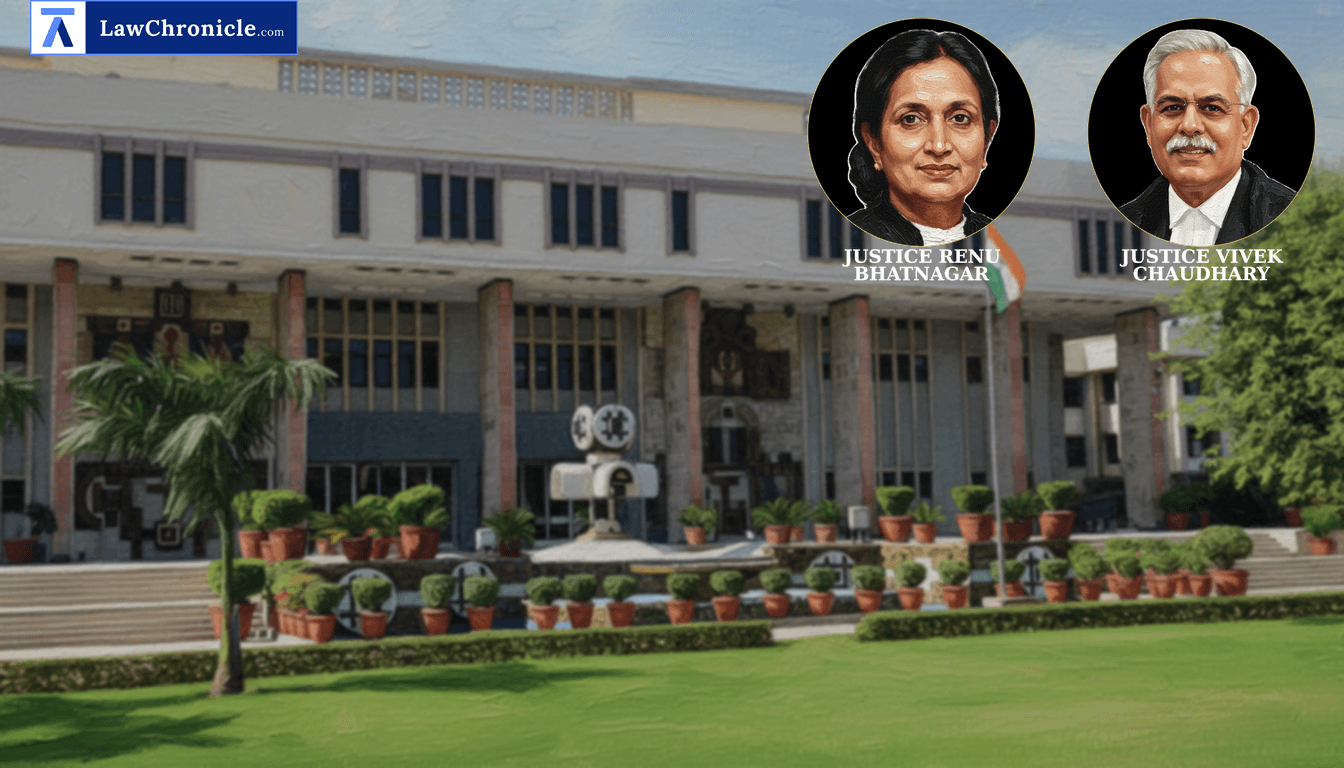
The Delhi High Court has clarified that a temporary or prior residence of a married couple cannot be used to anchor territorial jurisdiction for divorce proceedings when a subsequent permanent residence exists. The Court emphasized that the statutory mandate under Section 19(iii) of the Hindu Marriage Act, 1955 specifically requires the petition to be filed where the parties 'last resided together', effectively barring litigants from choosing historical matrimonial homes to suit their convenience.
A division bench comprising Justice Vivek Chaudhary and Justice Renu Bhatnagar dismissed an appeal filed by a wife challenging a Family Court order that returned her divorce petition for lack of jurisdiction. The Court found that despite a two-year stay in Delhi, the couple's subsequent four-year residence in Gurugram made the latter the only legally recognized 'last residence' under the law.
Key Takeaways
- Strict Interpretation of 'Last Resided': The Court affirmed that the place where the parties lived immediately prior to their separation is the sole determining factor for jurisdiction under Section 19(iii) of the Hindu Marriage Act, 1955.
- Historical Residence Insufficiency: Prior residences, even if spanning several years, do not confer jurisdiction if the couple subsequently established a new joint household elsewhere.
- Maintainability Safeguards: The Court highlighted the necessity of impleading the husband as a party in appeals arising from matrimonial disputes, noting that an appeal against the State alone is not maintainable.
- Territorial Boundation: Litigants must approach courts where the marriage was solemnized, where the respondent resides, or where the parties last cohabited, preventing forum shopping based on parental homes or former residences.
Primacy of the Final Matrimonial Home
The Court scrutinized the pleadings to determine the timeline of the parties' cohabitation. It was noted that while the marriage was solemnized in 2019 and the parties initially lived in Sangam Vihar, Delhi, they had moved to Gurugram in 2021 and lived there until their separation in 2026. The Court held that this four-year period at Gurugram superseded the initial two-year stay in Delhi for jurisdictional purposes.
The Court, in its reasoning, observed: "Merely relying upon the parties’ earlier residence at Sangam Vihar for about one and a half years cannot confer territorial jurisdiction upon the learned Family Court when, admittedly, the parties thereafter shifted to Gurugram and lastly resided together there. The requirement under Section 19(iii) of the HMA is that the parties must have last resided together within the territorial jurisdiction of the Court. ... On the contrary, the statutory expression 'the parties to the marriage last resided together' makes the last place of such joint residence determinative."
Impleadment of Necessary Parties
The Bench further pointed out a procedural lapse where the appellant had filed the appeal against the State of NCT of Delhi without impleading the husband. The Court noted that since the husband's conduct and the divorce proceedings were the subject matter, the appeal was technically not maintainable due to the defect in the array of parties.
The Court has following directions:
"Accordingly, the present appeal stands dismissed on maintainability as well as on merits. Pending applications, if any, also stand disposed of."
Ratio
The expression 'the parties to the marriage last resided together' under Section 19(iii) of the Hindu Marriage Act, 1955 refers to the most recent place of joint residence before the filing of the petition. Any place where the parties resided earlier in point of time, irrespective of the duration of stay, cannot confer territorial jurisdiction if the couple subsequently shifted their joint residence to a different location.
Background
The appellant-wife filed for divorce under Section 13(1)(i-a) of the Hindu Marriage Act, 1955 alleging cruelty due to the husband's habitual alcohol consumption. The marriage took place in Gurugram in 2019. After staying in Delhi for two years, the couple moved to a rented accommodation in Gurugram, where they lived for four years. The wife alleged she was turned out of the house two weeks prior to filing the petition.
The Family Court returned the petition under Order VII Rule 10 of the Code of Civil Procedure, 1908, citing Section 19 of the Hindu Marriage Act, 1955, stating that Gurugram was the place of marriage and the last residence. The wife appealed, citing Renu Vij v. Surinder Kumar, Balvinder Kaur v. Mukul Kumar Srivastava, and Vijay Singh v. Chanchal Chaudhary, arguing that the Delhi stay was significant enough to confer jurisdiction. However, the High Court distinguished these precedents, holding that they do not support jurisdiction at a former residence when a subsequent last residence is admitted.
Case Details:
Case No.: MAT.APP.(F.C.) 285/2026
Case Title: Poonam V. State Nct Of Delhi
Appearances:
For the Petitioner(s): Mr. Manoj Singh, Adv.
For the Respondent(s): None.
Source: 2026 CaseBase(DEL) 5679
Similar Articles
 Breaking News


