


Lethal Weapon Blow To Vital Organ Justifies Attempt To Murder Charge: Himachal Pradesh HC
 Copy Link
 Share
 Save
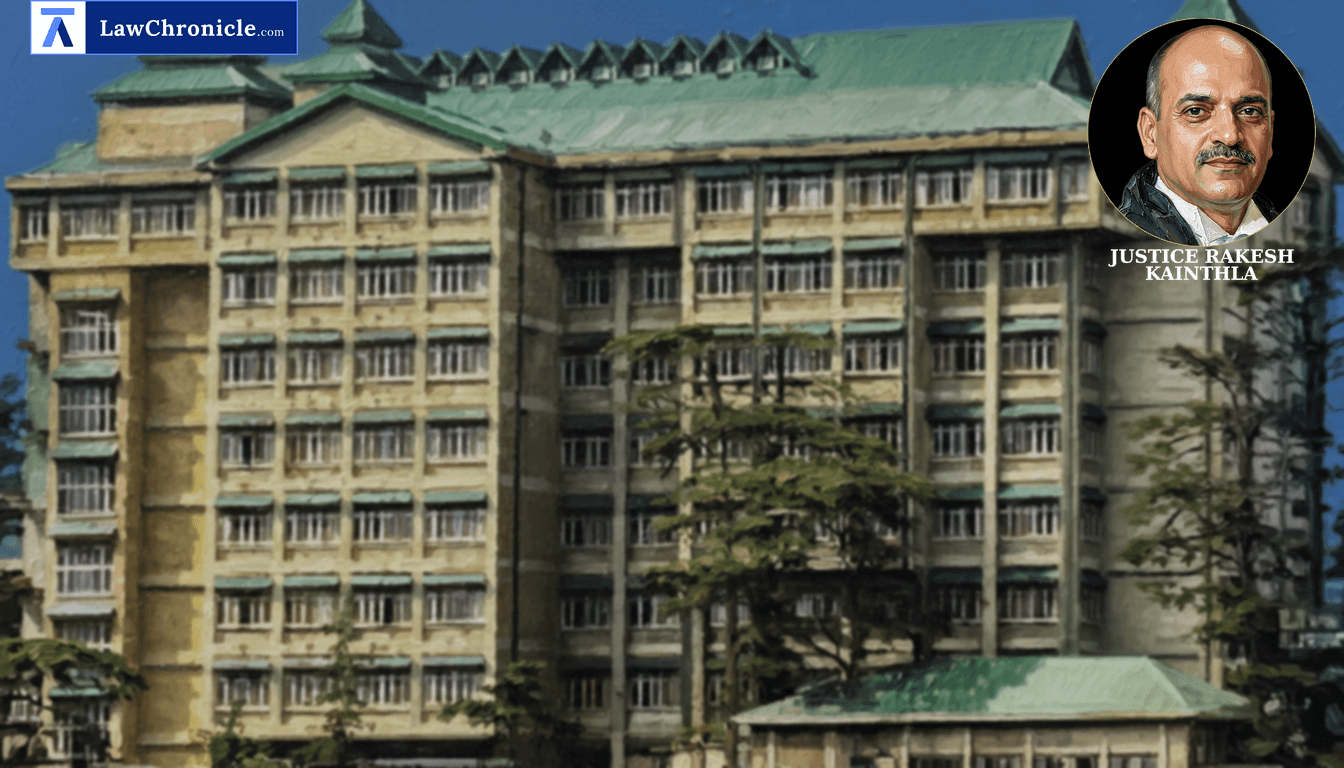
The High Court of Himachal Pradesh has ruled that the absence of a fatal injury or blood on the weapon does not preclude a charge of attempt to murder, provided the intent to cause death is prima facie evident from the choice of weapon and target. This decision reinforces the principle that judicial scrutiny at the stage of framing charges must focus on the existence of a prima facie case rather than the ultimate probability of conviction.
A Single Judge bench of Justice Rakesh Kainthla dismissed a revision petition challenging the framing of charges under Section 109 of the Bharatiya Nyaya Sanhita. The Court emphasized that causing injury to a vital part of the body with a deadly weapon is sufficient to infer homicidal intent for the purposes of initiating a trial.
Key Takeaways
Intent Over Injury
To attract Section 109 of Bharatiya Nyaya Sanhita, it is not essential for the injury to be life-threatening; the primary test is the intention or knowledge of the perpetrator.
Prima Facie Scrutiny
At the stage of framing charges, courts are only required to form a presumptive opinion on the existence of factual ingredients, not to evaluate evidence threadbare.
Defective Investigation Impact
The failure to recover a weapon or the absence of blood on a recovered object constitutes a potential investigative defect but does not mandate an immediate discharge or acquittal.
Vital Part Doctrine
Striking a victim on the head, a vital organ, with a pickaxe provides a sufficient basis for a court to infer an intention to cause death.
High Court Upholds Trial Court Reasoning
The Court observed that the petitioner was allegedly armed with a 'Kassi' (pickaxe) and targeted the victim's head, causing a depressed fracture. The Court relied on Surender Kumar v. State of Haryana ( "2026 SCC OnLine SC 191": 2026 CaseBase(SC) 6026) to reiterate that the nature or gravity of the injury and the weapon used are critical indicators of intent.
The Court has following directions:
"In view of the above, there is no error in the order passed by the learned Trial Court; hence, the present revision fails and is dismissed. The observations made hereinbefore shall remain confined to the disposal of the present petition and shall have no bearing whatsoever on the merits of the case. A copy of this judgment, along with records of the learned Courts below, be transmitted forthwith."
The Court, in its reasoning, observed: "...causing injury to a vital part of the body by means of a deadly weapon can prima facie lead to an inference that the injury was caused with an intention to cause death. Therefore, there is no infirmity in the order passed by the learned Trial Court that the material on record justified framing of charge for the commission of an offence punishable under Section 109 read with Section 190 of the BNS."
Ratio
The culpability for an attempt to murder under Section 109 of the Bharatiya Nyaya Sanhita is determined by the act, intention, or knowledge of the accused, rather than the actual severity of the resulting injury. Where an accused uses a deadly weapon to strike a vital part of the body, a prima facie case for attempt to murder is established, and disputes regarding the evidentiary value of weapon recovery are matters for trial, not discharge proceedings.
Background
The case originated from a clash on October 22, 2025, where the petitioner, Phool Singh, and co-accused allegedly attacked several individuals with sticks and pickaxes. The police investigation, supported by CCTV footage, indicated that the petitioner struck victims on the head multiple times. The medical report from Indus Super Speciality Hospital confirmed a depressed fracture on the parietal region of one victim.
The petitioner moved the High Court arguing that the MLC did not categorize the injuries as life-threatening and noted that no blood was found on the recovered pickaxe. He contended that charges under Section 109 of Bharatiya Nyaya Sanhita (corresponding to Section 307 of the Indian Penal Code, 1860) were unsustainable.
However, the Court referred to Vishnu Kumar Shukla v. State of U.P. and Yuvraj Laxmilal Kanther v. State of Maharashtra ( "2025 SCC OnLine SC 520": 2025 CaseBase(SC) 348), noting that discharge is only permissible when there are no sufficient grounds to proceed. The Court further cited Singapagu Anjaiah v. State of A.P. ( "(2010) 9 SCC 799": 2010 CaseBase(SC) 1299) to establish that even a single blow to the head with a heavy object like a crowbar can constitute a grave offence. Regarding the investigative lapses, the Court referenced Edakkandi Dineshan v. State of Kerala, holding that defective investigation does not automatically result in acquittal. Consequently, the revision petition was dismissed.
Case Details:
Case No.: Cr. Revision No. 594 of 2026
Neutral Citation: 2026:HHC:40675
Case Title: Phool Singh Versus State of HP
Appearances:
For the Petitioner(s): Mr Sudhir Thakur, Senior Advocate with Mr Karun Negi, Advocate.
For the Respondent(s): Mr Jitender Sharma, Additional Advocate General.
Source: 2026 CaseBase(HP) 8071
Similar Articles



 Breaking News


