


Life Term Under Section 304B IPC Not Mandatory in Every Dowry Death: Allahabad HC
 Copy Link
 Share
 Save
Life imprisonment under Section 304B IPC should be awarded only in rare cases rather than as a routine measure, the Allahabad High Court has ruled, modifying the sentence of five convicts in a horrific double-murder dowry death case to the period already undergone.
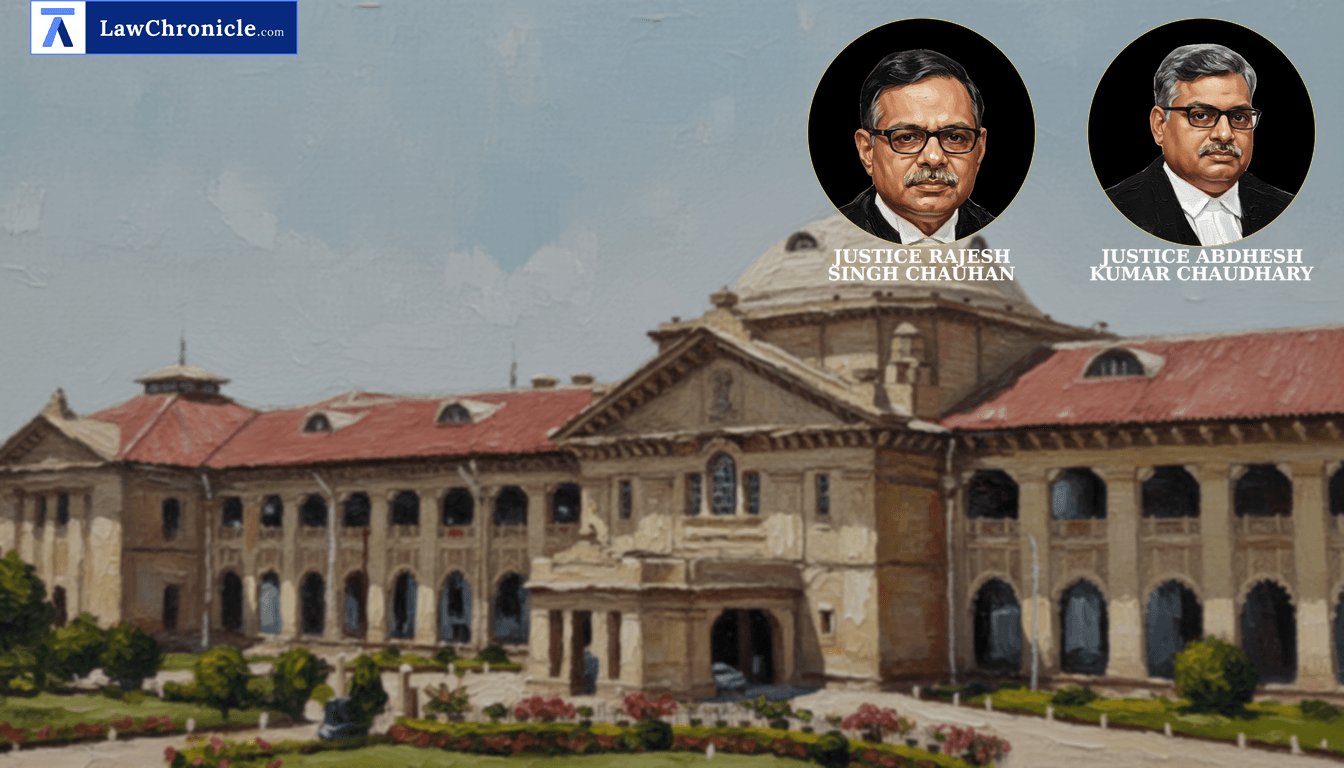
A Division Bench comprising Justice Rajesh Singh Chauhan and Justice Abdhesh Kumar Chaudhary held that while the prosecution successfully proved the guilt of the husband and his family under Indian Penal Code, 1860 and the Dowry Prohibition Act, 1961, the trial court erred in automatically imposing the maximum sentence of life imprisonment without recording specific reasons.
Key Takeaways
Life Sentence Not Mandatory: Imprisonment for life under Section 304B IPC is an extreme penalty reserved for rare cases and should not be routinely awarded.
Rebuttable Presumption: Once the prosecution proves unnatural death within seven years of marriage linked to dowry demand soon before death, the burden shifts entirely to the accused under Indian Evidence Act, 1872.
Proportionality in Sentencing: Courts must balance aggravating and mitigating factors, including the period of custody undergone and lack of criminal antecedents, when deciding the quantum of sentence.
Court's Rationale on Dowry Death Presumption and Sentence
The High Court affirmed the conviction of the appellants under Section 304B and Section 498-A of the Indian Penal Code, 1860 along with Section 4 of the Dowry Prohibition Act, 1961, applying the statutory presumption under Section 113-B of the Indian Evidence Act, 1872. Referring to established precedents such as Kashmir Kaur v. State of Punjab ( "(2012) 13 SCC 627": 2012 CaseBase(SC) 57) and Bhajju v. State of M.P. ( "(2012) 4 SCC 327": 2012 CaseBase(SC) 199), the Court reiterated that once foundational facts are established, the burden shifts to the defense under Section 106 of the Indian Evidence Act, 1872 to explain the unnatural death occurring within the privacy of the matrimonial home.
However, turning to the quantum of sentence, the Court highlighted that the trial court failed to provide any justification for imposing the maximum sentence of life imprisonment on all convicts.
The Court, in its reasoning, observed: "This Court is also unable to find any reason in the impugned judgment as to when the prescription under law is that punishment under Section 304B I.P.C. cannot be less than 7 years and may extend to Life Imprisonment, as to why all the Appellants have been placed in the same bracket and awarded the maximum punishment of life under Section 304B I.P.C. There is no automatic award of life imprisonment under Section 304B I.P.C after conviction. Some finding and/or reasoning ought to be given by the learned Trial Court for arriving at such a belief for awarding a life imprisonment under the provisions of Section 304B I.P.C."
Guided by the mitigating factors laid down in V.K. Mishra v. State of Uttarakhand ( "(2015) 9 SCC 588": 2015 CaseBase(SC) 96), Hem Chand v. State of Haryana ( "(1994) 6 SCC 727": 1994 CaseBase(SC) 504), State of Karnataka v. M.V. Manjunathegowda ( "(2003) 2 SCC 188": 2003 CaseBase(SC) 748), G.V. Siddaramesh v. State of Karnataka ( "(2010) 3 SCC 152": 2010 CaseBase(SC) 33), Hari Om v. State of Haryana ( "(2014) 10 SCC 577": 2014 CaseBase(SC) 763), and Navas v. State of Kerala, the Court noted that the appellants had already served substantial prison terms—the husband and brother-in-law having spent over 17 years in custody including remission—and lacked prior criminal records. Consequently, the High Court reduced their sentence under Section 304B IPC to the period already undergone while maintaining the fine and sentence under other counts.
Ratio
Awarding the extreme punishment of life imprisonment under Section 304B IPC is not automatic upon conviction; courts must exercise judicial discretion between the seven-year statutory minimum and life term based on specific aggravating and mitigating circumstances recorded in the judgment.
Background
The dispute originated from an incident on June 11, 2011, where Meena Devi and her 15-month-old daughter Soni were found brutally murdered with their throats slit inside her matrimonial home in District Shravasti. The informant (P.W.-1), brother of the deceased, alleged that since her marriage six years prior, the husband and his family members continuously tortured her demanding a motorcycle and Rs. 1,00,000/- in cash as additional dowry.
Following an investigation, a charge-sheet was submitted, and the Additional Sessions Judge (F.T.C.), Shravasti, convicted all five accused under Sections 304B, 498-A IPC, and Section 4 of the Dowry Prohibition Act, 1961, sentencing them to life imprisonment. The appellants challenged the conviction under Section 374(2) of the Code Of Criminal Procedure, 1973 before the High Court. The High Court, while upholding the conviction, partly allowed the appeals by modifying the life sentence to the period already undergone.
Case Details:
Case No.: Criminal Appeal No. 1768 of 2016
Case Title: Dinesh Kumar and Ors. v. State of U.P. (along with Criminal Appeal No. 1773 of 2016)
Appearances:
For the Petitioner(s): Deepshikha Singh, Dhananjay Kumar Singh, Ghulam Mohammad Kamil, Kunwer Dhananjay Singh, Piyush Kumar Singh, Vyas Narayan Shukla
For the Respondent(s): Govt. Advocate
Source: 2026 CaseBase(ALL) 600
Similar Articles


 Breaking News


