LN Sinha: Attorney General who once represented a Private Party
 Copy Link
 Share
Share Save
Save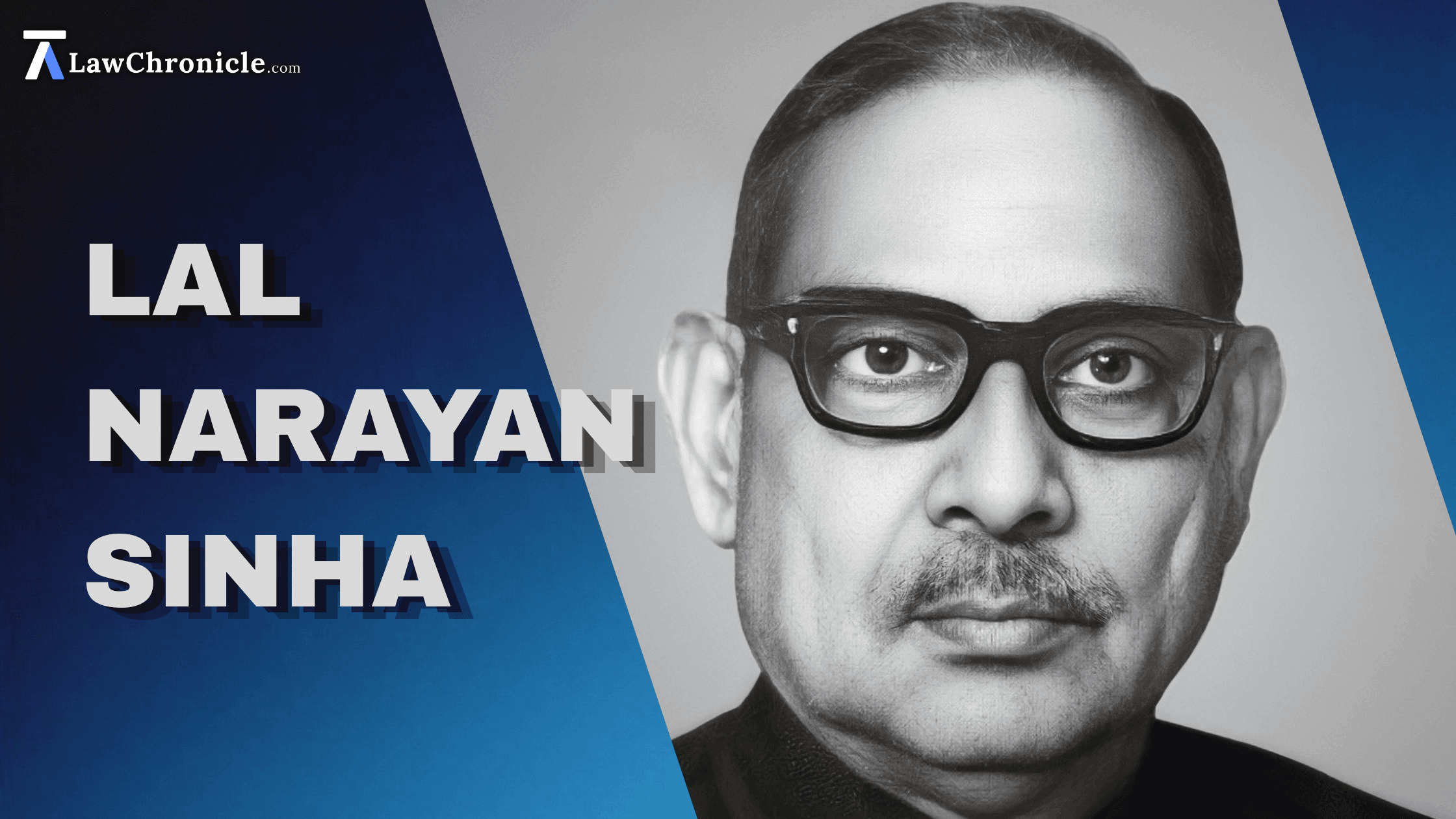
Lal Narayan Sinha, widely known as 'Lalbabu', was one of India's most distinguished legal figures who rose through the Bar in Bihar, to hold the country's highest law offices. Born in Gaya, Bihar, he served as the Advocate General of Bihar (1965–1972), the 6th Solicitor General of India (17 July 1972 – 5 April 1977), and the 5th Attorney General for India (9 August 1979 – 8 August 1983). Notably, he was the first Attorney General of India to represent a private party during his term in office and remains the only Attorney General to have come from Bihar. His son, Justice Lalit Mohan Sharma, became the 24th Chief Justice of India (1992–1993), and his grandson Justice Partha Sarthy serves as a Judge of the Patna High Court.
This article sails through the journey of Advocate Lal Narayan Sinha, whose mention recently found place in the Raju Ramachandran’s “14 Lawyers – Portraits from the Bar”.
Early Life and Education of LN Sinha
Lal Narayan Sinha was born on 1 April 1907 in Gaya, Bihar, into a Bhumihar family. His family background was rooted in the legal and professional circles of Bihar. LN Sinha obtained his law degree from Patna Law College. He was later celebrated as an alumnus of one of Bihar's premier legal institutions.
Legal Career
Early Practice at Gaya and the Patna High Court
Sinha began his legal practice at the District Court in Gaya in 1930. In 1939 he moved to Patna to practice at the High Court. He quickly rose to the top of the Patna High Court Bar and became one of its most sought-after advocates. His knowledge of English was described as basic but his exposition brilliant; his arguments were always brief and to the point. In 1947 he became a Government Pleader. He was offered Judgeship of the Patna High Court, to which he initially consented but later withdrew his consent. He was also offered Judgeship of the Supreme Court of India, which did not materialize.
After becoming Government Advocate in 1953, he continuously appeared before the Supreme Court of India, cementing a national practice alongside his Bihar base.
Advocate General of Bihar (1965–1972)
In 1965, Lal Narayan Sinha was appointed Advocate General of Bihar, an office he held until his appointment as Solicitor General in 1972. His tenure was so highly valued that successive governments of different political persuasions desired his continuance in the role. Chief Justice A.M. Ahmadi later noted, at the Full Court Reference in 1995: "His services were so highly valued that successive popular governments of different political hues desired that he continues to serve them as Advocate General.”
Solicitor General of India (17th July 1972 – 5th April 1977)
LN Sinha was appointed Solicitor General of India on 17th July 1972 and served until 5th April 1977, when the Janata Party government came to power. During this period, he appeared on behalf of the Government of India in the landmark Kesavananda Bharati v. State of Kerala (1973 CaseBase(SC) 111) case, the 13-judge constitutional bench decision that introduced the basic structure doctrine, alongside H.M. Seervai and Attorney General Niren De. He was also called on short notice to argue Indira Gandhi's Election (1975 CaseBase(SC) 17) case when Attorney General Niren De fell ill, which he did with ease.
Attorney General for India (9th August 1979 – 8th August 1983)
Lal Narayan Sinha was appointed the 5th Attorney General of India in August 1979, succeeding S.V. Gupte. He served until 8thAugust 1983. During his tenure as the Attorney General for India, he appeared in many significant constitutional and governmental matters. He was the first Attorney General to represent a private party during his term in office, a practice that subsequently attracted debate.
In 1983, he resigned as Attorney General and returned to private practice. He also served as a constitutional advisor to the then Prime Minister Indira Gandhi.
Notable Cases of LN Sinha Attorney General
Kesavananda Bharati v. State of Kerala (1973 CaseBase(SC) 111)
LN Sinha appeared for the Government of India as Solicitor General alongside H.M. Seervai and Attorney General Niren De. The 13-judge bench established the basic structure doctrine limiting Parliament's powers to amend the Constitution of India.
Indira Gandhi's Election Case (1975 CaseBase(SC) 17)
In this case, LN Sinha was called on short notice to argue the case when Niren De fell ill, which he handled with ease.
The case holds importance in Constitutional Law since the Court reiterated that the power to amend Constitution u/art. 368 does not include power to alter or destroy basic structure or essential features of Constitution. It was held that validity of any proceedings in Parliament shall not be called into question on ground of any alleged irregularity of procedure.
Personal Life
Lal Narayan Sinha was a devotee of yoga and a firm believer in Homoeopathy. He was an enthusiast of Urdu ghazals. He was described as a man of few words, mild in manner but firm in approach, possessing dignity that was, in Chief Justice Ahmadi's words, 'a natural manifestation of a great soul rather than any conscious effort on his part.'
His son, Justice Lalit Mohan Sharma (12th February 1928 – 3rd November 2008), served as the 24th Chief Justice of India from 18th November 1992 to 11th February 1993. His grandson, Justice Partha Sarthy, serves as a Judge of the Patna High Court.
Lal Narayan Sinha passed away in February 1995. At the Full Court Reference on 8 March 1995, Chief Justice A.M. Ahmadi paid tribute: “He was a man of dignity, yet his dignity was a natural manifestation of a great soul rather than any conscious effort on his part. He had the modesty, simplicity and tenderness of an innocent child, yet the firmness of a rock... He was a gentleman to the core, simple, courteous and polite and carried his office lightly. He was like Webster in weight of thought.”
Awards and Recognition
The Supreme Court of India unveiled a portrait of Lal Narayan Sinha in recognition of his contribution to Indian law. He remains the only Attorney General of India to have come from Bihar.
 Breaking News