


Location of Head Office Does Not Confer Writ Jurisdiction: Delhi High Court
 Copy Link
 Share
 Save
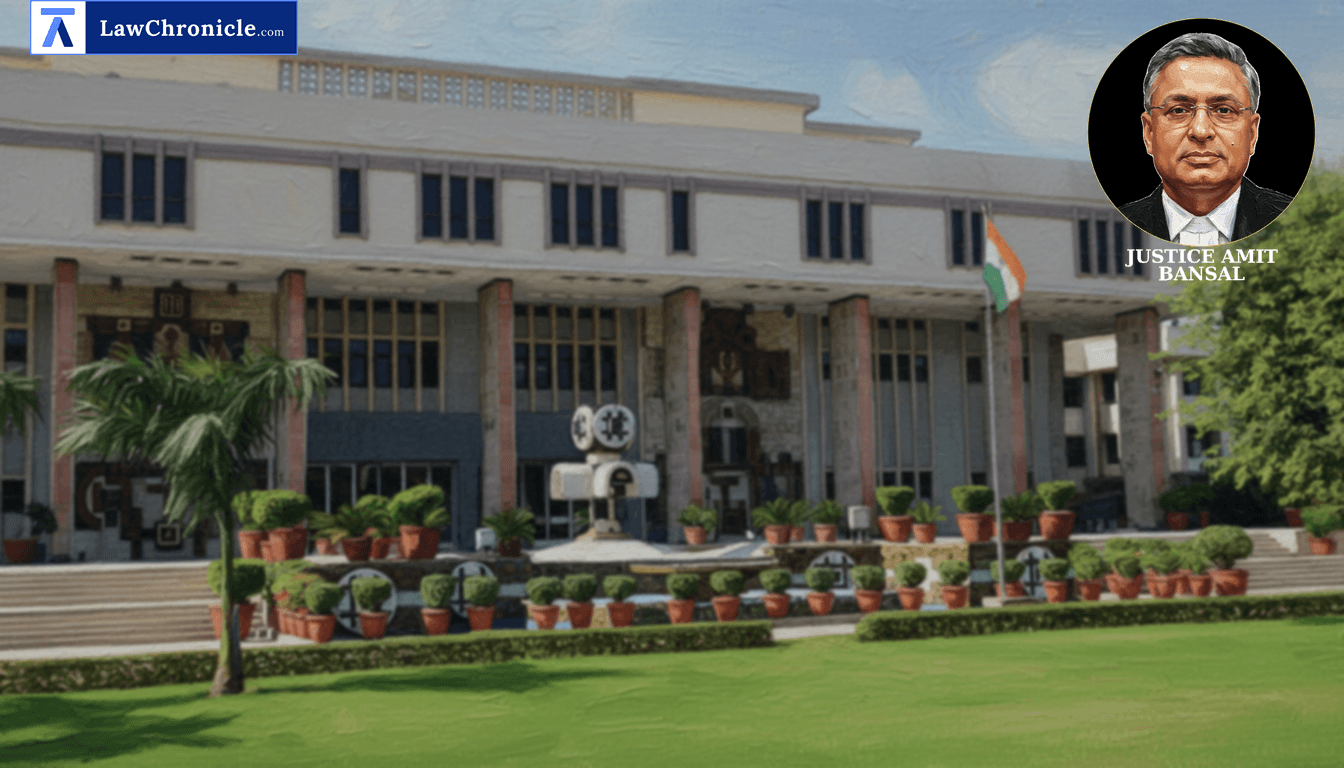
The Delhi High Court has held that the mere location of a statutory authority's head office within its jurisdiction does not confer territorial power to entertain a writ petition if no integral part of the cause of action arose there.
A single-judge bench of Justice Amit Bansal dismissed a writ petition challenging the cancellation of a railway lease contract and forfeiture of a security deposit for lack of territorial jurisdiction.
Key Takeaways
- Headquarters Location Irrelevant: Merely having a departmental head office in Delhi does not give the Delhi High Court jurisdiction under Constitution of India.
- Integral Cause of Action: A material, essential, or integral fraction of the cause of action must occur within the territorial limits to invoke writ powers.
- Distinction From Civil Suits: Provisions under Section 20 of the Code of Civil Procedure, 1908 enabling suits where defendants reside do not apply to constitutional writ petitions.
Court Observations and Directions
The Delhi High Court examined the scope of Article 226(2) of the Constitution of India and affirmed that for a High Court to exercise jurisdiction, an integral part of the cause of action must arise within its territorial limits. The Court noted that the impugned show cause notice, cancellation order, and appellate rejection were all executed by railway authorities based in Firozpur, Punjab, while the inspection leading to the action took place at Mumbai Central Station.
The Court, in its reasoning, observed: "The legal position that emerges from a reading of the
aforesaid judgments is that to invoke the jurisdiction of a High Court under Article 226 of the Constitution of India, there has to be at least a small fraction of the cause of action that has arisen within the jurisdiction of this Court and such fact must constitute a material, essential or integral part of the cause of action. Merely because the head office of a government or a statutory authority is located within the jurisdiction of a Court would not vest jurisdiction under Article 226."
The Court has following directions:
"30. Accordingly, the present writ petition is dismissed on the ground of territorial jurisdiction.
31. The pending application stands disposed of."
Ratio
Under Article 226(2) of the Constitution of India, the presence of a central administrative office or head office of a authority within a High Court's territorial limits does not, by itself, vest writ jurisdiction unless an essential or material part of the cause of action directly arose within those territorial limits.
Background
The petitioner, a sole proprietorship operating a leased Front Second Class Luggage Rake (FSLR-1) on Train No. 12904 between Mumbai Central and Amritsar under the Northern Railways, challenged multiple administrative actions. On June 17, 2024, a random inspection by the Railway Protection Force at Mumbai Central Railway Station revealed undeclared old laptops, leading to proceedings under Section 163 of the Railways Act, 1989.
Following the inspection, the Senior Divisional Commercial Manager at Firozpur issued a show cause notice and subsequently terminated the lease on June 28, 2024. The petitioner's appeal to the Divisional Railway Manager's Office in Firozpur was rejected on July 12, 2024, and the security deposit was forfeited on August 28, 2024. The petitioner approached the Delhi High Court seeking to quash these orders and obtain a refund and compensation.
The respondents raised a preliminary objection regarding territorial jurisdiction. The petitioner argued that because Northern Railways is headquartered in New Delhi, a material part of the cause of action arose within the court's jurisdiction, relying on Union of India & Anr v. Sri Ladulal Jain. The Court rejected this argument, noting that Union of India & Anr v. Sri Ladulal Jain related to Section 20 of the Code of Civil Procedure, 1908, which governs civil suits rather than writ petitions.
Relying on precedents including Oil and Natural Gas Commission v. Utpal Kumar Basu and Ors ( "(1994) 4 SCC 711": 1994 CaseBase(SC) 292), Kusum Ingots & Alloys Ltd. v. Union of India, Alchemist Ltd. & Anr. v. State Bank of Sikkim and Ors ( "(2007) 11 SCC 335": 2007 CaseBase(SC) 574), Dr. Neha Chandra v. Union of India, and Manjira Devi Ayurveda Medical College & Hospital v. Uttarakhand University of Ayurveda & Ors, the High Court held that policy formulation or the location of head offices does not establish cause of action. Finding that no part of the dispute arose in Delhi, the Court dismissed the petition for lack of territorial jurisdiction.
Case Details:
Case No.: W.P.(C) 3308/2025 and CM APPL. 15621/2025
Case Title: M/S RAIL TRANSPORT CORPORATION OF INDIA v. UNION OF INDIA & ORS.
Appearances:
For the Petitioner(s): Mr. Manish Kaushik, Mr. Ankit Batra and Ms. Anuradha, Advocates.
For the Respondent(s): Mr. Piyush Beriwal, Mr. Yash Tyagi, Ms. Ruchita Srivastava and Mr. Sparsh Jain, Advocates for R-1 to 3.
Source: 2026 CaseBase(DEL) 4773
Similar Articles
 Breaking News


